
Assaf Rappaport is one of the clearest examples I have found of how cloud security, venture capital, and “founder equity math” can turn an operator into a billionaire on paper before a deal even closes.
The core question I set out to answer was simple: what is Asaf Rappaport’s net worth, and what is it actually based on.
Most coverage I reviewed treats net worth like a scoreboard. It quotes a single number, usually from a rich list, and moves on. That is not enough. With private-company founders, the net worth figure is usually a shorthand for one thing, the implied value of their equity, multiplied by a valuation headline, then discounted by assumptions that often are not stated.
In this article, I lay out the range I think is reasonable, explain the assumptions, and map the career path that got him here.
Key takeaways
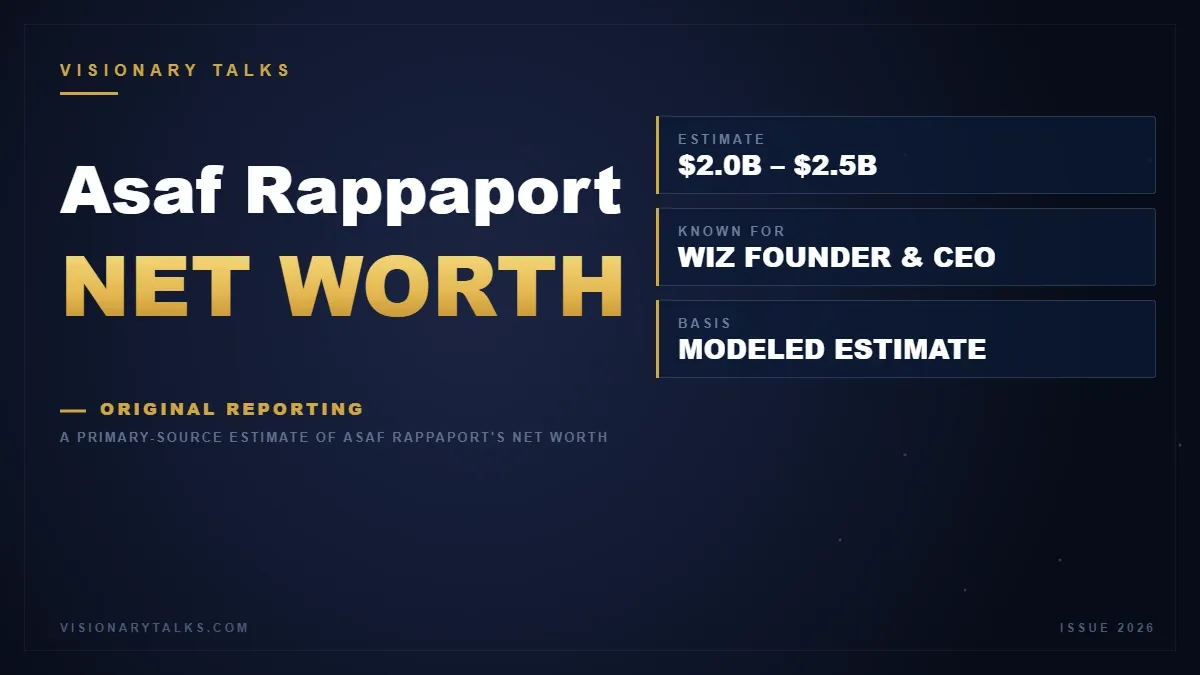
- My base case estimate for Asaf Rappaport’s net worth is $2.0B to $2.5B, primarily driven by his Wiz equity, assuming high single digit ownership and a valuation above $20B
- The best available public estimate of Asaf Rappaport’s net worth clusters around the low single digit billions, driven mostly by his Wiz equity.
- Private-company “net worth” is not cash, it is valuation math, and it can swing meaningfully based on ownership percentage, liquidation preferences, vesting, taxes, and whether a deal closes.
- His career path is unusually linear for a unicorn founder: elite security background, Adallom exit to Microsoft, then Wiz, a company built around a simple cloud-security control plane.
- If the Wiz acquisition closes at the widely reported headline value, his pre tax value could be materially higher than the rich list number. After tax and deal structure details, the realized amount could be meaningfully lower.
What is Asaf Rappaport’s net worth right now
What I can say with high confidence
When I look for a number that is both widely referenced and grounded in a consistent methodology, I end up anchoring on major business lists that publish “real time” or “rich list” estimates. Those sources put Rappaport in billionaire territory.
But I treat that figure as an equity value proxy, not a cash balance.
My working range
Based on public reporting about Wiz valuations, reported founder ownership, and the reality that private-equity value is not fully liquid, I think the most defensible framing is a range:
- Conservative range: $1.5B to $2.5B (assumes lower effective ownership, haircuts for illiquidity, and meaningful taxes on a future liquidity event)
- Base case range: $2.0B to $3.0B (assumes ownership in the high single digits and a valuation in the low tens of billions)
- Upside case: $3.0B+ (assumes a successful close of a large acquisition price, limited adverse deal terms for common shareholders, and no major regulatory derailment)
I am deliberately avoiding a single precise number because the precision would be fake. The uncertainty is structural.
The net worth math behind a private-company founder
Here is the simplified equation I use:
Implied net worth from Wiz equity = (Company valuation or deal price) × (Founder ownership) − (taxes and transaction effects) − (discounts for illiquidity and constraints)
Why the same founder can be called a $2B billionaire and still “feel” cash poor
Private founders can be “worth” billions while still having the cash profile of a senior executive. The reasons are standard:
- The equity is not liquid until an IPO or acquisition closes.
- A portion may be unvested or subject to continued employment.
- Preferred shareholders can have liquidation preferences that shift proceeds.
- Taxes can remove a large portion of the headline proceeds.
- Wealth lists often use conservative haircuts, and they update on their own schedule.
My scenario table: what different assumptions do to the outcome
The table below is intentionally simple. I use it to show how sensitive the outcome is to two variables: valuation and ownership.
Assumptions:
- I use three valuation points that have been publicly discussed for Wiz: $12B (funding valuation), $23B (reported offer stage), $32B (reported acquisition headline).
- I show two ownership levels, 9% and 10%. Public reporting has described founder ownership as roughly high single digits.
- I apply an illustrative 30% “all in” haircut for taxes and friction. This is not a tax opinion. It is a rough stress test.
| Scenario | Wiz valuation or deal price | Assumed ownership | Gross equity value | Illustrative haircut (30%) | Implied value after haircut |
|---|---|---|---|---|---|
| A | $12B | 9% | $1.08B | $0.32B | $0.76B |
| B | $12B | 10% | $1.20B | $0.36B | $0.84B |
| C | $23B | 9% | $2.07B | $0.62B | $1.45B |
| D | $23B | 10% | $2.30B | $0.69B | $1.61B |
| E | $32B | 9% | $2.88B | $0.86B | $2.02B |
| F | $32B | 10% | $3.20B | $0.96B | $2.24B |
How I interpret this table:
- If you anchor on the $12B valuation, he is still very wealthy, but the “billionaire” label becomes sensitive to how lists treat liquidity and taxes.
- If you anchor on $23B to $32B, billionaire territory becomes the base case even after meaningful haircuts.
- Lists that quote around $2.2B are plausibly assuming a mix of (a) high single digit ownership, (b) a large deal headline, and (c) conservative haircuts.
Asaf Rappaport’s career path: how he got here
1) Early formation in elite security culture
Most founder stories are messy. This one is unusually consistent. Rappaport comes from the Israeli cybersecurity talent pipeline that has produced multiple global security companies. That matters because Wiz’s product is essentially a cloud-native reframing of classic security posture management, built by people who have shipped security products before.
2) Adallom: the first big validation, and the Microsoft acquisition
Before Wiz, Rappaport co-founded Adallom, a cloud access security broker, which was acquired by Microsoft in 2015. In my research, this is the pivotal step. It created three things:
- Credibility with enterprise buyers
- Credibility with top tier investors
- An inside seat at Microsoft to learn distribution, platform strategy, and cloud product scaling
3) Microsoft: operating at platform scale
Post acquisition, he moved into senior leadership within Microsoft’s cloud security ecosystem and later ran Microsoft’s Israel R&D center. This phase matters because it sharpened Wiz’s eventual wedge: build something that works across clouds, moves fast, and plugs into the reality of how enterprises actually buy and run security.
4) Wiz: a company designed to scale fast
Wiz launched in 2020 and quickly became one of the fastest-growing cybersecurity companies on record. When I look at why, I see three compounding advantages:
- Timing: cloud security became board-level urgent.
- Product clarity: unify visibility, risk prioritization, and remediation paths across major cloud environments.
- Founder pattern recognition: the team had already built, sold, and integrated a cloud security business.
5) Liquidity narrative: offers, valuation jumps, and the deal question
A large acquisition headline can change perceived net worth overnight. But it is not real until it closes. Regulatory review, deal terms, and employee retention structures can all shift the realized outcome.
What most net worth writeups get wrong
- They confuse “valuation based wealth” with liquidity. A founder can be worth billions and still live like a salaried executive.
- They treat ownership like a known constant. Private cap tables evolve. Secondary sales happen. Option pools expand.
- They ignore taxes and frictions. Cross-border founders often face complex outcomes.
- They miss the operator story. Rappaport’s wealth is not a meme stock windfall. It is the result of building a second major cloud security company after already doing it once.
What I am watching next
- Whether the Wiz deal closes on the terms reported, and what the disclosed equity breakdown looks like if any details become public.
- How regulators treat a large cloud-security acquisition, and whether that creates timing or probability discounts.
- Whether Wiz’s founders diversify through secondary sales, philanthropy, or other visible asset moves that provide real-world signals beyond valuation headlines.
Sources I used for this report
I based this analysis on major business net worth trackers, company announcements about Wiz funding and valuation, and reporting from credible business and tech publications that discussed Wiz’s valuation, founder ownership, and acquisition talks.