
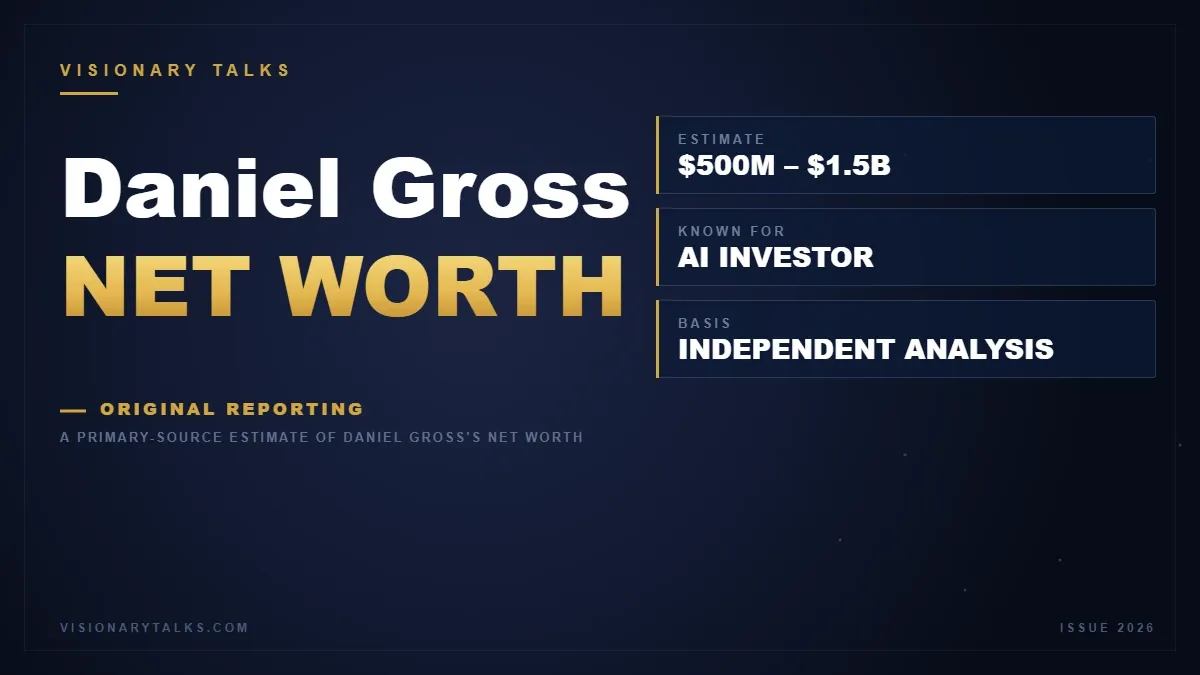
Editorial disclaimer: This article is independent research and analysis. Daniel Gross’s exact net worth is not publicly disclosed, and no public wealth index confirms a precise personal fortune. My estimate is based on public reporting, known company outcomes, disclosed career history, major startup valuations, and reasonable assumptions about founder equity, venture economics, and private-market investing. This is not investment advice.
Daniel Gross net worth is difficult to estimate because his wealth sits across several private and semi-private buckets: the sale of Cue to Apple, early angel investments, his venture partnership with Nat Friedman, his cofounder role at Safe Superintelligence, and his move into Meta’s superintelligence effort.
My estimate is that Daniel Gross is likely worth $500 million to $1.5 billion in 2026, with a credible bull case above $2 billion if his retained Safe Superintelligence equity, NFDG economics, and early AI investments are larger than outside observers can verify.
I would not call the number confirmed. I would call the story exceptional.
Gross is not a normal venture capitalist. He is a founder who sold a company to Apple in his early twenties, ran AI and search projects at Apple, helped build Y Combinator’s AI program, backed some of the defining startups of the AI cycle, co-created a GPU cluster as an investment weapon, co-founded Safe Superintelligence with Ilya Sutskever, then joined Meta during one of the most aggressive AI talent wars in Silicon Valley history.
The most interesting part is not just that Gross may be a billionaire. It is that he understood, earlier than most investors, that AI startups did not only need checks. They needed compute.
Key Takeaways
- I estimate Daniel Gross’s net worth at $500 million to $1.5 billion, with a possible bull case above $2 billion.
- His wealth likely comes from several sources, including Cue’s Apple sale, angel investments, NFDG, Safe Superintelligence equity, and Meta compensation.
- His personal site lists investments or examples including ElevenLabs, Perplexity, Character.ai, Groq, Coinbase, GitHub, Figma, Rippling, CoreWeave, Notion, and SpaceX.
- Reuters reported that Gross joined Meta to lead its AI products division after leaving Safe Superintelligence, while Ilya Sutskever took over SSI.
- NFDG, the venture firm Gross co-founded with Nat Friedman, has backed high-profile startups including Safe Superintelligence, Perplexity and Figma, according to Reuters.
- The real Daniel Gross story is not only about picking AI companies. It is about turning scarce GPU access into a venture-capital advantage.
Who Is Daniel Gross?
Daniel Gross is an Israeli-American entrepreneur, AI investor, and former Apple and Y Combinator operator. His own biography says he co-founded Cue, a search engine acquired by Apple in 2013, ran AI and search projects at Apple from 2013 to 2017, was a partner at Y Combinator, started YC’s AI program, and later co-founded Safe Superintelligence.
That career path is almost too clean for the AI era.
He began as an outsider founder. He became an Apple machine-learning operator. He moved into Y Combinator as an AI-focused talent scout. Then he became an investor with Nat Friedman, one of the most connected technical operators in Silicon Valley. Finally, he moved into the center of the frontier-AI war through Safe Superintelligence and Meta.
Gross’s career is not a straight line. It is a series of bets on where intelligence moves next: search, personal assistants, machine learning, startup talent, GPUs, AI applications, and eventually superintelligence.
The Origin Story: The Israeli Founder Who Pivoted in 48 Hours
Gross’s story starts in Israel.
Inc. described him in 2011 as an Israeli high-school graduate who had been preparing for army duty before applying to Y Combinator. At 19, he and co-founder Robby Walker created Greplin, a search product that let users search across services such as Facebook, Twitter, Google Documents and Salesforce. Inc. also reported that the company had raised nearly $5 million after six months.
The best detail is the pivot.
According to the same Inc. interview, Gross said his original YC project had been shut down only 48 hours before the end of the program. Instead of disappearing, he built and pitched a new idea. That idea became Greplin, later Cue.
That is important because it reveals a pattern. Gross is not only a capital allocator. He has repeatedly positioned himself at bottlenecks.
In 2010, the bottleneck was personal information scattered across the cloud.
In 2023, the bottleneck was AI compute.
In 2025, the bottleneck was top AI talent.
Cue, Apple and the First Fortune
Cue was the first major wealth event.
The Times of Israel reported in 2013 that Apple bought Cue for an estimated $40 million, after the company had raised $4.7 million in 2011 and another $10 million in 2012.
This likely did not make Gross hundreds of millions. After co-founder splits, investor ownership, employee options, and dilution, his personal proceeds were probably much smaller than the headline sale price. My rough estimate is that Cue may have created single-digit to low-double-digit millions of personal wealth for Gross.
But the Apple deal mattered more than the cash.
It gave him a credential in AI and search before the current AI boom. Y Combinator later wrote that Gross continued at Apple and led machine-learning efforts across iOS and OS X for three years after the acquisition.
That Apple period likely gave him something more valuable than immediate liquidity: technical judgment about search, personal assistants, distribution, product quality, and what large tech companies can and cannot build quickly.
Y Combinator and the AI Talent Machine
Gross left Apple and returned to Y Combinator, the same institution that had helped launch him.
The timing matters. In 2017, AI was not yet the consumer obsession it became after ChatGPT. But YC was already trying to formalize an AI track. In a YC post written by Gross, the organization said its long-term goal was to democratize AI and prevent innovation from being locked up inside large companies such as Google or Facebook.
That sentence now looks prophetic.
Gross’s later strategy with AI Grant and Andromeda was essentially the same thesis: do not let frontier AI become available only to giant companies with giant compute budgets.
But he also understood the hard truth. Telling founders to build AI companies is not enough if they cannot access GPUs.
That insight became the foundation of his next act.
NFDG, AI Grant and the Compute Strategy
Gross’s most important partnership was with Nat Friedman, the former GitHub CEO.
Their investing partnership became known through AI Grant and NFDG. AI Grant’s own site describes the accelerator as offering $250,000 on an uncapped SAFE, plus $350,000 in Azure credits and $250,000 in additional credits for seed-stage AI startups. The site also says Nat and Daniel invested $10 million in AI Grant, while larger investments are made separately and can come with access to the Andromeda Cluster.
That is the key distinction.
Most investors offered money.
Gross and Friedman offered money plus compute.
TIME described Andromeda in 2023 as a roughly $100 million compute cluster, including electricity and cooling, built by Gross and Friedman to give portfolio companies access to scarce AI chips in exchange for equity.
That was not a gimmick. It was a structural edge.
In the AI boom, a startup with no GPUs could be a brilliant team that simply could not train, fine-tune, or serve its model. A startup with GPU access could move faster. Gross and Friedman turned that bottleneck into a venture product.
Daniel Gross Net Worth in 2026: My Estimate
My estimate for Daniel Gross’s net worth is $500 million to $1.5 billion, with a credible upside case above $2 billion.
Here is how I would break it down.
| Wealth driver | What is known | My estimate impact |
|---|---|---|
| Cue sale to Apple | Reported sale around $40 million | Likely millions, not hundreds of millions |
| Apple and early career | Senior AI and search role after acquisition | Important for credibility, less important for net worth |
| Angel investing | His own site lists companies including Coinbase, GitHub, Figma, Rippling, CoreWeave, Perplexity, Character.ai and ElevenLabs | Potentially very large, but exact ownership is private |
| NFDG economics | Reuters says NFDG backed SSI, Perplexity and Figma | Potentially hundreds of millions through GP economics and carry |
| Safe Superintelligence | Co-founder of a company Reuters said was most recently valued at $32 billion | Potentially the largest single wealth driver |
| Meta role | Reuters reported he joined Meta to lead AI products | Could include major compensation, but terms are private |
The most uncertain line is Safe Superintelligence. If Gross retained even a small co-founder stake in SSI after leaving for Meta, that equity could be worth hundreds of millions on paper. If the retained stake is larger, the billionaire case becomes much stronger.
The second largest uncertainty is NFDG. Venture funds are not personal wealth, but general partner economics can become extremely valuable when a fund has large gains in companies like SSI, Perplexity, Figma and ElevenLabs.
What Happened After Daniel Gross Backed the AI Winners?
Unlike Leopold Aschenbrenner, Gross is not mainly a public-markets hedge fund story. I cannot honestly show “what happened to the stock after he bought it” for most of his best investments because many are private companies.
But I can show something similar: what happened to the companies after Gross, Friedman, NFDG, or their investment ecosystem became associated with them.
| Company | Gross connection | Later outcome |
|---|---|---|
| Safe Superintelligence | Gross co-founded SSI with Ilya Sutskever and Daniel Levy | Reuters reported SSI was most recently valued at $32 billion and had raised $1 billion the previous year. |
| Perplexity | Reuters says NFDG backed Perplexity | Reuters reported Perplexity was in advanced talks to raise at a $14 billion valuation in May 2025, after raising at a $9 billion valuation the previous year. |
| ElevenLabs | Reuters listed NFDG as an existing investor increasing support | Reuters reported ElevenLabs raised $180 million at a $3.3 billion valuation in January 2025. |
| CoreWeave | Gross’s site lists CoreWeave among his investment examples | Reuters reported CoreWeave’s market valuation had risen to $61.61 billion, up from $23 billion at its market debut. |
| Figma | Gross’s site lists Figma among his investment examples, and Reuters says NFDG backed it | Figma shares more than tripled on their first trading day after its IPO, giving it a market cap above $57 billion, according to Investopedia. |
The pattern is clear. Gross’s best-known AI-era investments were not small lifestyle software bets. They were concentrated around three major themes: AI infrastructure, AI interfaces, and frontier model companies.
That is why his net worth is hard to estimate but easy to take seriously.
The Safe Superintelligence Chapter
Safe Superintelligence may be the biggest swing in Gross’s career.
In June 2024, Ilya Sutskever announced SSI with Daniel Gross and Daniel Levy. AP reported that the company’s only goal was safely developing superintelligence, and that it would be insulated from short-term commercial pressures. AP also noted that the company had roots in Palo Alto and Tel Aviv.
This was not another AI wrapper startup. It was a direct attempt to build a frontier AI lab around one of the most important AI researchers in the world.
Reuters later reported that Sutskever took over SSI after Gross left to join Meta, and that Meta had also attempted to acquire SSI, which was most recently valued at $32 billion.
That makes Gross’s departure from SSI one of the strangest moves in recent AI history.
Why leave a company valued at $32 billion?
The answer may be simple: Meta was offering a different kind of leverage. SSI gave Gross a founder seat inside a pure superintelligence company. Meta gave him distribution, compute, budget, and a role inside one of the largest AI efforts on earth.
The Meta Move: Why Zuckerberg Wanted Gross
Reuters reported that Gross joined Meta to lead its AI products division. The same article said Meta launched Meta Superintelligence Labs after setbacks with Llama 4 and key staff departures, and that the unit would be led by Alexandr Wang and Nat Friedman after Meta invested $14.3 billion in Scale AI.
This tells me why Gross mattered to Meta.
Gross was not hired only because he knew AI. Plenty of people know AI.
He was hired because he sits at the intersection of AI product, talent, compute, startup networks, and venture intelligence. That combination is rare.
Meta already has money. It already has engineers. It already has distribution. What it needed was a better map of the frontier AI world: who matters, which ideas are real, which labs are moving fast, and where the next product wave may come from.
Gross has spent years building exactly that map.
Why Daniel Gross Is Different From a Normal VC
Most venture investors operate with three tools: capital, network, and reputation.
Gross added a fourth: infrastructure.
The Andromeda Cluster was not just a perk. It was a new venture-capital mechanism. In a compute-constrained market, the ability to give a founder GPU access can be more valuable than offering a slightly higher valuation.
This changes the investor-founder negotiation.
A traditional investor says: I will write you a check.
Gross and Friedman could say: I will write you a check, give you access to scarce compute, introduce you to technical advisors, and put you inside a network of AI-native founders.
That is much harder to replicate.
The Net Worth Bull Case
The bull case for Daniel Gross being worth more than $1 billion rests on four assumptions.
First, he retained meaningful equity in Safe Superintelligence.
Second, his personal angel investments include large early positions in companies that became major winners.
Third, NFDG’s fund economics created substantial carry or mark-to-market value.
Fourth, Meta compensation included a major package tied to AI talent acquisition.
None of those assumptions can be fully verified from public documents. But none of them are unreasonable.
The SSI piece alone could be enormous. At a $32 billion valuation, a retained 1% stake would be worth $320 million on paper. A retained 3% stake would be worth $960 million on paper. That does not mean Gross owns those percentages. It only shows why even small differences in private ownership radically change the net worth estimate.
The Net Worth Bear Case
The bear case is also important.
Private startup valuations are not cash. SSI has not released a product. Venture fund carry may not be realized. Some investments may be held through fund structures rather than personal accounts. Meta compensation terms are private. Early angel checks may have been small or diluted.
That is why I do not want to publish a fake precise number.
A confident statement like “Daniel Gross is worth $1.8 billion” would be more clickable. It would also be less honest.
The right answer is a range.
Final Estimate: Daniel Gross Net Worth
My final estimate for Daniel Gross’s net worth in 2026 is:
| Scenario | Estimated net worth | What would need to be true |
|---|---|---|
| Conservative case | $250 million to $500 million | Smaller SSI retained stake, smaller personal positions, and limited realized carry |
| Base case | $500 million to $1.5 billion | Meaningful SSI equity, strong NFDG economics, and valuable personal angel portfolio |
| Bull case | $2 billion+ | Large retained SSI stake, major NFDG carry, large early personal stakes, and significant Meta package |
My publishable estimate is $500 million to $1.5 billion.
I would describe Gross as a likely centimillionaire and possible billionaire. I would not describe him as a confirmed billionaire unless stronger evidence emerges.
Daniel Gross vs. Leopold Aschenbrenner
The comparison with Leopold Aschenbrenner is useful because both men represent a new kind of AI-era capital allocator.
| Investor | Main vehicle | Core edge | Main difference |
|---|---|---|---|
| Leopold Aschenbrenner | Situational Awareness LP | Public-markets AGI infrastructure thesis | Turns an AI worldview into liquid market exposure |
| Daniel Gross | NFDG, AI Grant, SSI, Meta | Startup network plus compute access | Turns AI infrastructure and talent access into venture outcomes |
Aschenbrenner is the more dramatic public-markets character.
Gross is the more embedded venture and operating character.
Aschenbrenner says, in effect: if AGI is coming, buy the bottlenecks.
Gross says, in effect: if AI startups are compute-constrained, give the best founders compute before everyone else can.
Both are betting that AI is not just software. It is capital, infrastructure, and power.
What I Am Watching Next
I am watching four things.
First, whether Safe Superintelligence eventually releases a product, model, or research result that justifies its valuation.
Second, whether Gross’s Meta role produces visible AI products, not just talent announcements.
Third, whether NFDG’s portfolio continues to compound through companies like Perplexity, ElevenLabs, Figma, CoreWeave and SSI.
Fourth, whether the compute advantage that made Gross and Friedman early winners remains valuable as hyperscalers, neoclouds, and governments flood the market with AI infrastructure.
My bottom line is simple.
Daniel Gross is one of the most important AI investors of his generation, not because he wrote the biggest checks, but because he saw the constraint before most of the market did.
The constraint was not ambition. It was not ideas. It was not even capital.
It was compute.
And in the AI boom, the investor who controls the bottleneck can become as important as the founder building on top of it.