
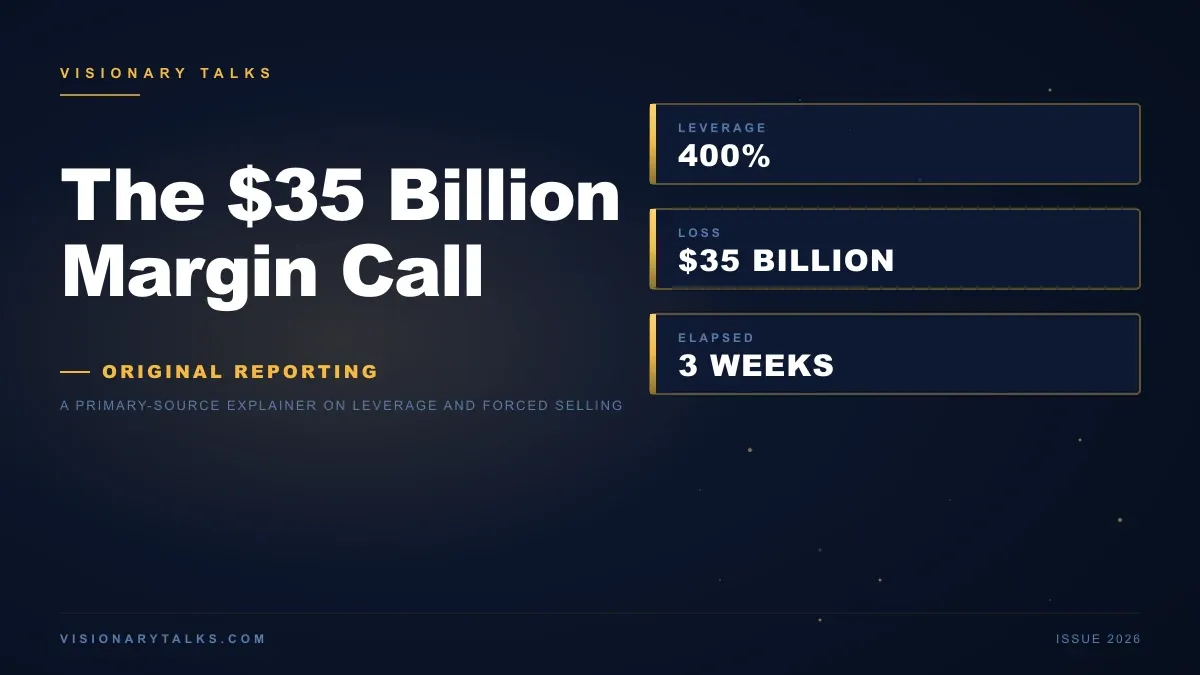
In July 2026 a hedge fund with roughly $45 billion in assets shrank to about $10 billion in three weeks. Nothing was stolen, no fraud has been alleged, and the stocks it owned did not go to zero. They fell by about a third.
A leveraged fund loses far more than the market does, because borrowed money magnifies the loss and then the lender forces you to sell at the worst possible moment. At four times leverage, a 25% fall in your holdings costs roughly 76% of your capital, not 25%. That gap between what the market did and what happened to the fund is what a margin call is, and as of August 2026 the clearest live example is Situational Awareness LP.
Most explanations stop at "he was over-leveraged." That is true and useless. The interesting part is the loop: why selling to meet a margin call creates the conditions for the next margin call, and why the way out was to sell $16 billion of stock to a competitor in a single block at a discount rather than sell it into the open market at full price.
This piece is the mechanics. For the fund, the filings and what the collapse did to the founder's personal wealth, see the companion piece on Leopold Aschenbrenner's net worth.
Key takeaways
- Leverage multiplies the loss, not just the position. At 4x, the market falls 25% and your capital falls about 100%.
- A margin call is a deadline, not a bill. The broker demands you restore a collateral ratio within hours, and if you do not, the broker sells your positions for you.
- Selling to meet a call pushes the price down, which shrinks your collateral again. That feedback is the collateral spiral, and it is the thing that turns a bad month into a terminal one.
- Concentration is the accelerant. When 55% of a book sits in two stocks, the forced seller is also the marginal price setter in those two stocks.
- Regulation T caps an ordinary margin account at 2x. Getting to 4x requires portfolio margin or swaps, so the leverage limit is set by a bank's risk model, not by a public rule.
- Situational Awareness lost about 67%, not the roughly 140% the raw arithmetic implies, because it cut leverage on the way down. The Citadel block sale is what stopped the loop.
- This is a repeating structure: LTCM in 1998 at about 25:1, Archegos in 2021 at roughly $36 billion of capital against $160 billion of exposure, Situational Awareness in 2026.
This article is based on primary sources: FINRA Rule 4210 (margin requirements, including the 25% maintenance minimum at 4210(c)(1)), Federal Reserve Regulation T at 12 CFR Part 220, Situational Awareness LP's Form 13F-HR filings for Q1 and Q2 2026 retrieved from SEC EDGAR under CIK 0002045724, and the Federal Reserve History account of the 1998 LTCM near-failure. Contemporaneous figures for July 2026 come from CNBC and Reuters. Worked examples below are my own arithmetic, using round numbers to show the mechanism rather than to reconstruct any particular fund's book. Full source list at the bottom.
How a margin call works right now
A margin call is not an invoice. It is a deadline attached to a ratio.
When you borrow from a prime broker to buy securities, the securities are the collateral. The broker cares about one number: your equity divided by the market value of the positions. Cross that floor and you get a call, usually with hours rather than days to fix it.
| Term | What it means | Who sets it |
|---|---|---|
| Initial margin | Cash you must put up to open the position | Regulation T, 12 CFR Part 220, or the broker's risk model |
| Maintenance margin | The minimum equity ratio you must hold afterwards | FINRA Rule 4210(c)(1): 25% of market value for long equity. Brokers routinely set their own higher house floors |
| Margin call | Demand to restore the ratio by a deadline | Your prime broker |
| Forced liquidation | The broker sells your positions itself | Your prime broker, if the call is not met |
The critical asymmetry: the debt is fixed in dollars and the collateral is not. Your borrowing does not fall when the market does. All of the movement lands on your equity.
The leverage math: what 400% actually means
Reported leverage of 400% means roughly $4 of market exposure for every $1 of your own capital. It does not mean a 400% loss. It means every move in the market hits your capital four times as hard.
| Gross exposure per $1 of capital | Book falls 10% | Falls 20% | Falls 25% | Falls 35% |
|---|---|---|---|---|
| 1.0x (unleveraged) | -10% | -20% | -25% | -35% |
| 2.0x (Regulation T maximum) | -20% | -40% | -50% | -70% |
| 3.0x | -30% | -60% | -75% | -105% |
| 4.0x (reported at Situational Awareness) | -40% | -80% | -100% | -140% |
Read the bottom row carefully. At 4x, a 25% decline consumes all of your capital. Past that point the losses are no longer yours to absorb: they belong to whoever lent you the money, which is precisely why the lender stops asking politely and starts selling.
CNBC reported that Situational Awareness's largest disclosed positions, Nebius, Sandisk, Micron and CoreWeave, each fell more than 35% in July 2026. The bottom-right cell of that table is the scenario the fund was walking into.
Step by step: the collateral spiral
Here is the loop with numbers. Start with $10 billion of capital, borrow $30 billion, hold $40 billion of stock. That is 4x, and an equity ratio of 25%.
| Step | Positions | Borrowed | Your equity | Equity ratio | What happens |
|---|---|---|---|---|---|
| 1. Start | $40.0B | $30.0B | $10.0B | 25.0% | Nothing. You are at the floor |
| 2. Book falls 10% | $36.0B | $30.0B | $6.0B | 16.7% | Margin call. Debt did not move; your equity absorbed all $4B |
| 3. Sell $12.0B, repay debt | $24.0B | $18.0B | $6.0B | 25.0% | Call satisfied. You are a third smaller |
| 4. Your own selling drops the price 8% | $22.1B | $18.0B | $4.1B | 18.5% | Second call, caused by step 3 |
| 5. Sell $5.8B, repay debt | $16.3B | $12.2B | $4.1B | 25.0% | Satisfied again. Smaller again |
| 6. Book falls another 10% | $14.7B | $12.2B | $2.4B | 16.7% | Third call |
Follow the equity column: $10.0B to $2.4B. That is a 76% loss of capital. Now follow the market: the book fell 10%, then 8%, then 10%, which compounds to about 25.5%.
A 25% market move produced a 76% capital loss. No fraud, no zeros, no single catastrophic position. Just arithmetic running four times a day.
Three details that make the real version worse than the table:
Selling does not restore your leverage, it restores the ratio. At step 3 you sold a third of the fund just to stand still. Every cycle you own less of the eventual recovery.
You cannot choose what to sell. Under time pressure you sell what has a bid, which is usually your best positions, leaving a portfolio increasingly made of what nobody wanted.
Haircuts rise as you fall. Brokers raise collateral requirements on positions that have become volatile or concentrated, so the floor you are trying to reach moves up while you are climbing toward it.
Why concentration turns a drawdown into a spiral
The table above assumed your selling moved the price 8%. Whether that number is 1% or 20% is the whole ballgame, and it is decided by concentration.
Situational Awareness's Q2 2026 13F, filed August 14, discloses $20.24 billion across 26 positions with 28.0% in Sandisk and 27.5% in Micron: 55.5% of the disclosed book in two names.
| Book structure | Days of average volume to exit | Price impact of forced selling | Spiral risk |
|---|---|---|---|
| 200 positions, none over 2% | Under 1 day each | Minimal | Low |
| 40 positions, largest 8% | 1 to 3 days | Noticeable | Moderate |
| 26 positions, two over 27% each | Many days, in size | Severe | Extreme |
When you are a large share of a stock's float and you must sell now, you are not receiving the market price. You are setting it, downward, against yourself. Every dollar of forced selling makes the next dollar worth less.
Concentration is also what produced the 439% net return in the first half of 2026. It is the same property in both directions. That is worth stating plainly, because the coverage tends to treat the gain as skill and the loss as recklessness when they were the same decision.
Why 4x needs a bank's permission, not just a bank
An ordinary US margin account cannot reach 4x. Regulation T requires 50% initial margin on equities, which caps you at 2x. Getting past that requires one of two doors.
| Route | Practical leverage | Who sets the limit | Shows in a 13F? |
|---|---|---|---|
| Regulation T margin account | 2x | Federal Reserve, 12 CFR Part 220 | Yes, if US-listed |
| Portfolio margin, FINRA Rule 4210(g) | Risk-model based, materially higher | Your prime broker's model | Yes, if US-listed |
| Total return swaps | Negotiated bilaterally, often far higher | Your prime broker's credit desk | No. The bank holds the shares |
That third row is how Archegos reached roughly $160 billion of exposure on about $36 billion of capital in 2021 without appearing in anyone's 13F: the banks held the stock, and Archegos held a contract on its performance. Each bank could see its own exposure and none could see the whole. A fund's disclosed positions and its actual exposure are different quantities, and the gap between them is invisible until the unwind.
History: the same spiral, three times
| Fund | Year | Capital before | Gross exposure | Time to unwind | What the lenders lost |
|---|---|---|---|---|---|
| Long-Term Capital Management | 1998 | $4.7B equity | About $125B on balance sheet, roughly 25:1, over $1 trillion notional | About 5 weeks | Nothing directly: 14 firms put in $3.6B on September 23, 1998 to wind it down in an orderly way |
| Archegos Capital Management | 2021 | About $36B | About $160B via total return swaps | Under 1 week | Over $10B, including $5.5B at Credit Suisse |
| Situational Awareness LP | 2026 | About $45B | Leverage reported up to 400% | About 3 weeks | None reported. The public book went to Citadel |
The pattern is identical every time: concentrated positions, leverage supplied by prime brokers competing for the business, a price move that was survivable unlevered, and a forced seller who is also the largest holder. What differs is the ending. LTCM needed the Federal Reserve Bank of New York to convene its creditors. Archegos's banks raced each other to the exit and several lost billions. Situational Awareness found a buyer.
Why sell $16 billion to Citadel instead of into the market
This is the part that looks strange from outside. If you must raise cash, why sell to a rival at a discount rather than sell at the market price?
Because the market price is not available in that size. The Information reported the portfolio at around $16 billion, sold at a discount near 10%. Treat the exact discount as reported rather than confirmed, but the logic holds at any number in that neighbourhood.
| Option | What you receive | What it costs | Speed |
|---|---|---|---|
| Sell into the open market | Falling prices you are causing | Potentially 20% to 30% in impact on concentrated names, and days of it | Days to weeks, which you do not have |
| Let the broker liquidate you | Whatever they get | Everything. You lose control of sequencing entirely | Immediate |
| Sell the whole book in one block | One negotiated price | A discount, reported near 10% | Same day |
A 10% discount to end the spiral today beats a 30% impact that also takes a week and might not end it. The discount is the price of immediacy, and Citadel is one of a very small number of firms that can absorb $16 billion of concentrated AI positions in a single trade.
This is also why the loss stopped at roughly 67% rather than the roughly 140% the 4x arithmetic implies. Deleveraging into a single block sale ended the compounding. Reuters reported that Goldman Sachs, JPMorgan Chase, Bank of America and Citigroup facilitated the transaction.
One caveat on the record: Reuters wrote on July 30 that it was not clear whether the fund faced formal margin calls before the deal, while CNBC reported that three of the prime brokers had been working with the fund on margin requirements ahead of it. The mechanics above describe how these situations work generally; the precise sequence inside this one is not fully public.
FAQ
What is a margin call in simple terms?
Your lender telling you that your collateral has fallen below an agreed ratio and you have until a deadline, often the same day, to post more cash or sell positions. Miss it and the lender sells for you.
How much leverage do hedge funds normally use?
It varies enormously by strategy. Equity long/short funds commonly run 1.5x to 3x gross. Reported leverage of 400% at a concentrated single-sector equity fund is at the aggressive end.
Can a hedge fund lose more than 100%?
The fund's investors cannot lose more than they invested, because the fund is a limited liability vehicle. But the positions can absolutely fall past the point where the fund's capital covers the debt, and that shortfall becomes the lender's loss. That is what happened to Credit Suisse with Archegos.
Why does forced selling make prices fall further?
Because a forced seller is price-insensitive: they have to sell by a deadline regardless of the price. Other participants can see the flow and step away, so the buyer of last resort sets a lower price than a patient seller would have accepted.
Did Situational Awareness go bankrupt?
No. It sold its public equity book, kept its private holdings including a stake in Anthropic reported at about $5 billion, and committed $400 million to a new private investment on August 5, 2026. It ended July far smaller, not gone.
How is this different from a short squeeze?
A short squeeze is the same spiral running upward against people who are short. Rising prices erode the short seller's collateral, they buy to cover, buying pushes the price higher. The mechanism is identical; only the direction changes.
What I'm watching next
Whether the prime brokers change their terms. After Archegos, several banks cut back their prime brokerage risk appetite. Whether the same happens for concentrated AI exposure is the question that determines if this repeats in 2027.
The Q3 2026 13F, due mid-November. It will show whether Situational Awareness rebuilt a public book, and at what concentration.
Aggregate margin debt. FINRA publishes margin statistics monthly. Rising aggregate margin debt against a narrowing set of AI names is the condition that makes another one of these likely, and it is observable in advance.
Sources
1. FINRA Rule 4210, Margin Requirements: FINRA rulebook. The initial margin reference at 4210(b), the 25% maintenance minimum for long equity at 4210(c)(1), and portfolio margin at 4210(g).
2. Regulation T, Federal Reserve Board, 12 CFR Part 220: Federal Reserve compliance guide. The 50% initial margin requirement that caps an ordinary margin account near 2x.
3. Form 13F-HR, Situational Awareness LP, Q2 2026 (filed August 14, 2026): SEC EDGAR filing. $20,242,292,228 across 26 positions and the 55.5% Sandisk and Micron concentration.
4. Federal Reserve History, the near-failure of Long-Term Capital Management: Federal Reserve History essay. LTCM's $4.7 billion equity, roughly $125 billion balance sheet, and the $3.6 billion recapitalization of September 23, 1998.
Secondary sources:
5. CNBC, July 31, 2026: Situational Awareness fund fire sale. The $45 billion peak, the 400% leverage figure, the 35%-plus declines.
6. Reuters, July 30, 2026: Citadel buys most of Situational's stock holdings. The 67% July loss, the prime brokers, the margin-call caveat.
7. CNBC, November 20, 2024: Archegos founder Bill Hwang sentenced to 18 years. Roughly $36 billion of capital against about $160 billion of exposure, and over $10 billion of bank losses including $5.5 billion at Credit Suisse.