
Where billionaires live
Residents on Forbes’ billionaire list, grouped by residence in this dated snapshot.
Hover, tap or use Tab and Enter to explore. Alaska and Hawaii appear as insets. Zero means the source recorded no resident billionaire, not missing data.
Source, methodology & all 51 figures
Visionary Talks independently checked the source table and joined each jurisdiction to Census-derived state boundaries. The Visual Capitalist / Voronoi dataset uses Forbes’ list accessed July 24, 2025. This map totals 871 residents across 50 states and DC; overseas residents and territories are excluded. Checked October 11, 2026. This is a dated snapshot.
| State | Billionaires |
|---|---|
| 199 | |
| 136 | |
| 117 | |
| 83 | |
| 30 | |
| 23 | |
| 23 | |
| 21 | |
| 19 | |
| 17 | |
| 17 | |
| 15 | |
| 13 | |
| 12 | |
| 11 | |
| 10 | |
| 10 | |
| 10 | |
| 9 | |
| 8 | |
| 7 | |
| 7 | |
| 7 | |
| 7 | |
| 6 | |
| 6 | |
| 5 | |
| 4 | |
| 4 | |
| 4 | |
| 4 | |
| 3 | |
| 3 | |
| 3 | |
| 2 | |
| 2 | |
| 2 | |
| 2 | |
| 1 | |
| 1 | |
| 1 | |
| 1 | |
| 1 | |
| 1 | |
| 1 | |
| 1 | |
| 1 | |
| 1 | |
| 0 | |
| 0 | |
| 0 |
Boundaries: US Atlas / US Census Bureau, 2017, Albers USA projection. Color bands represent values, not state size.
How many billionaires by state are there in 2026? The honest answer is more complicated than most rankings admit. The United States has more billionaires than any other country in the world, but there is no official government registry of billionaires by state. That means every serious answer has to rely on named-person wealth databases, especially Forbes, then clearly explain what is being counted.
My goal in this analysis is simple: build the clearest available map of where America’s billionaires live, explain why they cluster in certain states, and separate real data from the lazy narrative that “billionaires just move to low-tax states.”
That narrative is partly true, but it is incomplete. California still has the most billionaires. New York still has the highest major-state density. Florida has become the most important migration story. Texas is the scale-and-tax story. Wyoming looks small by count but massive by per-capita concentration. And several states still have no resident billionaires at all.
This article is designed as the billionaire-level companion to my earlier analysis of millionaires by state. The millionaire map is mostly about home equity, retirement accounts, and broad household wealth. The billionaire map is different. It is about company ownership, founder equity, financial markets, inheritance, private businesses, tax residency, and control.
Key Takeaways
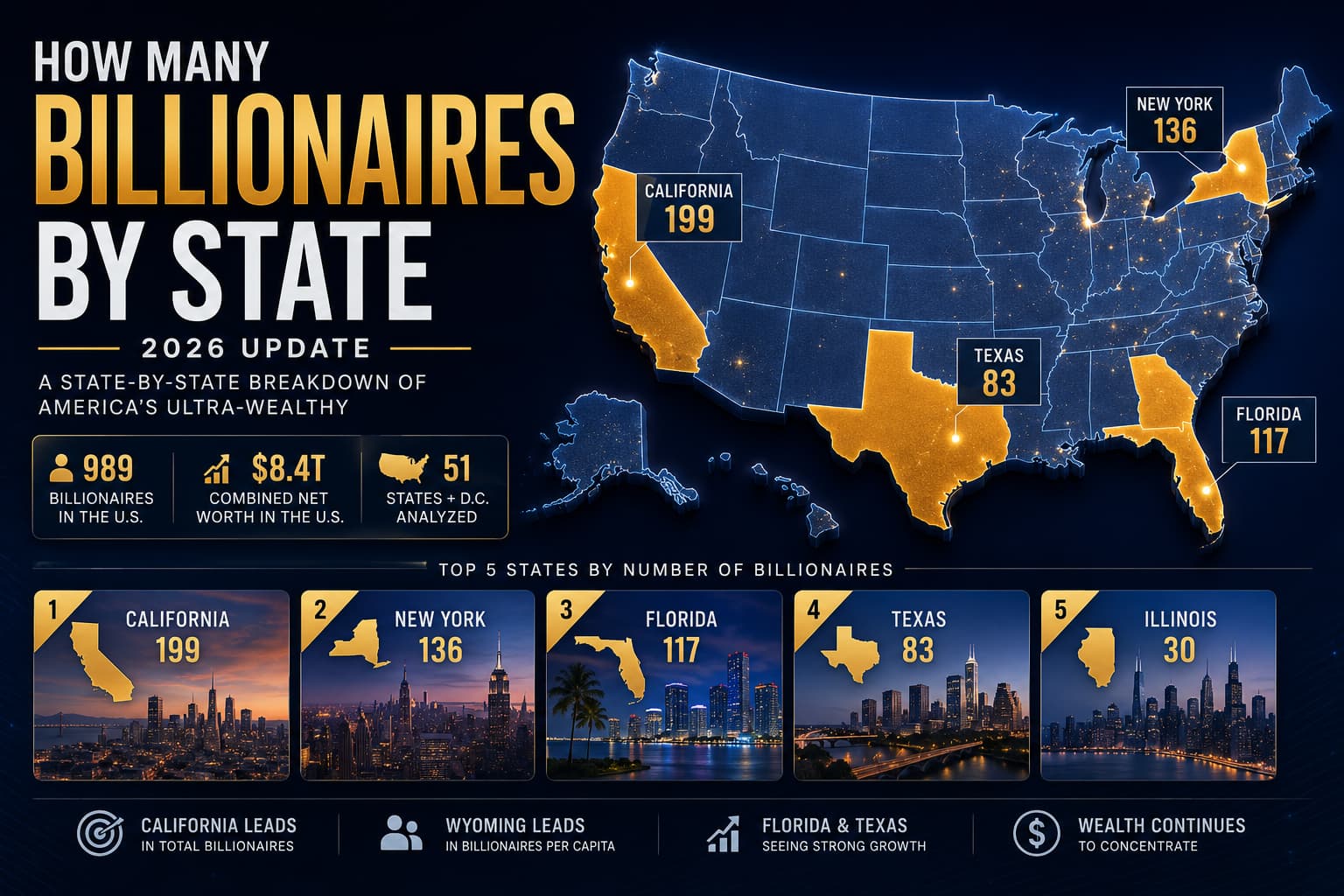
- California still has the most resident billionaires, with 199, more than New York and Florida individually.
- New York ranks second by count, with 136 billionaires, but it has the highest billionaire density among large states.
- Florida ranks third, with 117 billionaires, reflecting migration, finance relocation, real estate wealth, and no state income tax.
- Texas ranks fourth, with 83 billionaires, led by energy, technology, private business ownership, and the presence of Elon Musk.
- The top four states, California, New York, Florida, and Texas, account for 535 billionaires in the latest complete state table I reviewed.
- Wyoming has only 7 billionaires, but because its population is small, it has the highest billionaire-per-capita figure in the table.
- Alaska, Delaware, and West Virginia are the only states in the latest state map with zero resident billionaires.
- The biggest methodological risk is mixing three different ideas: billionaires by residence, billionaires by citizenship, and richest person by state.
Methodology: What I Counted and What I Did Not Count
For this article, I define a billionaire as:
A person with an estimated net worth of at least $1 billion, measured in U.S. dollars.
For the state table, I use resident billionaires by state. That matters because a billionaire’s citizenship, business headquarters, tax domicile, and primary residence may not all be in the same place.
The baseline state-by-state count comes from Visual Capitalist’s Voronoi map, which used Forbes Real-Time Billionaires data accessed July 24, 2025. The methodology states that Forbes tracks individuals confirmed to be billionaires and includes assets such as public company equity, private company equity, real estate, art, and other holdings.
For the 2026 national context, I use Forbes’ 2026 World’s Billionaires list, which reported that the United States had a record 989 billionaires with a combined net worth of about $8.4 trillion.
For population-adjusted density, I use the St. Louis Fed FRED table for 2025 resident population by state, which is based on Census population estimates.
For broader wealth concentration context, I use the Federal Reserve Distributional Financial Accounts and the Congressional Budget Office’s long-run family wealth distribution work. Those sources do not count billionaires by name, but they are useful for understanding why billionaire geography is really a story about ownership concentration.
Important limitation: I did not find a fully official June 2026 state-by-state billionaire registry. So I do not pretend that every state count below is a live count. The table should be read as the latest complete verified state distribution I could use, placed inside the newer 2026 national billionaire context.
How Many Billionaires by State? Full State Table
| Rank | State | Code | Billionaires | Billionaires per 1M residents |
|---|---|---|---|---|
| 1 | California | CA | 199 | 5.06 |
| 2 | New York | NY | 136 | 6.80 |
| 3 | Florida | FL | 117 | 4.99 |
| 4 | Texas | TX | 83 | 2.62 |
| 5 | Illinois | IL | 30 | 2.36 |
| 6 | Massachusetts | MA | 23 | 3.21 |
| 7 | Pennsylvania | PA | 23 | 1.76 |
| 8 | Georgia | GA | 21 | 1.86 |
| 9 | Nevada | NV | 19 | 5.79 |
| 10 | Connecticut | CT | 17 | 4.61 |
| 11 | Washington | WA | 17 | 2.12 |
| 12 | Arizona | AZ | 15 | 1.97 |
| 13 | Colorado | CO | 13 | 2.16 |
| 14 | Tennessee | TN | 12 | 1.64 |
| 15 | Virginia | VA | 11 | 1.24 |
| 16 | Maryland | MD | 10 | 1.60 |
| 17 | North Carolina | NC | 10 | 0.89 |
| 18 | Ohio | OH | 10 | 0.84 |
| 19 | Michigan | MI | 9 | 0.89 |
| 20 | Missouri | MO | 8 | 1.28 |
| 21 | New Jersey | NJ | 7 | 0.73 |
| 22 | Utah | UT | 7 | 1.98 |
| 23 | Wisconsin | WI | 7 | 1.17 |
| 24 | Wyoming | WY | 7 | 11.89 |
| 25 | Arkansas | AR | 6 | 1.93 |
| 26 | Montana | MT | 6 | 5.24 |
| 27 | Minnesota | MN | 5 | 0.86 |
| 28 | Louisiana | LA | 4 | 0.87 |
| 29 | Nebraska | NE | 4 | 1.98 |
| 30 | Oklahoma | OK | 4 | 0.97 |
| 31 | South Carolina | SC | 4 | 0.72 |
| 32 | Hawaii | HI | 3 | 2.09 |
| 33 | Kansas | KS | 3 | 1.01 |
| 34 | Oregon | OR | 3 | 0.70 |
| 35 | Indiana | IN | 2 | 0.29 |
| 36 | Mississippi | MS | 2 | 0.68 |
| 37 | New Hampshire | NH | 2 | 1.41 |
| 38 | Washington, D.C. | DC | 2 | 2.88 |
| 39 | Alabama | AL | 1 | 0.19 |
| 40 | Idaho | ID | 1 | 0.49 |
| 41 | Iowa | IA | 1 | 0.31 |
| 42 | Kentucky | KY | 1 | 0.22 |
| 43 | Maine | ME | 1 | 0.71 |
| 44 | New Mexico | NM | 1 | 0.47 |
| 45 | North Dakota | ND | 1 | 1.25 |
| 46 | Rhode Island | RI | 1 | 0.90 |
| 47 | South Dakota | SD | 1 | 1.07 |
| 48 | Vermont | VT | 1 | 1.55 |
| 49 | Alaska | AK | 0 | 0.00 |
| 50 | Delaware | DE | 0 | 0.00 |
| 51 | West Virginia | WV | 0 | 0.00 |
The 10 States With the Most Billionaires
| Rank | State | Billionaires | Main Wealth Engines |
|---|---|---|---|
| 1 | California | 199 | Technology, venture capital, AI, entertainment, real estate |
| 2 | New York | 136 | Finance, hedge funds, private equity, media, real estate |
| 3 | Florida | 117 | Migration, finance relocation, real estate, sports, inheritance |
| 4 | Texas | 83 | Energy, technology, private business, space, finance |
| 5 | Illinois | 30 | Finance, trading, food, family business, industrial wealth |
| 6 | Massachusetts | 23 | Biotech, software, finance, universities, healthcare |
| 7 | Pennsylvania | 23 | Private business, sports ownership, healthcare, retail |
| 8 | Georgia | 21 | Atlanta corporate wealth, logistics, media, private companies |
| 9 | Nevada | 19 | Casino wealth, real estate, migration, tax residency |
| 10 | Connecticut | 17 | Hedge funds, private equity, family wealth, finance |
The top of the list tells a simple story, but not a complete one.
California, New York, Florida, and Texas dominate by raw count. Together, they have 535 resident billionaires in the latest complete state table. That is not an accident. These states combine giant economies, major capital markets, founder ecosystems, global real estate demand, and the ability to attract or retain ultra-high-net-worth residents.
But the reasons are different in each state.
California creates billionaires. New York finances them. Florida attracts them. Texas increasingly does both, especially in energy, space, software, private business, and relocation-driven wealth.
California Still Has the Most Billionaires
California has 199 resident billionaires, the highest count of any state.
That number is important because it cuts against the simple tax-flight narrative. Yes, some billionaires have left California. Yes, tax policy matters. Yes, business leaders complain about regulation, housing costs, and political risk. But the state still has the deepest founder-equity machine in America.
The reason is structural. California has Silicon Valley, Los Angeles, San Francisco, San Diego biotech, venture capital, public technology companies, entertainment, defense technology, AI labs, and one of the deepest pools of technical talent in the world.
The California billionaire base is not just old money. It is founder equity. That makes it more sensitive to equity markets than to wages. When Nvidia, Meta, Alphabet, Tesla, or private AI companies reprice upward, California’s billionaire count can rise quickly. When technology valuations correct, California can lose paper billionaires just as quickly.
California’s billionaire story is therefore not just “rich people live in California.” It is that California owns a large share of the company-creation infrastructure that mints billionaires.
New York Is Still the Billionaire Capital of Finance
New York has 136 billionaires, second only to California.
This should surprise nobody, but the composition matters. New York’s billionaire base is tied to finance, hedge funds, private equity, real estate, media, fashion, and inherited wealth. It is less dependent on one technology cycle than California, but it is deeply tied to asset prices.
New York also looks stronger when adjusted for population. With roughly 20 million residents and 136 billionaires, it has about 6.8 billionaires per million residents. That is higher than California and Florida.
That tells me New York is still one of the densest extreme-wealth centers in the country. The New York billionaire class may be less visible in the startup press than Silicon Valley, but it remains central to the ownership of capital.
The risk for New York is not that it stops producing wealth. The risk is that more liquid billionaires can move tax residency while leaving their financial relationships in New York. That is a different kind of migration than moving a factory or software company.
Florida Has Become the Billionaire Migration State
Florida has 117 billionaires, ranking third nationally.
Florida is the most important migration story in the billionaire map. The state has no personal income tax, major luxury real estate markets, global capital flows, private wealth offices, finance migration to Miami and Palm Beach, and a long-standing retirement and second-home infrastructure.
But I would not describe Florida as merely a tax haven. That is too simplistic.
Florida’s billionaire growth is driven by several overlapping forces:
- Northeastern wealth migration
- Finance and hedge fund relocation
- Sports, entertainment, and media wealth
- Real estate appreciation in Miami, Palm Beach, Naples, and Tampa
- International wealth using Florida as a U.S. base
- Retirees and founders converting liquidity events into residency moves
Florida’s weakness is that it attracts more billionaire wealth than it creates organically. That may change as Miami’s finance and tech ecosystem matures, but California and New York still have stronger billionaire-creation engines.
Texas Is the New Scale-and-Control State
Texas has 83 billionaires, ranking fourth nationally.
Texas is not just a low-tax alternative. It is a control state. Billionaires like Texas because it offers space, energy, low personal income tax, large private business markets, permissive business culture, and major metropolitan growth in Austin, Dallas, Houston, and Fort Worth.
Texas has several wealth engines:
- Energy and oil fortunes
- Technology migration into Austin
- Space, defense, and advanced manufacturing
- Private business ownership
- Real estate development
- Family-controlled industrial capital
- Public-company founders and executives
The presence of Elon Musk also distorts the Texas narrative. He is not just another billionaire resident. His companies and public profile make Texas look like the symbolic center of founder relocation from California.
But the broader point is more durable than one person. Texas is becoming a preferred headquarters and residence state for founders who want lower taxes, more space, and a business culture that feels less hostile to concentrated ownership.
Billionaires Per Capita: The Map Looks Very Different
Raw count favors large states. Billionaires per capita reveals a different pattern.
| Rank | State | Billionaires | Billionaires per 1M residents |
|---|---|---|---|
| 1 | Wyoming | 7 | 11.89 |
| 2 | New York | 136 | 6.80 |
| 3 | Nevada | 19 | 5.79 |
| 4 | Montana | 6 | 5.24 |
| 5 | California | 199 | 5.06 |
| 6 | Florida | 117 | 4.99 |
| 7 | Connecticut | 17 | 4.61 |
| 8 | Massachusetts | 23 | 3.21 |
| 9 | Washington, D.C. | 2 | 2.88 |
| 10 | Colorado | 13 | 2.16 |
This table is where the story gets more interesting.
Wyoming has only seven billionaires, but because its population is below 600,000, it has the highest billionaire-per-capita figure in the dataset. That does not mean Wyoming has the largest billionaire economy. It means a small number of ultra-wealthy residents can dramatically change the per-capita ranking in a small state.
Nevada and Montana show a similar pattern. They are not bigger wealth economies than California, New York, Florida, or Texas. But they attract ultra-wealthy residents because of lifestyle, tax structure, land, privacy, and luxury real estate.
Connecticut remains a classic finance-density state. Its count is smaller than Florida’s, but its billionaire-per-capita concentration is much higher.
Mississippi has two resident billionaires in the July 24, 2025 source, not eight. Its approximate density is 0.68 per million residents using the article’s population denominator. The source count has been corrected here and in the map.
Why Billionaire Geography Is Not the Same as Millionaire Geography
The billionaire-by-state map should not be interpreted like the millionaire-by-state map.
Millionaire status is increasingly common in high-home-equity states. A household can cross $1 million in net worth through a house, a retirement account, and decades of compounding. That is why millionaire density is high in places like Vermont, Hawaii, New Jersey, California, and New Hampshire.
Billionaire status is different.
A billionaire is usually created by concentrated ownership. That means founder equity, inherited business stakes, public company shares, private equity ownership, hedge fund economics, oil and gas assets, real estate empires, sports teams, or family-controlled enterprises.
The millionaire map measures broad asset ownership. The billionaire map measures control.
That is why California dominates billionaires even though many households struggle with affordability. It is also why Florida can rise quickly without having the same company-creation base as California. A billionaire can move residency faster than a state can build a deep innovation ecosystem.
What Most Billionaire-by-State Rankings Get Wrong
I see four major mistakes in most billionaire-by-state content.
1. They confuse residence with origin
A billionaire living in Florida may have built their company in New York, California, Washington, Illinois, or abroad. Residence tells us where wealth sits today. It does not always tell us where wealth was created.
That distinction matters. If a founder builds a company in California and later moves to Texas, California created the founder ecosystem, but Texas may get the resident billionaire.
2. They confuse citizenship with state residence
Forbes may count a billionaire as American by citizenship or country, while a state map may count where someone resides. A U.S. citizen living abroad is not a resident billionaire of California, New York, or Florida. A foreign-born billionaire living in the U.S. may appear in a state count depending on the methodology.
This is why state totals and country totals do not always line up cleanly.
3. They ignore stock market timing
Billionaire counts are not stable. A founder can move above or below $1 billion because a public stock rises or falls. Private-company valuations can also change, sometimes sharply, when funding markets tighten.
A billionaire count is therefore a snapshot, not a census.
4. They treat tax policy as the only driver
Taxes matter, but billionaires do not choose states only based on tax rates. They also care about deal networks, talent, family, aviation access, schools, privacy, legal structures, climate, political risk, and proximity to companies or investors.
Florida and Texas benefit from tax policy, but New York and California still dominate because they remain powerful wealth-creation ecosystems.
The 2026 Billionaire Context: The U.S. Is Still the Global Center of Billionaire Wealth
The latest Forbes 2026 World’s Billionaires list puts the U.S. at a record 989 billionaires with about $8.4 trillion in combined wealth.
That number matters because it shows the American billionaire class is not shrinking, even as some state-level migration patterns change. The U.S. remains the dominant global home for billionaire wealth because it has the deepest public markets, the largest venture ecosystem, the strongest founder-equity culture, and massive private-company ownership.
The AI boom has likely intensified this concentration. Nvidia, cloud infrastructure, private AI labs, semiconductor supply chains, enterprise software, robotics, defense technology, and data-center infrastructure all create new paths to extreme wealth.
I would not be surprised if the next state-level update shows more billionaire concentration in California, Texas, Washington, Florida, and New York, with smaller gains in Utah, Colorado, Arizona, Tennessee, and North Carolina.
The States With No Billionaires
The latest state map shows three states with no resident billionaires:
| State | Billionaires |
|---|---|
| Alaska | 0 |
| Delaware | 0 |
| West Virginia | 0 |
This does not mean these states have no wealthy people. It means they did not have a confirmed resident billionaire in the dataset.
The Delaware result is especially interesting because Delaware is extremely important legally and corporately. Many companies are incorporated there, but incorporation is not residence. Billionaires can use Delaware entities without living in Delaware.
West Virginia reflects a different issue. It has wealthy families and resource-linked fortunes, but it has not developed the same concentration of public-company founders, finance billionaires, or major private-equity-backed wealth as larger states.
Alaska is small, resource-rich, and high-income in certain sectors, but it does not have a large billionaire-resident base.
What the Billionaire Map Says About Power
The billionaire map is not just a curiosity. It is a map of financial power.
Billionaires control companies, foundations, investment funds, sports teams, media assets, political donations, real estate empires, venture capital networks, and sometimes entire local economies. When billionaires concentrate in certain states, those states often become centers of capital allocation.
This matters for:
- Political fundraising
- Philanthropy
- Venture capital
- Sports ownership
- Media influence
- Real estate development
- University donations
- Startup formation
- Tax policy debates
California’s 199 billionaires are not just residents. They represent a huge concentration of company ownership. New York’s 136 billionaires are not just wealthy individuals. They are tied to finance and asset management. Florida’s 117 billionaires signal migration of private wealth. Texas’s 83 billionaires show the rise of business-friendly, low-tax wealth clustering.
In other words, billionaire geography is a proxy for where capital makes decisions.
My Bottom Line
The latest complete billionaire-by-state map shows the U.S. billionaire class is extremely concentrated.
California, New York, Florida, and Texas dominate by raw count. Together, they account for 535 resident billionaires in the state table I analyzed. California remains the largest billionaire state because it still creates founder equity at a scale no other state can match. New York remains the capital of finance-linked billionaire wealth. Florida is the clearest billionaire migration story. Texas is the strongest hybrid of old energy wealth, new technology wealth, and low-tax founder relocation.
But raw count is not the whole story.
On a per-capita basis, Wyoming, Nevada, Montana, Connecticut, and New York show how small populations, financial hubs, privacy, tax structures, and lifestyle markets can create extreme billionaire density.
Going forward, I am watching five signals.
First, whether AI wealth keeps increasing California’s billionaire count despite tax pressure.
Second, whether Florida continues to attract hedge fund, private equity, and founder wealth from New York, California, and Illinois.
Third, whether Texas keeps converting migration into actual company creation, not just resident relocation.
Fourth, whether smaller states like Wyoming, Montana, Nevada, Utah, and Tennessee gain more ultra-wealthy residents as tax and lifestyle migration continues.
Fifth, whether the next market correction pulls recently minted AI, software, and private-company billionaires back below the $1 billion threshold.
The most important conclusion is this: billionaires by state should not be read as a simple prosperity ranking. It is a control map. It shows where extreme ownership lives, where it moves, and which states are becoming more important in the geography of American capital.
Methodology and Government Data Sources
There is no official U.S. government registry of billionaires by state. The federal government does not publish a named list of residents with net worth above $1 billion, and billionaire residence can be complicated because many ultra-high-net-worth individuals maintain multiple homes, business entities, trusts, and tax domiciles.
Because of that, I treated the billionaire count as an estimate based on named-person wealth lists, then used government and Federal Reserve data to validate the population, economic, income, ownership, and wealth-distribution context behind the ranking.
For population-adjusted comparisons, I used the U.S. Census Bureau’s State Population Totals and Components of Change, which provides official state population estimates. This is the denominator I would use to calculate billionaires per million residents.
For household and demographic context, I used the Census Bureau’s American Community Survey, which is the federal government’s premier source for detailed information about U.S. households, housing, income, and demographic characteristics across all 50 states and Washington, D.C.
For state income and tax context, I used the IRS Statistics of Income program’s individual income tax state data. This helps separate billionaire wealth from high annual income, because income and net worth are not the same thing.
For national wealth concentration, I used the Federal Reserve’s Distributional Financial Accounts, which provide quarterly estimates of how U.S. household wealth is distributed across wealth groups.
For the broader household balance-sheet framework, I used the Federal Reserve’s Survey of Consumer Finances, which tracks family assets, debts, pensions, income, and demographic characteristics. This does not identify billionaires by name, but it is one of the strongest public sources for understanding how American wealth is measured.
For state economic context, I used the Bureau of Economic Analysis Regional Economic Accounts, which provide state GDP, state personal income, wages, compensation, and other regional economic measures.
For company ownership and public-market wealth context, I used the SEC’s EDGAR search tools, because public-company filings can disclose major share ownership, executive holdings, insider transactions, and other securities information relevant to publicly traded billionaire wealth.
For the long-term inequality backdrop, I used the Congressional Budget Office report on trends in the distribution of family wealth, which shows how wealth ownership has changed across U.S. families over time.
The key limitation is that these government sources do not directly count billionaires by state. Instead, they provide the official framework around the estimate: population denominators, household wealth concepts, income data, public-company ownership records, state economic output, and national wealth concentration.
Independent Research Disclaimer
This article is independent research for informational purposes only. It is not investment, tax, legal, political, or financial advice. Billionaire net worth estimates are inherently imperfect because they depend on public equity prices, private-company valuations, real estate estimates, debt assumptions, art and private asset values, and reporting methodology. State residence can also change, and some billionaires maintain multiple homes, business entities, and tax domiciles. The state table should be read as a rounded, methodology-dependent snapshot, not an official government registry.