
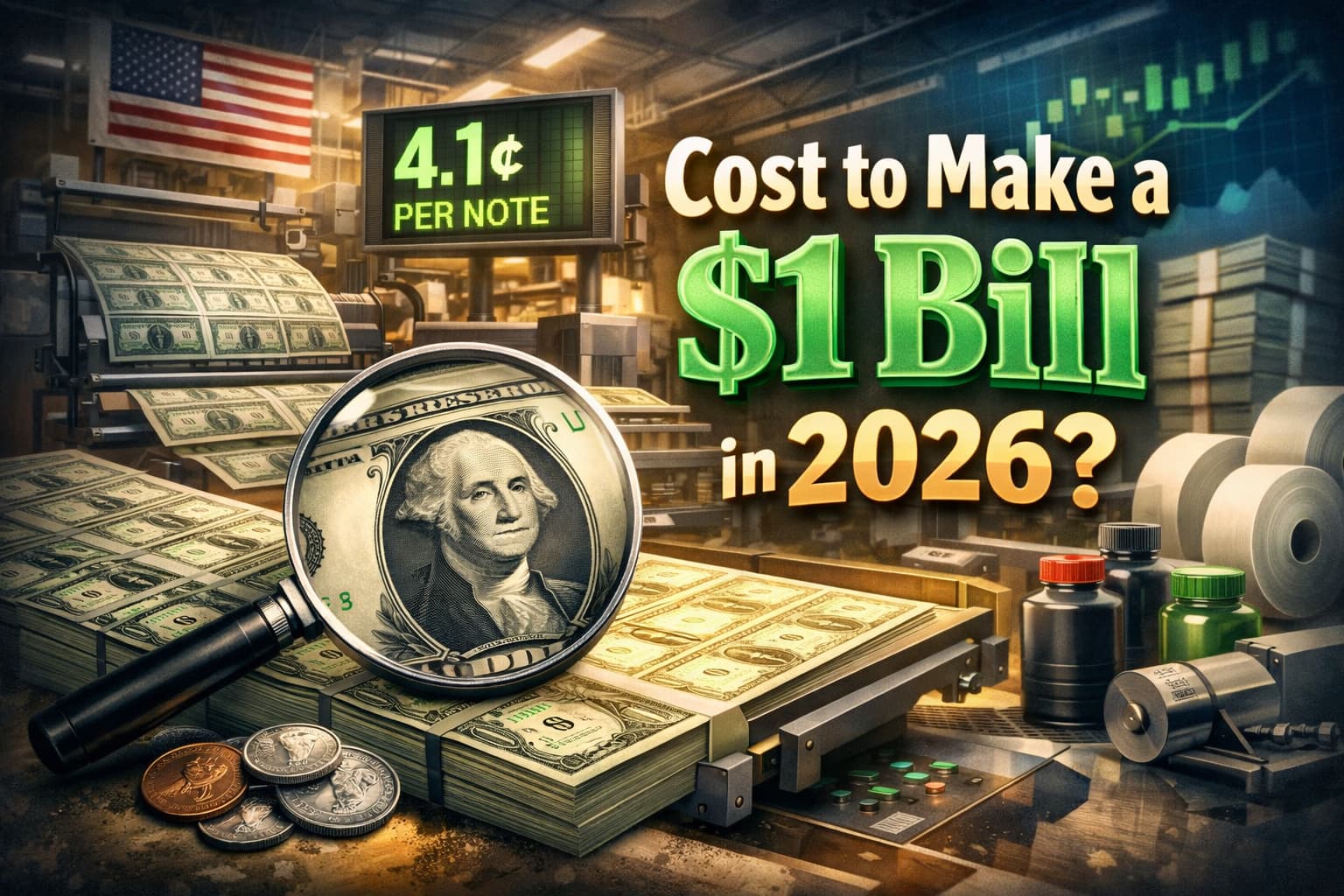
If you mean how many cents it takes to physically print a $1 bill, the best official figure going into 2026 comes from the Federal Reserve’s currency production data.
The short answer
Printing one $1 bill costs about 4.1 cents in variable production cost. That includes the paper, ink, labor, and direct overhead required to produce a single note.
That means:
- 1 bill ≈ $0.041 to print
- 100 bills ≈ $4.10
- 1,000 bills ≈ $41
This is the figure the Federal Reserve uses when budgeting how much it will cost to supply new currency to the U.S. economy.
Who actually prints U.S. money?
The physical printing of U.S. paper money is done by the Bureau of Engraving and Printing (BEP), a bureau of the U.S. Treasury. However, the Federal Reserve decides how many bills of each denomination are needed and places an order with BEP.
BEP then bills the Federal Reserve for the cost of producing the currency. This is why most cost figures come from the Federal Reserve rather than directly from Treasury.
How many $1 bills will be printed in 2026?
The Federal Reserve’s most recent currency print order for calendar year 2026 calls for between 1.3 billion and 1.44 billion one‑dollar bills.
Using the 4.1‑cent printing cost, that means:
- Low estimate: about $53 million to print new $1 bills
- High estimate: about $59 million to print new $1 bills
That is just for newly printed $1 bills, not all U.S. currency.
What exactly does 4.1 cents include?
The Federal Reserve defines the printing cost as the variable cost per note, which includes:
- Specialized currency paper
- Security inks
- Printing and numbering
- Direct labor
- Factory overhead tied to production
It does not include broader government costs like building facilities, research and development, long‑term equipment, or administrative operations.
What is a dollar bill actually made of?
U.S. currency is not normal paper. Dollar bills are printed on a special blend that is:
- 75% cotton
- 25% linen
This makes the bills more durable, harder to counterfeit, and able to survive years of circulation.
The paper is manufactured specifically for the U.S. government and cannot be bought on the open market.
Why do some sources say it costs 7–8 cents per bill?
In addition to variable printing costs, the Bureau of Engraving and Printing tracks a broader metric called manufacturing cost per 1,000 notes delivered. This includes:
- Equipment
- Facilities
- Administration
- Waste and spoilage
- Indirect labor
Recent BEP budget documents show this broader cost has ranged roughly from 6 to 8 cents per note in recent years, depending on production volume and denomination mix.
So both numbers are true:
- 4.1 cents is the marginal cost to print one more $1 bill
- 6–8 cents is closer to the all‑in manufacturing cost averaged across the entire currency system
Why it doesn’t cost $1 to make $1
A dollar bill is not valuable because of its material. It is valuable because:
- It is issued by the U.S. government
- It is backed by law
- It is accepted by the entire economy
Printing a bill for a few cents allows the government to create money at very low cost relative to its face value. The difference between face value and production cost is called seigniorage, and it helps fund government operations.
Bottom line
In 2026, it costs about 4.1 cents to print a $1 bill. With more than 1.3 billion new $1 bills expected to be produced, the U.S. government will spend roughly $50–60 million just printing new ones this year.
That tiny cost per bill is one of the reasons physical currency remains an efficient and powerful part of the U.S. monetary system.