
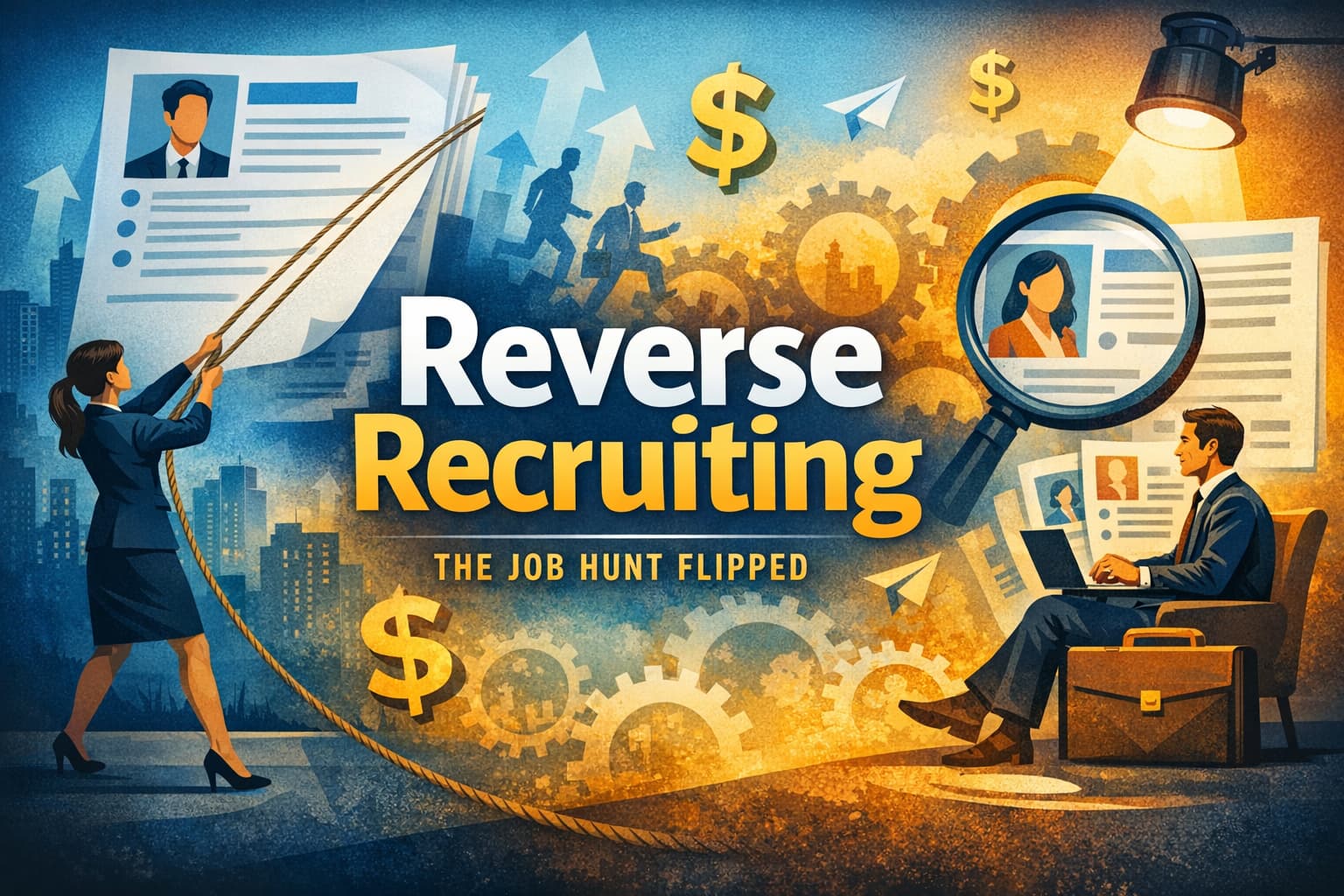
Reverse recruiting is having a real moment. In the last couple of weeks I have watched it jump from a niche corner of career coaching into mainstream headlines and LinkedIn debates. The core idea is simple, job seekers hire someone to run the search process for them. The reality is more complicated.
In this article I set out to answer one question: Is reverse recruiting a legitimate new category, or just expensive packaging around things you can do yourself? I also wanted to map the formats, the incentives, and the failure modes, because most coverage focuses on the novelty and the price tag, not on how the model actually works.
What I keep seeing people miss is that reverse recruiting is not one thing. It ranges from white glove, strategy led outreach to pure application volume mills. Those two look similar on the surface, but they have very different ethics, outcomes, and risks.
Key takeaways
- Reverse recruiting flipped attention because hiring got more automated, more crowded, and more exhausting for candidates.
- The category has multiple formats, and outcomes depend more on execution quality than on the label.
- The biggest risks are misaligned incentives, low quality mass applications, weak data practices, and unrealistic guarantees.
- The right provider behaves like a disciplined campaign manager, not a resume writer, not a spam engine.
What is reverse recruiting, in plain English
Reverse recruiting is when I pay a professional to do the recruiter grade work on my behalf, instead of waiting for an employer or agency recruiter to find me.
In traditional recruiting, the employer pays. In reverse recruiting, the candidate pays. That single change creates the momentum behind the trend, and also most of the controversy.
A good reverse recruiting engagement usually includes:
- Strategy: role targeting, positioning, messaging, and pipeline design
- Execution: applications, networking, outreach to hiring managers, follow ups
- Enablement: resume variants, LinkedIn optimization, interview prep, negotiation
- Reporting: weekly cadence, metrics, and feedback loops
A bad reverse recruiting engagement usually looks like:
- Resume polish plus high volume applications
- Generic outreach templates sent at scale
- Minimal accountability, minimal reporting, unclear ownership of results
Why reverse recruiting suddenly got so much attention
I think three forces converged.
1) Job search pain became a headline level story
Mainstream coverage framed reverse recruiting as an economic and cultural signal: white collar candidates feel stuck, and some are willing to pay meaningful money for an edge. That framing is powerful, because it turns an individual job hunt into a market story.
2) AI made both sides faster, and noisier
Employers use automation to screen. Candidates use automation to apply. The result is a flood of similar applications, more ghosting, and a stronger incentive to stand out through targeted outreach and referrals.
Reverse recruiting sits right in the middle of that arms race, and it is easy to explain in one sentence, so it travels.
3) The incentives are controversial
People react to the idea of paying to get hired. Some see it as pragmatic, like hiring an accountant or a lawyer. Others see it as an unfair advantage that widens inequality, or as a predatory business model when it is sold with hype.
That tension generates debate, and debate drives attention.
The main formats I see in the market right now
When people say “reverse recruiting,” they usually mean one of these four formats.
1) Full service reverse recruiting agency
A team runs a managed job search: targeting, messaging, outreach, applications, and interview prep. This is the most expensive format, and also the one most likely to work when done correctly.
2) “Done for you” application management
A service submits applications for you, sometimes at high volume. If quality is low, this can hurt your brand and burn bridges.
3) Talent agent style networking and outreach
Less emphasis on applications, more on warm intros, hiring manager outreach, and narrative control. For senior roles, this tends to outperform volume.
4) Marketplace freelancers
Pieces of the process are outsourced, for example LinkedIn optimization, outreach lists, or application submissions. Quality varies widely.
Pricing models, incentives, and what they encourage
The pricing model matters because it shapes behavior.
| Pricing model | Typical structure | What it incentivizes | What can go wrong |
|---|---|---|---|
| Monthly retainer | $900 to $2,500+ per month is common in media examples | Consistent execution, ongoing support | Provider can drift into busy work if scope is vague |
| Flat fee package | One time fee for 30 to 90 days | Clear deliverables | Can become a checklist, not a campaign |
| Success fee | Percent of first year salary, or a fixed placement fee | Outcomes, urgency | Pressure to push any offer, conflicts over role fit |
| Hybrid | Retainer plus success fee | Balance of effort and outcome | Most complex contracts, disputes if terms are unclear |
My rule is simple: the more the model pays for volume, the more you should demand proof of quality controls.
What to watch out for, the red flag checklist
If I were hiring a reverse recruiter for myself, here are the risks I would audit first.
Red flag 1: “Secret job databases” and vague claims
There is no magic hidden job board that replaces networking and targeting. Real advantages come from process and execution.
Red flag 2: Mass applying under your name
If someone is submitting dozens of low fit applications, your name becomes associated with noise. That can reduce callback rates over time.
Red flag 3: Weak data handling
A reverse recruiter touches sensitive information: your resume, your salary history, your target list, your logins, sometimes even your email. If they cannot explain how they store data, who has access, and how they delete it, I would walk.
Red flag 4: Outsourcing without disclosure
Some services are a front end for a distributed team doing templated work. Outsourcing is not inherently bad, but secrecy is.
Red flag 5: Guarantees that sound like marketing, not operations
A guarantee can be real, but only if it is defined. What counts as an “offer,” what role level, what geography, what comp band, what timeline, what happens if the market shifts.
What good reverse recruiting looks like in practice
Good reverse recruiting is closer to running a sales pipeline than to “applying for jobs.”
Here is what I expect to see:
- A written target thesis: titles, industries, dealbreakers, and priorities
- Two to four positioning angles, with resume variants to match
- A weekly activity plan that separates networking from applications
- Outreach that is tailored, short, and role specific
- A CRM style tracker: stages, outcomes, feedback, and next actions
- Interview prep that is structured: stories, metrics, objections, compensation
A quote from Steven Mostyn at Career Agents
I asked Steven Mostyn, founder of Career Agents, for a concise statement that reflects what his team is seeing as the category gets mainstream attention. Here is the quote he approved for publication in this piece:
“When the market gets noisy, candidates need a real campaign, not more advice. We are seeing demand jump because people are tired of sending applications into a black box. Reverse recruiting works when you treat the job search like a managed pipeline, with targeting, outreach, follow up, and interview readiness, all measured every week.”
Recent media coverage, and what each piece signals
I do not think one article “proved” reverse recruiting. What the coverage did was validate that it is now a recognizable category.
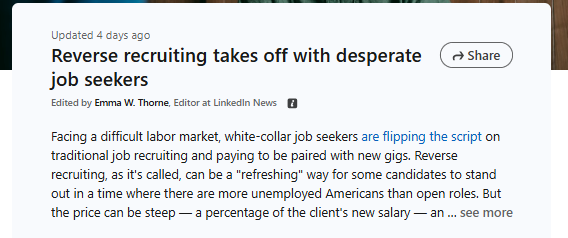
- LinkedIn News framed the trend as a reaction to a tough white collar market and highlighted the range of fee structures.
- CBS News emphasized the cost, the promise to shorten job searches, and the equity debate.
- The Wall Street Journal presented reverse recruiting as a broader cultural shift and tied it to AI driven scale on both sides.
- Financial Times mentioned reverse recruiting as one signal among many that the workplace is being reshaped by AI and new coordination models.
FAQ: reverse recruiting for people hearing about it for the first time
Is reverse recruiting the same as a resume writer or career coach?
No. Resume writing and coaching are usually advice and assets. Reverse recruiting, when done properly, is strategy plus execution.
Does reverse recruiting actually work?
Sometimes. Outcomes depend on role level, market conditions, and provider quality. The biggest predictor is whether the provider can show a repeatable process and real examples of targeted outreach.
How long should I try it before I decide it is not working?
I would expect early signals within 2 to 4 weeks: better response rates, warmer conversations, and clearer feedback. Offers take longer, but pipeline quality should improve quickly.
What should I ask before I pay anyone?
- Who exactly does the work, and what is their weekly time commitment?
- What does a “good week” look like, and how do you measure it?
- Do you apply under my name, or do you focus on outreach and referrals?
- What quality controls exist for role fit and messaging?
- What data do you store, and how do you protect it?
- If you claim a guarantee, define it in writing.
Is it ethical to pay for this?
I see it like hiring any professional service. The ethical line is crossed when providers mislead candidates, spam employers, or mishandle data. Transparency is the standard.
My practical framework for deciding if reverse recruiting is right for you
I would consider reverse recruiting if:
- I am a high earner where saving time has real financial value
- I am targeting competitive roles, where outreach and narrative matter
- I have been searching for 6 to 8 weeks with low response rates
- I can afford it without forcing desperate decisions
I would not consider it if:
- I have not done basic fundamentals, like clarifying target roles and updating my LinkedIn
- I am early career and still building core signal, where learning the process is valuable
- The provider cannot show a structured operating model
What I am watching next
I am watching three things.
- Whether employers start filtering out obvious third party application patterns.
- Whether regulation or platform rules tighten around automation, data access, and impersonation.
- Whether the market consolidates, separating serious operators from commodity application mills.
Reverse recruiting is not a magic trick. It is a response to a job market that became more automated, more crowded, and more exhausting. The upside is real when the work is strategic and disciplined. The downside is also real when the model turns into spam.
Sources and further reading (recent coverage)
LinkedIn News: https://www.linkedin.com/news/story/desperate-times-call-for-reverse-recruiters-6991212/
CBS News: https://www.cbsnews.com/news/what-is-reverse-recruiting-agency/
Wall Street Journal: https://www.wsj.com/lifestyle/careers/job-hunters-are-so-desperate-that-theyre-paying-to-get-recruited-44891ac2
Financial Times newsletter mention: https://www.ft.com/content/7f0a0fa9-b682-47d2-a7f8-2f8ac0ebb732
Career Agents: https://careeragents.org/reverse-recruitment/