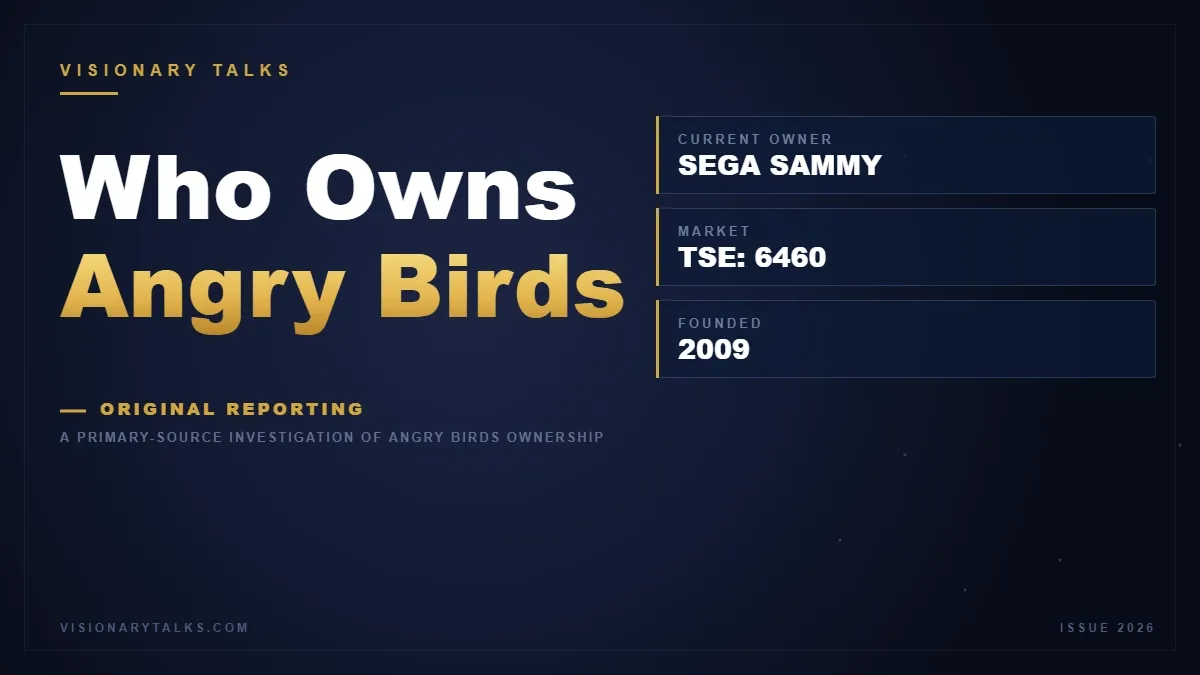
Angry Birds is owned by Sega through its wholly owned subsidiary Sega Europe Limited, following Sega Sammy Holdings’ 2023 acquisition of Rovio Entertainment, the original creator and IP owner of the franchise. As of 2026, Sega controls 100 percent of Rovio and therefore 100 percent of the Angry Birds intellectual property, including games, licensing, film rights, and consumer products.
This ownership matters far beyond a nostalgic mobile game brand. Angry Birds is now a strategic asset inside a publicly traded Japanese entertainment conglomerate, and its future is shaped by Sega’s capital allocation priorities, platform strategy, and long term view of mobile gaming as a growth engine.
Who Owns Angry BirdsRight Now?
Angry Birds is not an independent studio, nor is it a passive licensing brand floating in the mobile ecosystem. It sits squarely inside Sega’s global operating structure, managed through Rovio Entertainment, which now functions as Sega’s mobile gaming spearhead.
The acquisition closed in August 2023 after months of regulatory review and shareholder approvals. Sega Sammy Holdings acquired all outstanding shares of Rovio Entertainment Oyj via its UK based subsidiary Sega Europe Limited, taking the Finnish company private.
From an ownership perspective, there are no minority partners or retained founder equity. Sega owns the full stack, from codebases and live operations to animated content and merchandising pipelines.
Ownership Snapshot
| Entity |
Ownership Stake |
Notes |
| Rovio Entertainment Oyj |
100% |
Acquired in 2023 by Sega Europe Limited |
| Sega Europe Limited |
100% |
Operating subsidiary of Sega Sammy Holdings |
| Angry Birds IP |
100% |
Owned via Rovio, includes games, films, and licensing |
The Portfolio: The Illusion of Choice
Sega has spent decades mastering the art of portfolio management, allowing brands to appear creatively autonomous while being financially centralized. Angry Birds benefits from this structure, maintaining its Finnish studio culture while tapping Sega’s global distribution muscle.
To the outside world, Rovio still feels like Rovio. Internally, however, it is integrated into Sega’s broader entertainment roadmap, where IP cross pollination and platform leverage are the real value drivers.
Parent Company Brand Portfolio
| Brand |
Segment |
Positioning |
| Sonic the Hedgehog |
Console and multimedia |
Flagship global mascot |
| Persona |
Console RPG |
Premium narrative driven franchise |
| Yakuza Like a Dragon |
Console and PC |
Adult oriented storytelling |
| Angry Birds |
Mobile and licensing |
Mass market, evergreen IP |
Founders and Ownership Timeline
Understanding who owns Angry Birds today requires going back to a scrappy Finnish startup that failed dozens of times before creating one of the most recognizable characters in digital entertainment.
Angry Birds Founders
Rovio Entertainment was founded in 2003 by three students from Helsinki University of Technology: Niklas Hed, Jarno Väkeväinen, and Kim Dikert. The company was initially called Relude and focused on mobile game development competitions.
Niklas Hed served as CEO during the explosive rise of Angry Birds after its 2009 launch. The founders retained control through the early growth phase, resisting acquisition offers while they built a licensing and media empire around the birds.
That independence came with volatility, and by the mid 2010s, Rovio faced declining downloads and a bloated cost structure. The seeds of eventual acquisition were planted during this period.
Ownership History Timeline
| Year |
Event |
Ownership Impact |
| 2003 |
Rovio founded |
Founder owned private company |
| 2009 |
Angry Birds launches |
Explosive growth increases founder equity value |
| 2017 |
Rovio IPO on Nasdaq Helsinki |
Company becomes publicly traded |
| 2023 |
Sega acquisition announced and closed |
Rovio taken private, 100% Sega owned |
Current Leadership and CEO
Post acquisition, Sega chose continuity over disruption. Rovio continues to operate with its own executive leadership, reporting into Sega’s European and mobile gaming management structure.
This approach reflects Sega’s belief that Angry Birds’ value lies in operational expertise, not just IP extraction.
Leadership Snapshot
| Role |
Name |
Since |
| CEO, Rovio Entertainment |
Alex Pelletier-Normand |
2020 |
| Group CEO |
Haruki Satomi |
Sega Sammy Holdings |
Why This Ownership Structure Exists
The acquisition of Rovio fits Sega’s broader strategy of vertical integration across platforms, genres, and geographies. Rather than relying on third party mobile publishers, Sega now owns a proven free to play machine.
This is not a private equity roll up or a short term financial play. It is a conglomerate model built around IP longevity and cross platform monetization.
The Business Genius
Angry Birds is uniquely suited for this structure because its brand recognition transcends gaming. Sega gains a family friendly IP that monetizes through ads, in app purchases, consumer products, and entertainment media.
By owning Rovio outright, Sega captures the full profit pool while reducing execution risk. There is no licensing leakage, no royalty negotiations, and no dependency on external studios.
The Risk
The downside is creative stagnation. Large conglomerates can unintentionally sand down the edges that made a brand special in the first place.
Mobile gaming also moves faster than console cycles. If Sega’s governance slows iteration or risk taking, Angry Birds could become a maintenance brand rather than a growth story.
Tracing the Ownership Chain
To understand ultimate control, investors need to move one level above Sega itself. Sega is not a standalone company, it is part of a larger publicly listed holding structure.
Sega Sammy Holdings Inc. trades on the Tokyo Stock Exchange and reports consolidated results across gaming, pachinko, resorts, and entertainment.
Ownership Layers
| Layer |
Owner |
Control |
| Angry Birds IP |
Rovio Entertainment |
100% |
| Rovio Entertainment |
Sega Europe Limited |
100% |
| Sega Europe Limited |
Sega Sammy Holdings |
100% |
Because Sega Sammy Holdings is public, ultimate ownership is dispersed among institutional and retail shareholders. Major holders include Japanese asset managers and global index funds.
Details of the acquisition and strategic rationale were outlined in regulatory disclosures and reported extensively at the time, including by
Reuters coverage of Sega’s Rovio acquisition.
Debunking the Common Misconception
The most common misconception I encounter is that Angry Birds is still independent under Rovio. This belief lingers because Sega intentionally preserved Rovio’s brand and leadership visibility.
In reality, Rovio is no longer a public or independent entity. It is a wholly owned operating unit, and major strategic decisions ultimately roll up to Sega Sammy Holdings, whose financials and governance are publicly disclosed.
Key Takeaways for Entrepreneurs
- Brand independence can be an illusion, ownership determines strategy and capital access.
- Selling to a strategic buyer can extend IP lifespan more effectively than remaining standalone.
- Operational autonomy inside a conglomerate requires trust and consistent performance.
Angry Birds’ journey from a Finnish student project to a Sega owned global asset is a case study in timing, IP leverage, and the realities of scale. For founders and operators, it highlights a hard truth: independence is a phase, not a permanent state.
Under Sega, Angry Birds is no longer just a game that went viral. It is a line item in a multinational balance sheet, a cross platform growth lever, and a reminder that in business, ownership quietly shapes everything that follows.