
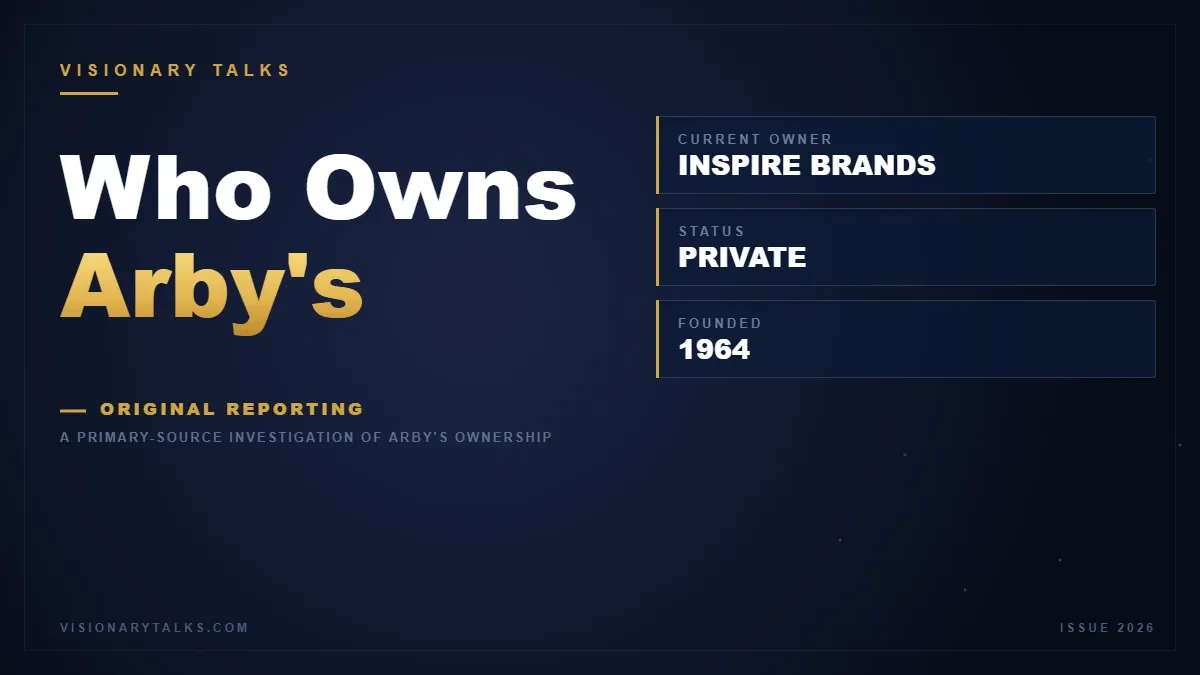
Who Owns Arby’s Right Now?
What changed in 2026
Arby’s did not change hands in 2026. Its owner started the process of selling itself to the public.
On May 8, 2026, Inspire Brands announced it had confidentially submitted a draft registration statement to the SEC for a proposed initial public offering. Roark is reportedly seeking a valuation of roughly $20 billion, per CNBC, and Bloomberg reported the offering could raise up to $2 billion. Inspire described more than 33,300 restaurants across six brands and $33.4 billion in annual systemwide sales, with proceeds earmarked for debt repayment.
The important word is confidentially. A draft registration statement is not public, so Inspire’s financials, and Arby’s numbers inside them, remain invisible. As of September 10, 2026 no public registration statement has been filed and nothing has been priced or scheduled.
An IPO is how private equity exits. If it completes, Roark stops being the answer to who controls Arby’s and dispersed public shareholders start becoming it, which is the 2011 transaction running in reverse.
The Portfolio Effect: What Else Does Inspire Brands Own?
Arby’s feels like a standalone chain, but it sits inside a bigger portfolio built to scale franchising economics across multiple brands.
Here is the core Inspire Brands portfolio and the best public “value signals” available (deal sizes where disclosed, or credible reported valuations):
| Brand (Parent company: Inspire Brands) | Year acquired (by Inspire or its predecessor) | Estimated value or revenue signal (public) |
|---|---|---|
| Arby’s | 2011 (Roark acquired majority; platform foundation) | Transaction value estimated at $430M |
| Buffalo Wild Wings | 2018 (closed) | About $2.9B transaction value including net debt |
| SONIC Drive-In | 2018 (closed) | $2.3B acquisition |
| Jimmy John’s | 2019 (closed) | Price undisclosed; reported valuation about $2.3B at the time |
| Dunkin’ | 2020 (closed) | $11.3B acquisition |
| Baskin-Robbins | 2020 (via Dunkin’ Brands) | Included in the Dunkin’ Brands $11.3B deal |
Scale note: Inspire says its brands produced more than $32.6B in global system sales in 2024 across 33,000+ restaurants, which gives a useful sense of the platform’s “market cap equivalent” even though Inspire is private.
The Ownership Timeline: How Arby’s Changed Hands
2011: Roark buys control, Wendy’s keeps a minority stake
In 2011, Wendy’s or Wendy’s Arby’s Group agreed to sell Arby’s to a buyer formed by Roark Capital, with the aggregate transaction value estimated at $430M. Wendy’s or Wendy’s Arby’s also retained an 18.5 percent ownership interest in the Arby’s business at the time.
2017 to 2018: Arby’s buys Buffalo Wild Wings, and Inspire Brands is born
Arby’s Restaurant Group signed a deal to buy Buffalo Wild Wings at roughly $2.9B including net debt. After closing, the combined platform launched as Inspire Brands in February 2018.
2026: Roark starts lining up the exit
Fifteen years after Roark bought control of Arby’s, the roll-up built on top of it is being prepared for public markets. Nothing has priced as of September 2026.
2018: Wendy’s exits completely
Wendy’s later sold its remaining stake in Inspire (reported as 12.3 percent at the time) back to the company for $450M, which effectively removed the last public-company legacy ownership link to Arby’s.
2018 to 2020: The roll-up accelerates
Inspire then stacked major acquisitions on top of Arby’s:
- SONIC for $2.3B (closed December 2018)
- Jimmy John’s (closed October 2019, price undisclosed)
- Dunkin’ Brands for $11.3B (closed December 2020), bringing Dunkin’ and Baskin-Robbins into the portfolio
The Strategy: Why This Ownership Structure Exists
Inspire Brands is a classic private equity platform and roll-up, optimized for franchising.
What a private equity roll-up is doing here
Roark did not just buy a sandwich chain. It built a multi-brand control tower that can centralize:
- Franchise development playbooks
- Supply chain purchasing power
- Technology, loyalty, and marketing capabilities
- Real estate, site selection, and remodel cycles
This is why a holding company can own different brands and still create real operating leverage.
It is not vertical integration in the classic sense
This is not a “own the whole supply chain” structure. It is closer to shared services plus franchising economics across a portfolio.
The real genius, and the real risk
- Genius: a diversified restaurant portfolio can smooth performance when one category is weak (wings vs coffee vs sandwiches).
- Risk: portfolio complexity grows fast, and brand focus can slip if operators treat unique concepts like interchangeable products.
Who Owns the Owner? The Roark Capital Control Layer
Because Inspire Brands is private, you will not see a clean “top shareholders” table like you would for a public company. As of September 2026 that is still true, and the confidential IPO filing keeps it true until Inspire files publicly. Private equity ownership is disclosed when the fund chooses to disclose it.
The control answer
Roark Capital Group controls Inspire Brands through its private equity funds and related ownership vehicles.
What is Roark Capital?
Roark is an Atlanta-based private equity firm that reports roughly $41B in assets under management and focuses on franchise and franchise-like business models.
Who runs Arby’s day to day?
Ownership sits at the Inspire level, but operating leadership sits at the brand level.
- Paul Brown is Co-Founder and CEO of Inspire Brands.
- Inspire’s leadership page lists David Graves as Brand President of Arby’s.
Key Takeaways for Entrepreneurs
- Control beats novelty. The edge is not a new menu item. It is building controllable systems for franchising, operations, and growth across multiple brands.
- Buy platforms, then compound. Arby’s became the platform that enabled larger deals like Buffalo Wild Wings, SONIC, and Dunkin’.
- Exit optionality is strategic. Private ownership can prioritize long-term unit economics without public market pressure, while still keeping resale paths open later.