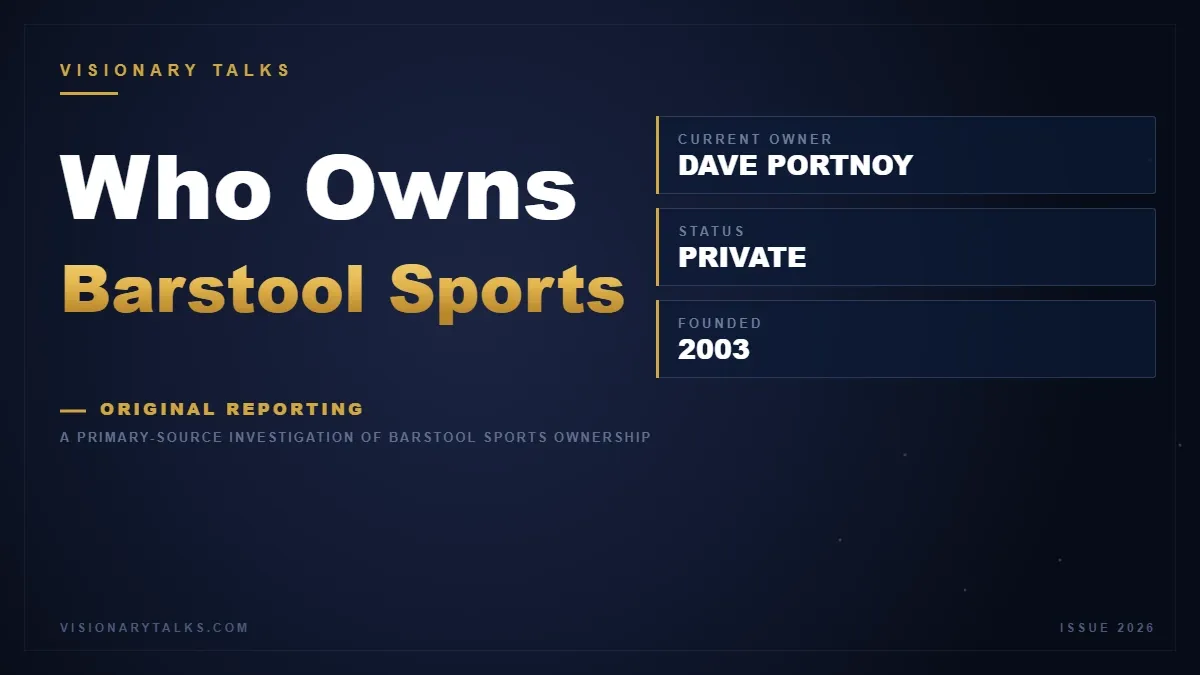
Barstool Sports is owned 100 percent by its founder Dave Portnoy as of 2026, following his buyback of the company from Penn Entertainment in August 2023. The media brand is privately held again, with Portnoy as the sole controlling owner through Barstool Sports LLC. There are no public shareholders, no private equity partners, and no corporate parent exercising control.
This ownership matters because it fundamentally reshaped Barstool’s strategy, risk tolerance, and cultural autonomy. For investors and operators, Barstool is a rare case of a founder reversing a large scale strategic exit and reclaiming full ownership. Understanding who owns Barstool is essential to understanding why the company behaves the way it does.
Who Owns barstool sports Right Now?
As of 2026, Barstool Sports is privately owned and controlled by Dave Portnoy, the company’s founder and long time public face. Portnoy holds 100 percent of the equity after reacquiring the brand from Penn Entertainment in a deal that stunned both media and gaming investors.
The transaction was not symbolic. Penn Entertainment sold Barstool back to Portnoy for a nominal amount, widely reported as one dollar, while retaining the right to receive a percentage of proceeds if Portnoy ever sells the company again in the future. Operational control, governance authority, and creative decision making all reverted fully to Portnoy.
There are no minority shareholders disclosed, no employee equity pool with voting power, and no outside board dictating strategic direction. Barstool today functions as a founder owned media company in the purest sense, with Portnoy acting as owner, executive decision maker, and brand governor.
Ownership Snapshot
| Entity |
Ownership Stake |
Notes |
| Dave Portnoy |
100% |
Sole owner after 2023 buyback from Penn Entertainment |
The Portfolio: The Illusion of Choice
One of Barstool Sports’ most underestimated strengths is its ability to appear decentralized while remaining tightly controlled. On the surface, Barstool looks like a chaotic collection of podcasts, social accounts, video shows, and personalities. In reality, it is a portfolio of brands operating inside a single ownership structure.
This illusion of choice allows Barstool to appeal to radically different audiences without diluting central control. Fans may follow only one podcast or personality and never consciously engage with Barstool as a corporate entity. From an ownership perspective, all roads still lead back to Portnoy.
Because there is no parent conglomerate demanding consistent brand safety standards, Barstool can allow each sub brand to push boundaries independently. Portnoy acts as a capital allocator, social arbiter, and final risk filter across the ecosystem.
Parent Company Brand Portfolio
| Brand |
Segment |
Positioning |
| Pardon My Take |
Sports podcast |
Mainstream sports audience with irreverent tone |
| Call Her Daddy (legacy) |
Culture podcast |
Demonstrated creator led breakout potential |
| Spittin’ Chiclets |
NHL media |
Niche sports community dominance |
| Barstool Bets |
Sports betting content |
High engagement gambling adjacent media |
| Barstool College Sports |
Youth sports culture |
Campus focused brand loyalty engine |
Founders and Ownership Timeline
To understand how unusual Barstool’s current ownership is, you need to start with its founding story. Barstool Sports did not begin as a venture backed startup or a digital media roll up. It started as a scrappy print publication funded largely by personal risk.
barstool sports Founders
Barstool Sports was founded in 2003 by Dave Portnoy in Boston. The original product was a free newspaper focused on sports betting odds, fantasy data, and sharp humor aimed at commuters.
Portnoy bootstrapped the business, handling sales, content, and distribution himself in the early years. What differentiated Barstool early was not technology or scale, but voice. The brand spoke like its audience at a time when most sports media sounded institutional.
As the internet ate print media, Barstool transitioned aggressively into blogs, video, and personality driven content. Importantly, Portnoy never ceded creative control during this transition, even as revenue and cultural relevance grew.
Ownership History Timeline
| Year |
Event |
Ownership Impact |
| 2003 |
Barstool Sports founded |
Dave Portnoy owns 100% |
| 2016 |
The Chernin Group acquires majority stake |
Portnoy becomes minority owner |
| 2020 |
Penn National Gaming buys 36% stake |
Gaming partnership begins |
| 2023 |
Penn Entertainment sells Barstool back |
Portnoy regains 100% ownership |
Current Leadership and CEO
Unlike many founder led companies that install professional management after scaling, Barstool remains tightly aligned to its original leadership ethos. Decision making is centralized, fast, and heavily influenced by audience response rather than spreadsheet optimization.
Dave Portnoy remains the dominant governing force. While there are operational executives running day to day functions, ultimate authority still runs through the founder.
Leadership Snapshot
| Role |
Name |
Since |
| Founder and Owner |
Dave Portnoy |
2003 |
| CEO |
Erika Nardini |
2016 |
Why This Ownership Structure Exists
Barstool’s ownership structure exists because it reflects what the business actually is. This is not a scalable SaaS platform or a regulated broadcast network. It is an attention driven media empire powered by personality, culture, and loyalty.
Conglomerate ownership proved incompatible with Barstool’s operating model. Risk committees, regulatory optics, and investor relations friction all undermined the brand’s ability to do what it does best, provoke engagement.
The Business Genius
From a strategic standpoint, Portnoy reclaiming full ownership was a rare but rational move. It removed brand misalignment with Penn’s gaming business and freed Barstool from the burden of serving two masters, its audience and a public market.
The structure allows Barstool to monetize through merchandise, live events, sponsorships, and creator economics without needing to justify decisions to external shareholders. Portnoy effectively trades financial leverage for cultural leverage, which is Barstool’s true moat.
The Risk
The downside of this structure is concentration risk. Barstool’s fortunes are deeply tied to Portnoy’s personal reputation, energy, and decision making. There is no governance buffer if leadership miscalculates.
Additionally, without institutional capital or a strategic parent, long term scaling depends entirely on internally generated cash flow. This limits acquisition velocity and diversification compared to venture backed competitors.
Tracing the Ownership Chain
Tracing Barstool’s ownership chain is refreshingly simple in 2026. There are no holding companies in the Caymans, no layered voting structures, and no dual class trickery.
Barstool Sports LLC sits at the operating level, fully owned by Dave Portnoy. There is no parent entity above Portnoy himself.
Ownership Layers
| Layer |
Owner |
Control |
| Barstool Sports |
Dave Portnoy |
100% |
| Ultimate Owner |
Dave Portnoy |
100% |
Because Barstool is private, there are no institutional shareholders to list. Control rests entirely with Portnoy, subject only to standard corporate and contractual obligations.
Details of the buyback were confirmed publicly by Penn Entertainment, whose filings and statements explain the strategic exit. Coverage from
Reuters reporting on Penn Entertainment selling Barstool back to Dave Portnoy remains the most authoritative summary of the transaction.
Penn Entertainment disclosed the divestment as part of its broader pivot toward ESPN Bet, outlined in its public communications and regulatory disclosures available via
SEC filings from Penn Entertainment.
Debunking the Common Misconception
Many people still believe Barstool Sports is owned by a large media conglomerate. This belief persists because of the company’s high profile partnerships and its three year ownership under a publicly traded gaming operator.
In reality, Barstool Sports is privately owned again after a rare founder buyback. Unlike most exits, this one moved ownership backward, not forward. Portnoy chose control over capital and reversed a multi billion dollar corporate relationship.
This is not a licensing arrangement or partial spin off. It is full ownership with a contractual revenue share clause attached only to a future sale, not current operations.
Key Takeaways for Entrepreneurs
- Founder control can be strategically superior when brand voice is the primary asset.
- Not all exits are final, ownership can be repurchased when incentives diverge.
- Cultural alignment matters more than capital efficiency in media businesses.
Barstool Sports is a reminder that ownership is not just a financial structure, it is a strategic decision. In reclaiming his company, Dave Portnoy bet that independence would outperform scale. As of 2026, Barstool’s private ownership is not an anomaly, it is the engine behind the chaos.