
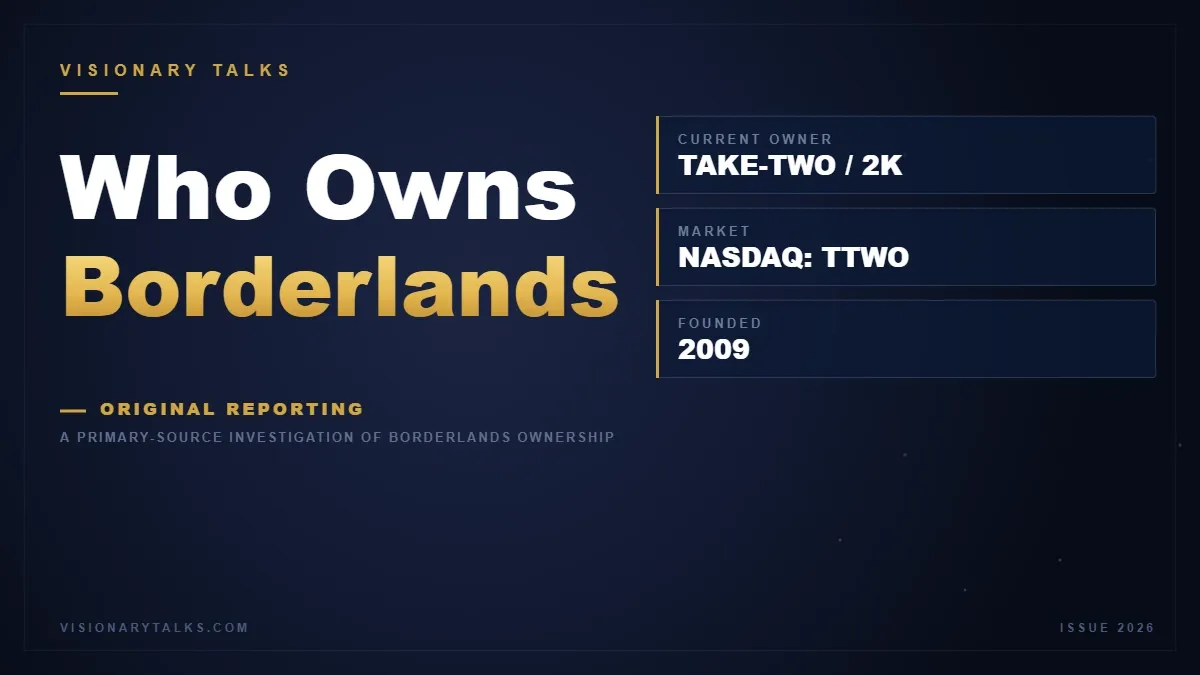
This ownership matters because Borderlands is not just a game series, it is a long-lived cash engine with cross-platform relevance, recurring DLC monetization, and film and licensing optionality. Knowing who controls it tells investors where the franchise cash flows land and how strategic decisions will be made over the next decade.
Who Owns BorderlandsRight Now?
Borderlands sits squarely inside Take-Two Interactive’s operating structure, under the 2K label that publishes franchises like NBA 2K and BioShock. After years of structural ambiguity due to Gearbox’s shifting corporate parents, ownership is now consolidated and clean.
In March 2024, Take-Two announced it would acquire Gearbox Entertainment from Embracer Group for approximately $460 million in cash and earn-outs. The deal brought Gearbox and its hit franchise Borderlands back under the same corporate roof as its publisher.
Today, Borderlands is not co-owned, licensed, or jointly managed. It is fully controlled by Take-Two Interactive, a publicly traded company listed on NASDAQ under the ticker TTWO.
Ownership Snapshot
| Entity | Ownership Stake | Notes |
|---|---|---|
| Take-Two Interactive Software, Inc. | 100% | Full ownership of Borderlands IP via 2K label |
| 2K Publishing | Operating control | Publishing, marketing, and franchise strategy |
The Portfolio: The Illusion of Choice
Take-Two is a master of brand compartmentalization. To players, Borderlands feels like a Gearbox creation, published by 2K, and stylistically separate from GTA or NBA 2K.
From an ownership perspective, this is intentional misdirection. The company uses labels to create creative autonomy while centralizing profit, legal control, and capital allocation at the parent level.
This illusion of independence allows Take-Two to run wildly different monetization models across franchises without confusing the market or diluting brand equity.
Parent Company Brand Portfolio
| Brand | Segment | Positioning |
|---|---|---|
| Grand Theft Auto | Open-world action | Flagship blockbuster franchise |
| NBA 2K | Sports simulation | Annualized live-service engine |
| Borderlands | Looter shooter RPG | Stylized narrative driven shooter |
| BioShock | Narrative FPS | Prestige single-player IP |
Founders and Ownership Timeline
To understand Borderlands ownership, you have to separate who created it from who owns it. Those two identities have diverged multiple times over the last fifteen years.
Borderlands Founders
Borderlands was created by Gearbox Software, founded in 1999 by Randy Pitchford, Brian Martel, Stephen Bahl, and Landon Montgomery. The studio built its reputation as a technically skilled FPS developer before launching Borderlands in 2009.
While Gearbox developed the game, Borderlands was published by 2K from day one. That publisher relationship laid the groundwork for Take-Two’s enduring control over the franchise.
Ownership History Timeline
| Year | Event | Ownership Impact |
|---|---|---|
| 2009 | Borderlands launches via 2K | IP aligned with Take-Two publishing control |
| 2013 | Gearbox remains independent | Development independent, publishing centralized |
| 2021 | Embracer acquires Gearbox | Studio ownership changes, IP remains tied to Take-Two |
| 2024 | Take-Two acquires Gearbox from Embracer | Full vertical ownership reunified |
Current Leadership and CEO
Borderlands does not operate as a standalone company, so its leadership structure mirrors Take-Two’s corporate hierarchy. Strategic decisions sit at the Take-Two and 2K level, with Gearbox functioning as a development arm.
The leadership alignment reduces friction between publisher and developer, a dynamic that historically caused delays and creative conflicts across the industry.
Leadership Snapshot
| Role | Name | Since |
|---|---|---|
| CEO, Take-Two Interactive | Strauss Zelnick | 2007 |
| President, 2K | David Ismailer | 2020 |
| Founder, Gearbox | Randy Pitchford | 1999 |
Why This Ownership Structure Exists
Take-Two’s ownership of Borderlands follows a vertically integrated media model. The company prefers to own the IP, the studio, and the publishing arm rather than rely on licensing.
This structure maximizes lifetime value per franchise and de-risks long development cycles that can exceed five years.
The Business Genius
By owning Borderlands outright, Take-Two controls sequel timing, monetization pacing, and platform strategy. The company can delay releases to optimize earnings windows or accelerate content if market conditions align.
It also enables transmedia experiments like film adaptations and licensing deals without negotiating with external rights holders.
The Risk
Vertical ownership concentrates risk. If a Borderlands installment underperforms, Take-Two absorbs the full hit rather than sharing downside with an independent studio.
Creative stagnation is another concern. Without external pressure, franchises can calcify and lose cultural relevance.
Tracing the Ownership Chain
Going one level up clarifies who ultimately controls Borderlands. The answer is not a private equity firm or holding company. It is public market shareholders.
Take-Two Interactive is a publicly traded corporation. Its strategic direction is shaped by management, but accountability runs to institutional investors.
Ownership Layers
| Layer | Owner | Control |
|---|---|---|
| Borderlands | 2K, Take-Two Interactive | 100% |
| Take-Two Interactive | Public shareholders | Variable |
Major institutional holders of Take-Two include firms like Vanguard and BlackRock, as disclosed in the company’s annual filings on SEC.gov. No single shareholder controls the company.
This dispersed ownership structure incentivizes predictable, repeatable franchises like Borderlands that can deliver multi-year revenue stability.
Debunking the Common Misconception
The most common misconception is that Borderlands is owned by Gearbox as an independent studio or that Embracer Group still owns it. Both are incorrect.
Gearbox is a developer, not the ultimate owner. Embracer exited the position entirely in 2024 as part of its balance sheet restructuring.
According to reporting by Reuters, Take-Two’s acquisition brought Gearbox and Borderlands fully back into its ecosystem, eliminating prior structural confusion.
Key Takeaways for Entrepreneurs
- Control of IP matters more than brand visibility. Publishing rights often equal ownership leverage.
- Vertical integration reduces friction but increases downside exposure.
- Clean ownership structures increase strategic flexibility and valuation multiples.
Borderlands is a case study in how long-lived intellectual property migrates toward capital strength over time. Creative origin stories matter, but balance sheets decide the endgame.
For founders and operators, the lesson is simple. If you want lasting control, own the IP. If you want scale, be prepared to sell it. Borderlands shows what happens when the two finally reunite.