
Key Takeaways
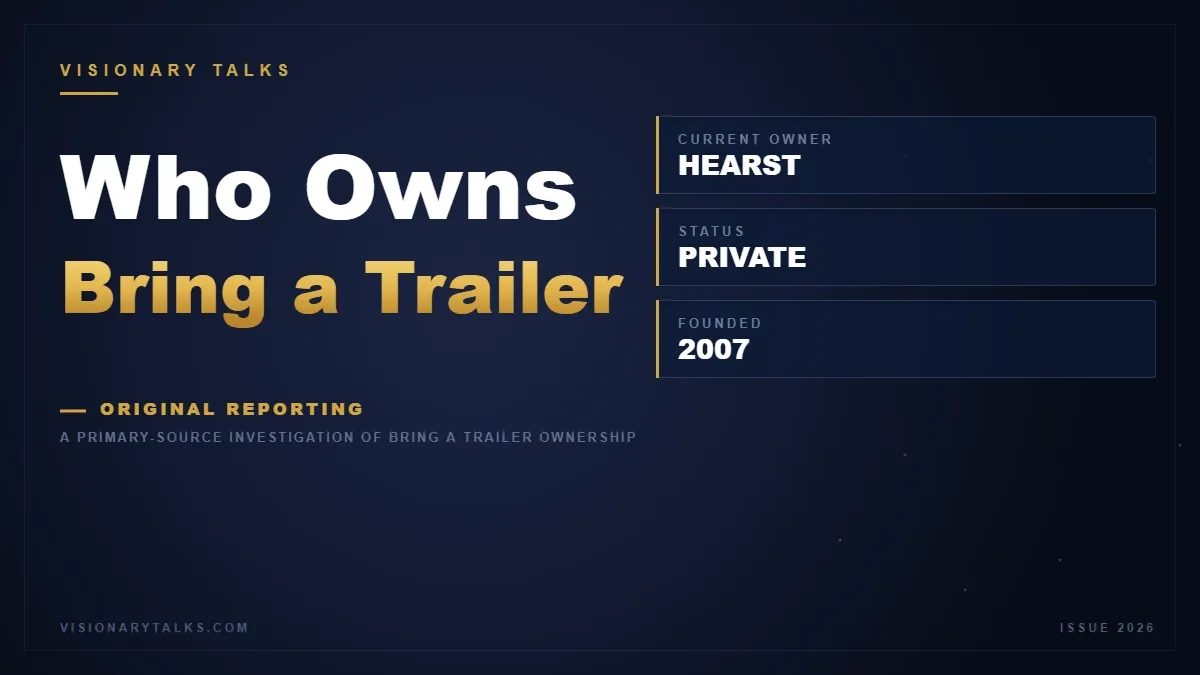
- Bring a Trailer is owned by Hearst Autos, not by an automaker, dealer group, or public company.
- Hearst acquired BaT in June 2020, but the purchase price was not publicly disclosed.
- Bring a Trailer founders Randy Nonnenberg and Gentry Underwood built the site before the Hearst deal.
- BaT generated $1.713 billion in total auction sales in 2025, but that is gross merchandise volume, not revenue.
- The business model is built around listing fees, buyer fees, curation, community trust, and transparent auction archives.
- My read: Hearst did not just buy an auction platform. It bought one of the strongest trust engines in the collector car market.
Who Owns Bring a Trailer Today?
Bring a Trailer is owned by Hearst Autos, which is part of Hearst. That means BaT ultimately sits inside a privately held media and information company, not inside a publicly traded marketplace operator like eBay or an automotive retailer like AutoNation.
The official acquisition announcement said Hearst Autos had acquired Bring a Trailer, a “digital auction platform and auto enthusiast community.” It also said BaT would continue to operate as an independent business led by Randy Nonnenberg and his team, with no planned personnel changes at the time of the deal (Autoweek).
That point matters. The ownership changed, but the brand’s public identity did not suddenly become “Hearst Auctions.” BaT still trades on its original reputation: curated listings, detailed descriptions, visible comment threads, and a community that often functions like a distributed due-diligence layer.
Bring a Trailer Ownership Structure
| Level | Entity | Role |
|---|---|---|
| Parent company | Hearst | Private media and information company |
| Automotive division | Hearst Autos | Owner of BaT and related automotive media assets |
| Operating brand | Bring a Trailer | Online auction marketplace for collector, classic, and enthusiast vehicles |
| Legal operating entity | Bring a Trailer Media, LLC | Entity referenced in BaT’s own terms and site materials |
| Public leader | Randy Nonnenberg | Co-founder and president |
BaT’s own terms identify Bring a Trailer Media, LLC, or BaTMedia, as the entity that owns or operates the digital services and owns the associated digital content and platform rights, subject to user content exceptions (Bring a Trailer Terms).
Bring a Trailer Founders: Who Started BaT?
Bring a Trailer was founded by Randy Nonnenberg and Gentry Underwood. The site launched in 2007 as a niche enthusiast blog, then evolved into a curated auction platform. BaT itself says the blog launched in 2007 and that BaT Auctions launched in 2014 (Bring a Trailer).
The original insight was simple but powerful. Instead of building another classified listing site, BaT created a place where cars were curated, discussed, challenged, and archived. That made the comment section part of the product.
In my view, this is why the site became more valuable than a normal vehicle marketplace. A car listing is replaceable. A trusted community with years of pricing history is much harder to replicate.
When Did Hearst Buy Bring a Trailer?
Hearst Autos announced the acquisition on June 25, 2020. The announcement framed the deal as a way to scale BaT’s technology, operations, products, and audience while preserving the parts of the company that made it valuable in the first place (Autoweek).
BaT’s own announcement to the community said the company had grown faster than expected and needed more operational and technical capacity. It also said Hearst owned automotive brands that mattered to enthusiasts, including Road & Track, Car and Driver, and Autoweek (Bring a Trailer).
Bring a Trailer Ownership Timeline
| Year | Event | Why It Matters |
|---|---|---|
| 2007 | Bring a Trailer launches as a blog | Built an enthusiast audience before becoming a marketplace |
| 2014 | BaT Auctions launches | The company shifts from content discovery to transaction infrastructure |
| 2020 | Hearst Autos acquires BaT | BaT gains a larger corporate owner and resources to scale |
| 2024 | BaT raises the standard 5% buyer fee cap to $7,500 | Shows the platform’s pricing power after years of demand growth |
| 2025 | BaT records $1.713 billion in total sales | Confirms BaT as one of the dominant online collector-car marketplaces |
| 2026 | BaT expands deeper into the UK market | Suggests Hearst is pushing the model internationally |
BaT reported 49,486 total listings, 40,465 sold listings, an 81.8% sale rate, and $1.713 billion in total sales for 2025 (Bring a Trailer).
How Does Bring a Trailer Make Money?
Bring a Trailer makes money primarily from listing fees, optional seller services, buyer fees, and related marketplace services. Sellers pay a $99 listing fee, with an optional Plus photo service listed at $330. Buyers pay either a 5% or 10% fee, depending on the auction category, with minimums and caps that vary by category (Bring a Trailer).
For most vehicle auctions, BaT’s standard buyer fee is 5%, capped at $7,500. In 2025, BaT moved certain categories, including motorcycles, parts, automobilia, wheels, ATVs, go-karts, and tractors, to a 10% buyer fee with a $4,000 cap (Bring a Trailer).
The important distinction is this: BaT’s $1.713 billion in 2025 sales is not BaT revenue. That number is marketplace sales volume. BaT’s actual revenue is the fee income layered on top of that activity, plus optional services and commercial partnerships. Since the company is privately held inside Hearst, BaT does not publicly disclose standalone revenue or profit.
My Estimate: How Big Is Bring a Trailer Financially?
I would not treat BaT’s total auction sales as revenue. That is the most common mistake I see in casual analysis of marketplace businesses.
Here is the cleaner way to think about it:
| Metric | Public Data or Estimate | Notes |
|---|---|---|
| 2025 total sales volume | $1.713 billion | Reported by BaT |
| 2025 total listings | 49,486 | Reported by BaT |
| 2025 sold listings | 40,465 | Reported by BaT |
| Seller listing fee | $99 | Standard listing fee |
| Standard buyer fee | 5% capped at $7,500 | Most vehicle categories |
| Select category buyer fee | 10% capped at $4,000 | Parts, motorcycles, wheels, and other categories |
| My revenue read | Likely tens of millions annually | Estimate, because fee caps and category mix prevent a simple 5% calculation |
A naive 5% of $1.713 billion would equal about $85.7 million, but that overstates the likely buyer-fee revenue because BaT caps the fee on higher-value transactions. On the other hand, listing fees, photography services, white-glove services, partnerships, and advertising-related opportunities add other revenue streams. My conclusion is that BaT is likely a high-margin, tens-of-millions revenue asset inside Hearst, but the exact number is not public.
Why Did Hearst Want Bring a Trailer?
My opinion is that Hearst bought Bring a Trailer for three reasons.
First, BaT turned automotive content into transactions. Traditional automotive media is good at attention, but BaT is good at intent. A person browsing Road & Track may be dreaming. A person bidding on BaT may be ready to wire money.
Second, BaT created a defensible trust layer. Completed auction results are archived, listings are detailed, and public comments expose issues that a normal classified listing might bury. Autoweek’s 2026 coverage of BaT’s UK expansion specifically pointed to detailed listings, staff curation, open comments, and public auction archives as part of the model (Autoweek).
Third, BaT gave Hearst a marketplace business that fits its broader shift beyond traditional publishing. Axios reported that Hearst has increasingly leaned on business-to-business and nontraditional media assets, with B2B operations becoming a majority profit contributor by 2024 (Axios).
Is Bring a Trailer Still Independent?
Operationally, BaT still presents itself as BaT. Ownership-wise, it is not independent. It is part of Hearst Autos.
The difference matters. A company can keep an independent editorial, product, and community identity while still being owned by a larger corporation. That appears to be the BaT model. Hearst bought the business, but the value of the acquisition depends on not damaging the culture that made BaT credible.
That is also the risk. If users feel the platform becomes too commercial, too dealer-heavy, or too detached from enthusiast norms, BaT’s biggest advantage could weaken. The inventory matters, but the community is the moat.
Is Bring a Trailer a Dealer or Auction House?
BaT is not a traditional car dealer or auctioneer in the way many consumers understand those terms. Its terms say BaTMedia is not an automobile broker, dealer, or traditional auctioneer and does not hold title, inspect vehicles, or take legal possession of listed vehicles (Bring a Trailer Terms).
That legal framing is important. BaT is primarily a platform and listing service. It facilitates auctions, content, bidding tools, and community discussion, while the vehicle transaction remains between buyer and seller.
The Bottom Line: Who Really Controls Bring a Trailer?
Bring a Trailer is owned by Hearst Autos, under the larger Hearst corporate umbrella. But the brand’s value still depends heavily on the system Randy Nonnenberg and Gentry Underwood built: curation, transparency, community commentary, and auction history.
My final read is this: Hearst owns the company, but the community still owns much of the trust. That is the fragile balance BaT has to maintain. If Hearst scales BaT without diluting its enthusiast credibility, the acquisition will look increasingly smart. If growth turns the site into just another high-volume vehicle marketplace, the asset becomes less special.
What I am watching next is BaT’s international expansion, especially the UK push, its fee structure, and whether the platform can keep serious collectors, dealers, casual enthusiasts, and skeptical commenters inside the same ecosystem without losing the culture that made it powerful in the first place.