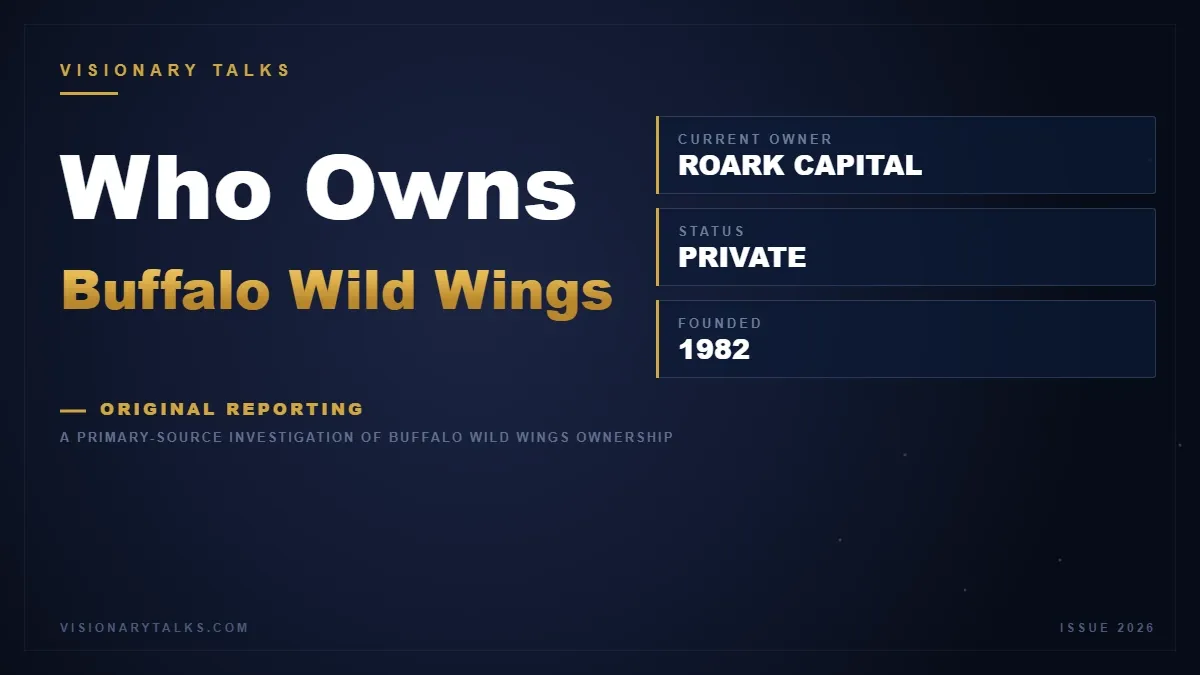
Buffalo Wild Wings is 100 percent owned by Inspire Brands, a private restaurant holding company backed and controlled by Roark Capital Group, as of September 2026. Inspire acquired it in 2018 in an all cash deal valued at approximately 2.9 billion dollars. The chain is not publicly traded, and that is the part now in play: Inspire filed confidentially for an initial public offering on May 8, 2026.
This ownership matters because Buffalo Wild Wings appears to consumers as a standalone sports bar brand, yet it operates within a multi brand platform that also controls Arby’s, Sonic, Jimmy John’s, Dunkin’, Baskin Robbins, and several other major restaurant chains. For investors and operators, this signals centralized capital allocation, shared infrastructure, and a scale driven strategy that goes far beyond wings and beer.
What changed in 2026
Buffalo Wild Wings did not change hands in 2026. Its owner filed to sell itself to the public, which is the first real movement in this ownership structure since 2018.
On May 8, 2026, Inspire Brands announced it had confidentially submitted a draft registration statement to the SEC for a proposed initial public offering. Roark Capital is reportedly seeking a valuation of roughly $20 billion, per CNBC, and Bloomberg reported the deal could raise up to $2 billion. Inspire disclosed a system of more than 33,300 restaurants across six brands and $33.4 billion in annual systemwide sales, with proceeds earmarked for debt repayment. Reporting at the time of the filing put Buffalo Wild Wings at 1,178 locations, the second smallest unit count in the portfolio after Baskin-Robbins.
Confidential is the operative word. A draft registration statement is not public, so neither Inspire's financials nor Buffalo Wild Wings' contribution to them can be read by outsiders. As of September 10, 2026 no public registration statement has been filed, and no price, share count or listing date has been set.
For this question the consequence is straightforward. An IPO is how a private equity firm gets its money out. If it completes, the honest answer to who owns Buffalo Wild Wings stops being Roark Capital and starts being whoever buys the stock.
In 2026, Inspire also began refranchising Buffalo Wild Wings itself, putting 83 company-owned locations up for sale across markets including Canada, Pennsylvania, the Northeast, South Texas, and Washington, D.C. (per FSR Magazine, 2026). Selling company-run stores to franchisees shifts more of the chain out of Inspire's direct ownership and into operators' hands, the same outward drift of ownership that runs through most big franchised brands.
Who Owns Buffalo Wild Wings Right Now?
Buffalo Wild Wings is wholly owned by Inspire Brands, which in turn is majority controlled by private equity firm Roark Capital Group. Inspire Brands was created in 2018 when Roark carved out Arby’s and used it as the foundation for a broader restaurant holding company.
The acquisition of Buffalo Wild Wings was a defining moment. Inspire acquired the company shortly after activist investors pressured BWW’s management to improve margins and sell the business. According to coverage from
Reuters reporting on the acquisition, Arby’s Restaurant Group agreed to purchase Buffalo Wild Wings for 157 dollars per share, representing a significant premium at the time.
After the deal closed, Arby’s Restaurant Group rebranded itself as Inspire Brands, then began acquiring additional platforms including Sonic, Jimmy John’s, Dunkin’, and Baskin Robbins. Buffalo Wild Wings now sits inside a portfolio that generates tens of billions in systemwide sales annually.
Ownership Snapshot
| Entity |
Ownership Stake |
Notes |
| Inspire Brands |
100% |
Private parent company of Buffalo Wild Wings |
| Roark Capital Group |
Controlling investor in Inspire |
Private equity owner and strategic controller |
The Portfolio: The Illusion of Choice
When I map the competitive landscape of American quick service and casual dining, I often see different logos that tell the story of competition. Underneath, however, many of them roll up to the same capital pools. Inspire Brands is one of the clearest examples of this consolidation.
Buffalo Wild Wings is positioned as a high energy sports bar with alcohol service and long dwell times. Arby’s targets traditional quick service sandwich customers. Sonic focuses on drive in convenience. Dunkin’ dominates coffee and breakfast traffic. To consumers, these brands feel distinct. To Roark, they are components in a diversified restaurant platform.
This is how the illusion of choice is engineered at scale. Brand identity remains independent while finance, procurement, technology, franchising, and executive oversight are centralized.
Parent Company Brand Portfolio
| Brand |
Segment |
Positioning |
| Buffalo Wild Wings |
Casual dining sports bar |
Wings, beer, live sports experience |
| Arby’s |
Quick service restaurant |
Roast beef and premium sandwiches |
| Sonic |
Drive in quick service |
Carhop service and drink innovation |
| Dunkin’ |
Coffee and breakfast |
High frequency beverage led traffic |
| Jimmy John’s |
Fast casual sandwiches |
Speed and delivery |
| Baskin Robbins |
Dessert and ice cream |
Impulse and treat occasions |
Founders and Ownership Timeline
To understand why Buffalo Wild Wings ended up in a private equity backed portfolio, you have to start in 1982. The founders did not set out to build a multi billion dollar acquisition target. They wanted New York style chicken wings in Ohio.
Buffalo Wild Wings Founders
Buffalo Wild Wings was founded in 1982 by Jim Disbrow and Scott Lowery. The two friends were transplants from Buffalo, New York, who were unable to find authentic Buffalo style wings near Kent State University in Ohio.
They opened the first location under the name Buffalo Wild Wings and Weck, referencing the beef on weck sandwich popular in western New York. The original concept was simple, wings, sports on television, and a casual atmosphere focused on community and game day energy.
The concept resonated. Franchising accelerated growth through the 1990s, and Buffalo Wild Wings went public in 2003. For more than a decade, it operated as an independent publicly traded company before activist pressure and strategic challenges opened the door to a sale.
Ownership History Timeline
| Year |
Event |
Ownership Impact |
| 1982 |
Company founded in Ohio |
Privately owned by founders |
| 2003 |
Initial public offering |
Became publicly traded company |
| 2017 |
Acquisition announced by Arby’s Restaurant Group |
Agreement to sell for 2.9 billion dollars |
| 2018 |
Deal closed, Inspire Brands formed |
BWW becomes 100% owned subsidiary |
The next row in that timeline has not been written yet. On May 8, 2026 Inspire Brands filed confidentially for an IPO at a reported target valuation near $20 billion, which if completed would move Buffalo Wild Wings from private equity ownership to public shareholders after eight years.
Current Leadership and CEO
While Inspire Brands owns Buffalo Wild Wings, operational leadership sits both at the brand level and at the holding company level. This dual structure allows Inspire to set financial targets while brand executives manage menu innovation, marketing, and franchise relationships.
As of 2026, Paul Brown serves as Chief Executive Officer of Inspire Brands. Brown previously served as CEO of Arby’s and became the founding CEO of Inspire after the Buffalo Wild Wings acquisition. Buffalo Wild Wings itself operates under a brand president who reports into the Inspire platform.
Leadership Snapshot
| Role |
Name |
Since |
| CEO, Inspire Brands |
Paul Brown |
2018 |
| Brand President, Buffalo Wild Wings |
Bill Kershner |
2023 |
Why This Ownership Structure Exists
The ownership model behind Buffalo Wild Wings is a classic private equity roll up platform. Roark Capital specializes in acquiring franchise heavy consumer brands with strong cash flow profiles. It then integrates them under shared systems to improve unit economics and long term exit optionality.
Buffalo Wild Wings fits this thesis neatly. It has a mix of company owned stores and franchise locations, established brand recognition, alcohol driven margins, and real estate leverage. Under Inspire, it benefits from bulk purchasing power, centralized digital infrastructure, and cross brand franchising expertise.
The Business Genius
The brilliance of this structure is capital efficiency. By pooling brands under Inspire, Roark lowers administrative duplication while preserving brand level differentiation. Procurement is consolidated. Technology is shared. Executive oversight scales across concepts.
For operators, this often means better supply chain contracts and improved digital ordering capabilities. For Roark, it means enhanced EBITDA across the entire platform. If Inspire were ever taken public, the combined scale could command a valuation multiple higher than individual concepts might receive on their own.
The Risk
The risk lies in leverage and complexity. Inspire has historically used significant debt to finance acquisitions, a common strategy in private equity buyouts. Restaurant downturns, labor inflation, or declining traffic across multiple brands could stress the platform simultaneously.
There is also brand dilution risk. If centralization goes too far, local authenticity may erode. Buffalo Wild Wings thrives on sports culture and in store energy. Over standardization could undermine that edge.
Tracing the Ownership Chain
To fully answer who owns Buffalo Wild Wings, we need to go one level higher than Inspire. Inspire Brands is not publicly traded. It is controlled by Roark Capital, a private equity firm headquartered in Atlanta.
Roark Capital manages multiple private equity funds and specializes in franchise and multi location businesses. According to Inspire Brands corporate information available on its official site at
Inspire Brands company overview, the portfolio includes more than 30,000 restaurants worldwide across its concepts.
This means Buffalo Wild Wings ultimately sits inside a financial structure controlled by limited partners who invest in Roark funds. Those investors can include pension funds, endowments, sovereign wealth funds, and high net worth individuals.
Ownership Layers
| Layer |
Owner |
Control |
| Buffalo Wild Wings |
Inspire Brands |
100% ownership |
| Inspire Brands |
Roark Capital Group |
Controlling private equity stake as of September 2026 |
| Roark Capital Group |
Its limited partners |
Private fund, holdings disclosed at the firm's discretion |
| Pending |
Public shareholders |
Only if the IPO filed 8 May 2026 completes; nothing priced yet |
Because Inspire is privately held, there are no public institutional shareholders to review through SEC filings. Instead, control rests with Roark and its fund investors. Governance is handled through private board structures rather than public market disclosure requirements.
Debunking the Common Misconception
One of the most persistent misconceptions I encounter is that Buffalo Wild Wings is an independent franchise system owned by franchisees. While franchisees own and operate many individual locations, they do not own the brand.
The intellectual property, trademarks, core operating standards, and franchising authority are controlled by Inspire Brands. Franchisees pay royalties and adhere to corporate guidelines. Strategic decisions about menu shifts, marketing campaigns, and long term capital moves are made at the Inspire level, not by a council of independent operators.
This distinction matters. Owning a franchise unit is not the same as owning the company. Thousands of entrepreneurs may operate Buffalo Wild Wings locations, but ultimate ownership is centralized under Inspire and Roark.
Key Takeaways for Entrepreneurs
- Do not assume brand independence just because a company feels standalone, always trace ownership up to the capital source.
- Private equity platforms can dramatically change operational priorities, focus often shifts toward margin expansion and exit strategy.
- Franchise opportunities are influenced heavily by the parent company’s financial structure, so study the full ownership chain before investing.
Buffalo Wild Wings began as a simple craving for authentic wings in Ohio. Today, it is a strategic asset inside one of the most powerful private restaurant portfolios in the world. If you walk into a game day crowd thinking you are supporting a local sports bar brand, you are really stepping into a system engineered by Inspire Brands and ultimately controlled by Roark Capital. For investors and founders, that ownership story is the real headline behind the wings.