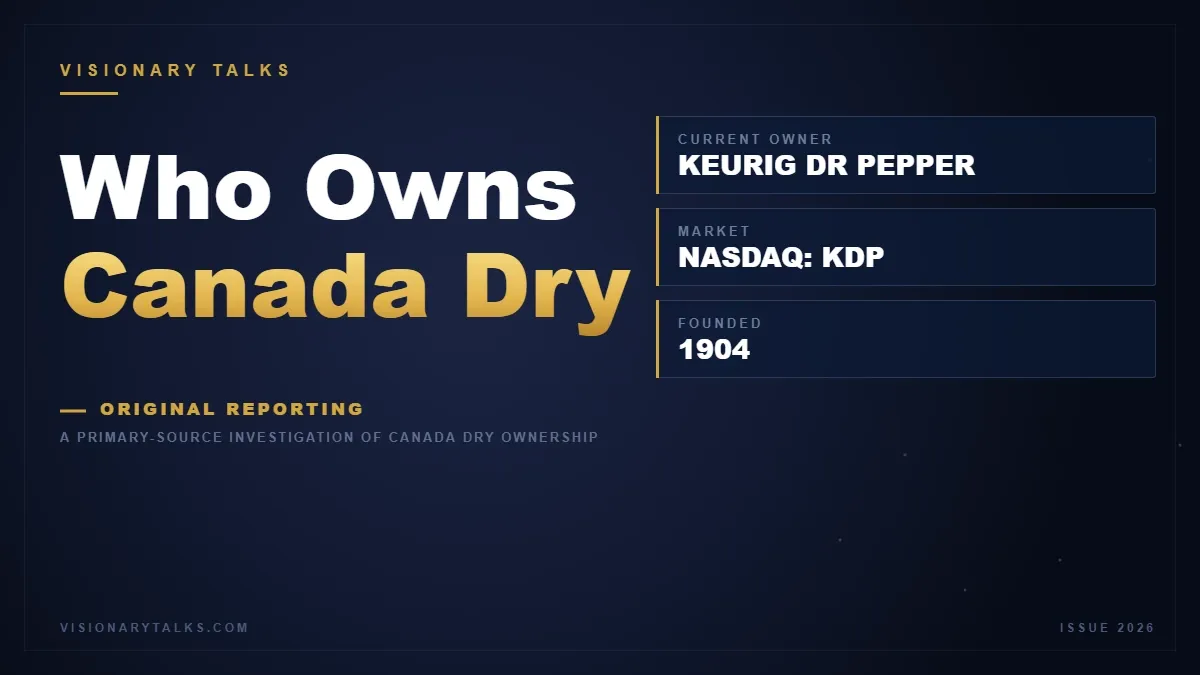
Canada Dry is owned by Keurig Dr Pepper Inc. (NASDAQ: KDP), which holds 100 percent of the brand in the United States and most international markets as of September 2026. It is not owned by Coca Cola or PepsiCo, and it is not independent. One thing is about to change: KDP is splitting itself in two, and Canada Dry has been assigned to the beverage half, which keeps the KDP listing.
Confused about which cola giant makes what? See the full
Coke vs Pepsi vs Dr Pepper brand map, covering 60 US beverage brands and their true parents.
This ownership matters because Canada Dry sits at the crossroads of legacy soda economics and modern portfolio strategy. For investors and operators, it offers a case study in how large beverage groups use heritage brands to anchor cash flow while competing in a fragmented, slow growth category.
What changed in 2026
Canada Dry itself did not change hands in 2026. Its owner did two things that will change what owning Canada Dry means.
First, the family money left. On June 11, 2026, JAB BevCo B.V., a subsidiary of JAB Holding Company, announced it had sold its remaining stake in Keurig Dr Pepper, roughly 59.1 million shares or about 4.3 percent of KDP's outstanding common stock, through an unregistered block trade run by J.P. Morgan Securities LLC. That was JAB's whole remaining position. The investment group that engineered the 2018 merger which created Canada Dry's current parent no longer owns any of it.
Second, the parent is being taken apart. KDP completed its roughly 15.7 billion euro acquisition of JDE Peet's in April 2026, and in a leadership update dated June 23, 2026 it confirmed it is separating into two independent public companies, Beverage Co. and Global Coffee Co., now targeted for early 2027 rather than the end of 2026 pace originally signalled in February 2026. Canada Dry is named in the Beverage Co. portfolio alongside Dr Pepper, 7UP, Mott's, A&W, Peñafiel, GHOST, Snapple, Clamato and Core Hydration. Global Coffee Co. takes Keurig, Peet's, L'OR and Jacobs, and is structured as the tax-free spin-off, so Beverage Co. is the entity that keeps the existing KDP listing.
KDP also said Tim Cofer stays as chief executive through the separation and will then lead Beverage Co., the company that will own Canada Dry.
Who Owns Canada Dry Right Now?
As of September 2026, Canada Dry is wholly owned by Keurig Dr Pepper Inc., the North American beverage company formed in 2018 through the merger of Dr Pepper Snapple Group and Keurig Green Mountain. KDP consolidated its brand portfolio under one corporate umbrella, and Canada Dry is one of its core carbonated soft drink assets.
Keurig Dr Pepper is publicly traded, which means Canada Dry ultimately answers to KDP shareholders. According to Keurig Dr Pepper investor filings and its corporate profile, the company manages a portfolio that includes Dr Pepper, 7UP in the United States, Sunkist in certain territories, A&W, RC Cola, Snapple, and Canada Dry among many others. Corporate details and public filings can be verified through the
SEC EDGAR database for Keurig Dr Pepper Inc.
Ownership Snapshot
| Entity |
Ownership Stake |
Notes |
| Keurig Dr Pepper Inc. |
100% |
Parent company, publicly traded on NASDAQ as KDP |
| KDP Shareholders |
Public float |
Institutional and retail investors own KDP shares |
The ownership is straightforward at the brand level. Canada Dry is not a joint venture. It is not licensed from Coca Cola. It is not privately held. It is a fully controlled operating brand within KDP.
There is one wrinkle worth knowing. KDP's Canadian operating company is legally named Canada Dry Mott's Inc., doing business as Keurig Dr Pepper Canada. The brand that stopped being Canadian decades ago still supplies the corporate name on the parent's Canadian subsidiary.
The Portfolio: The Illusion of Choice
When shoppers walk down the beverage aisle, they often perceive distinct, competing brands. Canada Dry ginger ale feels differentiated from Dr Pepper or 7UP. Yet many of those brands trace back to the same balance sheet.
Keurig Dr Pepper structures its portfolio across carbonated soft drinks, ready to drink teas, juices, mixers, enhanced waters, and coffee systems. The company competes against Coca Cola and PepsiCo in some categories, while also partnering with independent bottlers and distributors in others.
Parent Company Brand Portfolio
| Brand |
Segment |
Positioning |
| Canada Dry |
Carbonated Soft Drinks |
Premium ginger ale and mixers |
| Dr Pepper |
Carbonated Soft Drinks |
Flagship flavored soda |
| 7UP US |
Lemon Lime Soda |
Clear soda alternative |
| Snapple |
Ready to Drink Tea |
Fruit and tea beverages |
| Keurig |
Single Serve Coffee Systems |
At home brewing platform |
This brand architecture creates what I call the illusion of choice. From the outside, Canada Dry competes as its own entity. From the inside, it is a strategic node in a diversified beverage machine.
KDP uses Canada Dry heavily within the premium mixer space, particularly for tonic water and club soda. This creates cross category leverage that goes beyond retail soda aisles and into bars, restaurants, and hospitality channels.
Founders and Ownership Timeline
To understand how Canada Dry became a cog in a multibillion dollar corporation, we need to rewind more than a century.
Canada Dry Founders
Canada Dry was founded in 1904 by Canadian pharmacist and chemist John J. McLaughlin in Toronto, Ontario. McLaughlin initially developed the formula after experimenting with ginger ale recipes and refining the sweetness level to create a less sugary, more champagne like flavor.
The name Canada Dry reflected national pride and the dry style of the ginger ale. The brand gained international popularity, especially during Prohibition in the United States, when ginger ale was used to mask the taste of bootleg spirits.
Ownership History Timeline
| Year |
Event |
Ownership Impact |
| 1904 |
Founded by John J. McLaughlin |
Privately owned Canadian business |
| 1923 |
Public listing in the United States |
Access to larger capital markets |
| 1984 |
Acquired by Del Monte |
Became part of diversified food company |
| 2000 |
Cadbury Schweppes acquires Snapple Group |
Canada Dry placed inside global beverage portfolio |
| 2008 |
Dr Pepper Snapple Group spun off |
Canada Dry under DPS public company |
| 2018 |
DPS merges with Keurig Green Mountain |
Canada Dry becomes part of Keurig Dr Pepper |
The most important strategic shift occurred in 2018. The $18.7 billion merger between Dr Pepper Snapple Group and Keurig Green Mountain created Keurig Dr Pepper. The transaction was backed by JAB Holding Company, the European investment group that focuses on consumer brands, and was widely covered in financial press including
Reuters reporting on the formation of Keurig Dr Pepper.
That deal consolidated hot and cold beverages under one corporate roof, significantly boosting scale and distribution power. Canada Dry moved seamlessly into the new corporate entity because it was already inside Dr Pepper Snapple Group.
Current Leadership and CEO
Canada Dry does not have its own standalone CEO in the way a public company would. Instead, brand management sits within the broader Keurig Dr Pepper leadership structure.
Leadership Snapshot
| Role |
Name |
Since |
| CEO, Keurig Dr Pepper |
Timothy P. Cofer |
2023 |
| CFO, Keurig Dr Pepper |
Paige B. Clements |
2022 |
Timothy P. Cofer became CEO of Keurig Dr Pepper in 2023 after serving in senior roles within the company and previously at Mondelēz International. Under his leadership, KDP has focused on margin expansion, pricing power, and selective portfolio innovation.
For operators, the key insight is this. Canada Dry is a managed brand inside a holding structure. Its growth targets, innovation budgets, and distribution strategy are set by KDP executives looking at total portfolio performance, not just one label.
Why This Ownership Structure Exists
Canada Dry’s position inside Keurig Dr Pepper reflects the classic beverage conglomerate model. Scale in bottling, procurement, shelf space, and distribution is everything in this industry.
Carbonated soft drinks are mature and capital intensive. By embedding Canada Dry within a diversified beverage platform, KDP reduces volatility and generates predictable cash flow that can be reinvested into emerging categories such as energy drinks and premium coffee.
The Business Genius
The genius is operating leverage. Manufacturing plants, trucking networks, and retail contracts can service multiple brands simultaneously. Canada Dry benefits from shared advertising infrastructure and negotiated shelf space agreements that would be nearly impossible for a standalone ginger ale company to secure at the same scale.
There is also portfolio hedging. If sparkling water demand increases or consumer soda preferences shift, KDP can reallocate resources across brands without risking total category exposure.
The Risk
The risk is brand dilution and strategic neglect. In a large portfolio, priority often goes to faster growing categories such as energy or ready to drink coffee.
If management underinvests in Canada Dry innovation, competitors or private labels can chip away at premium positioning. Regulatory shifts affecting sugary beverages also pose structural risk across the entire carbonated segment.
Tracing the Ownership Chain
To truly answer who owns Canada Dry, we must go one level higher. Keurig Dr Pepper itself has its own ownership structure shaped by institutional investors and influential shareholders.
Ownership Layers
| Layer |
Owner |
Control |
| Canada Dry |
Keurig Dr Pepper Inc. |
100% |
| Keurig Dr Pepper Inc. |
Public shareholders |
100% public float as of September 2026, no blockholder |
| Canada Dry Mott's Inc. (dba Keurig Dr Pepper Canada) |
Keurig Dr Pepper Inc. |
Canadian operating subsidiary |
| From early 2027 (planned) |
Beverage Co. |
Retains the KDP listing, takes Canada Dry |
As of September 2026, Keurig Dr Pepper is held almost entirely by institutional investors. Major shareholders include large asset managers such as Vanguard Group, BlackRock, and State Street, each holding significant minority stakes through index and actively managed funds.
JAB Holding Company, the investment vehicle associated with the Reimann family, held a substantial position from the 2018 merger it orchestrated, and sold it down in stages over the following years. That story ended on June 11, 2026, when JAB BevCo B.V. sold the last roughly 59.1 million shares, about 4.3 percent of the company, in a block trade and fully exited. Any page telling you JAB is still a Keurig Dr Pepper stakeholder is describing the position as it stood before June 2026.
This means Canada Dry is now indirectly controlled by dispersed institutional capital and nothing else. There is no founding family, no strategic blockholder, and no single individual who owns Canada Dry outright. Control flows through the board and executive team of Keurig Dr Pepper, and from early 2027 it is planned to flow through the board of Beverage Co. instead.
Debunking the Common Misconception
The two most common misconceptions are that Canada Dry is still a small independent Canadian brand or that it is owned by Coca Cola. Both are incorrect.
Canada Dry has not been independent for decades. It has moved through a series of corporate parents, from Del Monte to Cadbury Schweppes to Dr Pepper Snapple Group, before landing inside Keurig Dr Pepper.
It is also not part of the Coca Cola portfolio. Coca Cola owns brands such as Coca Cola, Sprite, Fanta, and Schweppes in many global markets, but Canada Dry in the United States belongs to Keurig Dr Pepper. Confusion sometimes arises because distribution agreements vary by country, yet the core brand ownership in North America is firmly under KDP.
Key Takeaways for Entrepreneurs
- Brand heritage alone does not guarantee independence, over time many iconic labels migrate into larger platforms for scale and capital.
- Distribution and shelf space are strategic moats, embedding within a conglomerate can be more defensible than remaining standalone in a mature industry.
- Ownership transparency matters, investors and operators should always trace control back to the ultimate parent company and major shareholders.
Canada Dry may sound proudly Canadian and distinctly independent, but as of September 2026 it is a fully owned brand inside Keurig Dr Pepper, a publicly traded beverage powerhouse that is about to split in half. For founders and investors, the lesson is clear. Consumer brands often outlive their original owners, and the ultimate winners in mature categories are usually the platforms that control distribution, capital, and portfolio strategy at scale.