
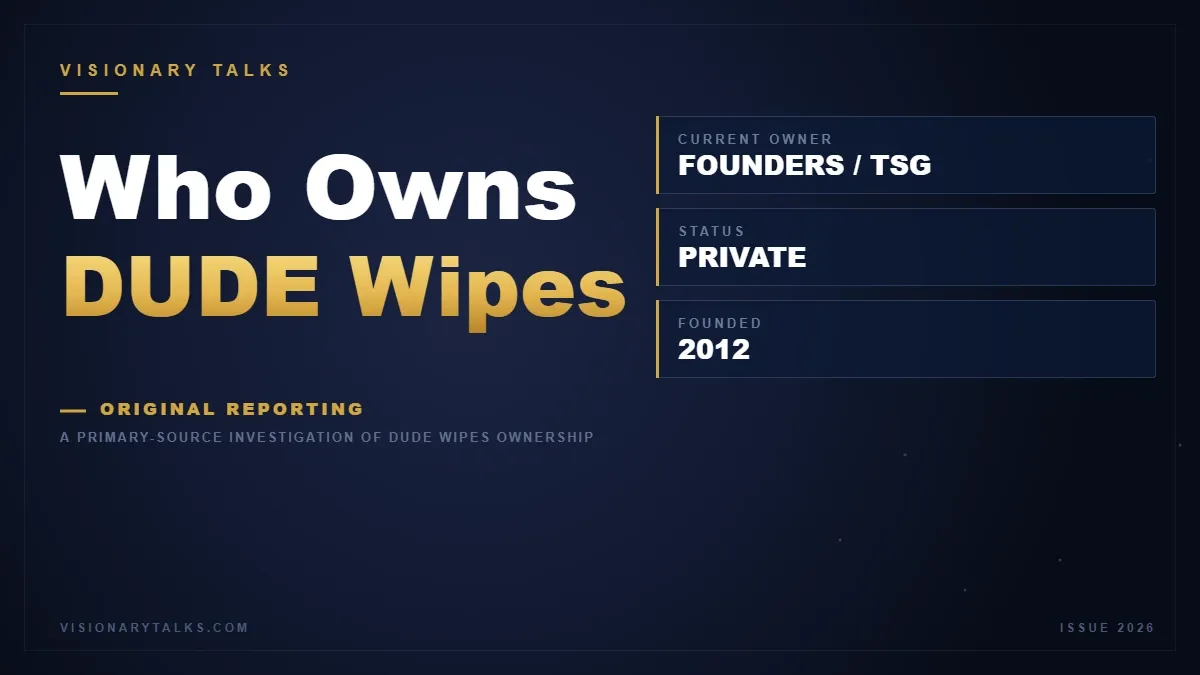
Who Owns DUDE Wipes Right Now?
DUDE Wipes is the brand. DUDE Products, Inc. is the company that owns the brand, controls the cash flows, and decides the long-term strategy.
The Portfolio Effect: This Is a Single-Brand Platform, Not a Giant Conglomerate
DUDE Wipes is not a big consumer conglomerate with dozens of subsidiaries. It is closer to a single-brand platform expanding into adjacent categories and new retail channels.
At the ownership layer above it, the key institutional backer is TSG Consumer Partners, a consumer-focused private equity firm that invests in a wide range of brands across beauty, food, beverage, retail, and fitness.
DUDE Products brand portfolio
| Brands (under DUDE Products) | Year launched | Estimated value or revenue signal |
|---|---|---|
| DUDE Wipes (signature flushable wipes) | 2012 | Reporting has placed the business at about $200M plus annual scale in recent years (private, not audited publicly) |
| DUDE Wipes line extensions and retailer exclusives | 2010s to 2020s | Sales and unit growth discussed publicly, but per-product revenue is not disclosed |
TSG Consumer Partners portfolio context (selected examples)
TSG is not a parent company in the Procter and Gamble sense. It is an investment firm that often buys minority or majority stakes in consumer businesses.
| Brands (TSG partner companies) | Year invested | Estimated value or revenue signal |
|---|---|---|
| Planet Fitness | 2012 | TSG involvement documented from 2012; company later went public |
| Dutch Bros | 2018 | Minority stake reported in deal announcements; financial terms not publicly disclosed |
| e.l.f. Cosmetics | 2011 | Minority investment reported; terms not publicly disclosed |
| DUDE Wipes | 2025 | Strategic growth investment; founders retained significant stakes |
This portfolio context matters because it hints at what DUDE Wipes can become under private equity ownership. A larger platform, new categories, broader distribution, and more operational muscle.
The Origin Story: How It Happened
DUDE Wipes founders
DUDE Wipes was founded by four lifelong friends: Sean Riley, Brian Wilkin, Ryan Meegan, and Jeff Klimkowski. They started the company in Chicago around a simple insight. Wet cleans better than dry, but category marketing was dated and not aimed at men.
Over time, Sean Riley became the public face as “Chief Executive Dude,” while the brand leaned hard into humor and taboo-breaking marketing that made a private problem feel normal to buy.
The ownership timeline
DUDE Wipes did not go through a classic acquisition. It went through two defining capital events.
2015: Mark Cuban enters the cap table (minority stake)
On Shark Tank, Mark Cuban invested $300,000 for 25 percent of the company. This is the first widely reported outside equity check tied directly to DUDE’s rise into mainstream awareness.
2016 to 2024: Founder-led scaling and retail expansion
The company scaled into major retail distribution and grew into a sizable business, with reporting placing it around $200M annual scale.
June 23, 2025: TSG Consumer invests (strategic growth investment)
DUDE Wipes announced a strategic growth investment from TSG Consumer Partners. The company stated the founders retained significant ownership stakes and continued to lead in their executive roles.
Was it a hostile takeover?
No. Everything publicly reported points to a negotiated growth partnership. Deal size, valuation, and ownership percentage were not publicly disclosed, which is common in private equity minority deals.
The Strategy: Why This Ownership Structure Exists
DUDE Wipes sits in a category where incumbents often win by default. The company hacked the category by treating wipes like a modern consumer brand.
This is not vertical integration, it is a category expansion platform
Vertical integration would mean buying factories, raw material supply, or logistics to control the supply chain.
DUDE’s play is different. Turn one hero product into a platform that can win shelf space, grow household penetration, and expand into adjacent hygiene moments.
Why TSG wanted this brand
Private equity firms like TSG look for a repeatable pattern.
- A brand with clear consumer love and distribution momentum
- Growth capital plus operational playbooks
- Channel and category expansion
- A later exit through a strategic sale or public market path
DUDE’s partnership messaging emphasized accelerating expansion, and public reporting highlighted strong retail growth in recent years.
Why the founders would take the money
At DUDE’s scale, constraints are less about product ideas and more about speed.
- Retail expansion and slotting economics
- Supply chain and inventory financing
- New product launches with meaningful marketing spend
- Hiring senior operators who have scaled consumer brands before
The structure also preserves founder upside. The founders stayed in leadership and retained meaningful ownership.
The quiet risk: flushable credibility and category scrutiny
Wipes brands can face scrutiny around flushable claims and plumbing impact. A brand trying to become a long-term household staple has to manage that risk carefully.
Institutional capital can help here by pushing stronger compliance, messaging discipline, and risk management before a future exit.
Who Owns the Owner? The Inception Layer
DUDE Products, Inc. is private
DUDE Products, Inc. is privately held. That means there is no ticker, no market cap, and no mandatory public shareholder disclosure.
The practical cap table (what is publicly known)
| Owner or stakeholder | Whole ownership or partial stake | What we know publicly |
|---|---|---|
| Founders (Riley, Meegan, Klimkowski, Wilkin) | Effective control | Founders retained significant ownership and leadership roles post-TSG investment |
| TSG Consumer Partners | Partial stake | Strategic growth investment announced June 23, 2025; exact percentage not disclosed |
| Mark Cuban | Partial stake | Invested $300,000 for 25 percent in 2015; current percentage not disclosed publicly |
Who owns TSG Consumer Partners?
TSG Consumer Partners is private. Like most private equity firms, it is controlled by its partners and funded by institutional limited partners such as pensions, endowments, and insurers.
Key Takeaways for Entrepreneurs
- Own the narrative, not just the product. DUDE turned a commodity purchase into a brand decision, and that brand equity became financeable.
- The best exit is optionality. A founder can bring in capital while staying in control if the company has leverage.
- Creator-style marketing scales best with institutional systems. Private equity money is not only cash. It is also hiring power, retail relationships, and operational discipline that can unlock the next growth phase.