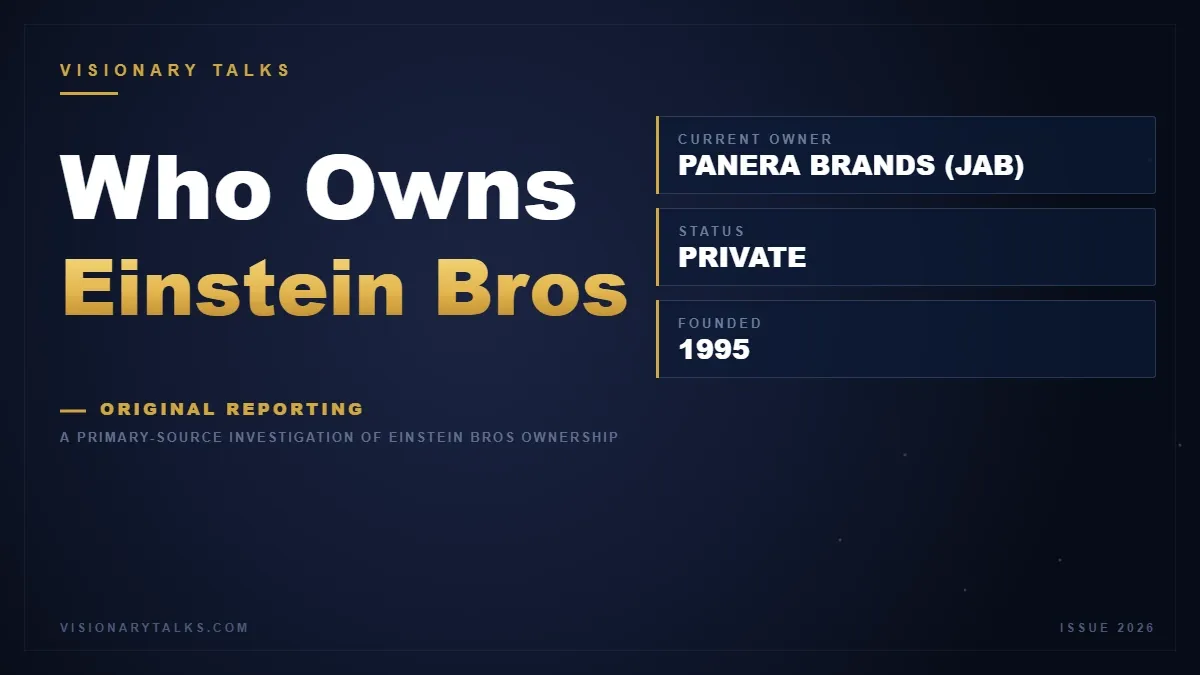
Einstein Bros. Bagels is owned 100 percent by Panera Brands, which itself is controlled by JAB Holding Company, the Luxembourg based investment firm chaired by the Reimann family. As of 2026, Einstein Bros operates as a subsidiary within Panera Brands, alongside Panera Bread and Caribou Coffee, with ultimate ownership resting under JAB’s private portfolio of global food and beverage assets.
That ownership matters more than most customers realize. What looks like a standalone neighborhood bagel chain is in fact part of a global coffee and bakery empire managed by one of the most sophisticated consumer investors in the world. For investors and operators, understanding that chain of control changes how you evaluate its scale, strategy, and competitive position.
Who Owns Einstein Bros Right Now?
Einstein Bros is not publicly traded. It does not have independent shareholders, nor does it operate as a franchise owned by disparate investors in the way many assume. The brand sits inside Panera Brands, which is wholly controlled by JAB Holding Company through its investment vehicles.
Panera Brands was formed to combine Panera Bread, Caribou Coffee, and Einstein Bros into a single platform. The group is privately held after JAB took Panera Bread private in 2017 in a transaction valued at approximately 7.5 billion dollars, according to reporting from
Reuters coverage of the acquisition. Einstein Bros became part of this broader platform through its earlier combination with JAB controlled bakery assets.
JAB Holding is not a passive financial investor. It operates as a long term strategic owner focused on premium consumer brands. That means Einstein Bros is managed within a capital allocation and operational framework designed for scale, cross brand efficiencies, and margin optimization.
Ownership Snapshot
| Entity |
Ownership Stake |
Notes |
| Panera Brands |
100% |
Direct parent company of Einstein Bros |
| JAB Holding Company |
100% of Panera Brands |
Private investment firm controlled by the Reimann family |
The Portfolio: The Illusion of Choice
Walk into an airport and you might see Einstein Bros, Panera Bread, and Caribou Coffee all competing for breakfast traffic. Most consumers assume they are independent competitors. In reality, they share a common ultimate owner.
This is a classic portfolio strategy. JAB has built a global coffee and bakery powerhouse by acquiring category leaders and positioning them as distinct consumer choices. The brands compete at the surface level, but capital and strategic direction flow from the same source.
Panera Brands was created to house these assets under one umbrella, theoretically to prepare for a public offering. As of 2026, the company remains privately held, although it has explored public market options in recent years.
Parent Company Brand Portfolio
| Brand |
Segment |
Positioning |
| Panera Bread |
Fast casual bakery cafe |
Premium soups, salads, sandwiches, bakery |
| Einstein Bros Bagels |
Quick service breakfast |
Bagels, shmears, breakfast sandwiches |
| Caribou Coffee |
Specialty coffee chain |
Premium coffee beverages and cafes |
To the consumer, the difference feels real. To the investor, it is a portfolio segmentation play. Each brand targets a slightly different daypart, demographic, and price tier while benefiting from shared supply chain leverage and back office infrastructure.
Founders and Ownership Timeline
Einstein Bros did not begin life as a global portfolio asset. It started as a regional bagel concept during the early 1990s specialty bakery boom.
Einstein Bros Founders
The chain was launched in 1995 by Boston Chicken, later renamed Boston Market. Boston Chicken was aggressively expanding into adjacent food categories at the time, backing a roll up strategy that combined smaller regional bagel bakeries under a single national brand. Einstein Bros was essentially built through acquisitions rather than a single founder driven origin story.
After Boston Market filed for bankruptcy in 1998, ownership of Einstein Bros shifted as part of restructuring proceedings. The brand ultimately landed under new ownership groups that would pave the way for its integration into what is now Panera Brands.
Ownership History Timeline
| Year |
Event |
Ownership Impact |
| 1995 |
Einstein Bros launched by Boston Chicken |
Owned by Boston Chicken |
| 1998 |
Boston Market bankruptcy |
Assets reorganized and sold |
| 2000s |
Einstein Noah Restaurant Group formed |
Brand consolidated under ENRG |
| 2014 |
JAB acquires Einstein Noah Restaurant Group |
Becomes part of JAB portfolio |
| 2021 |
Panera Brands created |
Einstein Bros placed under new holding structure |
When JAB acquired Einstein Noah Restaurant Group in 2014, it added another breakfast and bakery asset to its rapidly expanding coffee empire. That strategy was part of a broader consolidation push across global coffee and casual dining brands.
Current Leadership and CEO
Einstein Bros operates under the leadership structure of Panera Brands. While brand level presidents oversee daily operations, major strategic and capital decisions flow through the Panera Brands executive team.
As of 2026, Panera Brands is led by a group of senior executives appointed after leadership transitions at Panera Bread and Caribou Coffee. The structure reflects JAB’s preference for professional managers over founder CEOs.
Leadership Snapshot
| Role |
Name |
Since |
| CEO, Panera Brands |
Executive leadership team appointed post 2023 restructuring |
2023 |
| Brand President, Einstein Bros |
Appointed within Panera portfolio structure |
2020s |
Because the company is private, detailed compensation structures and equity distributions are not publicly disclosed through filings like those available on
SEC.gov. Control remains centralized at the holding company level.
Why This Ownership Structure Exists
The structure is a classic private equity style roll up, but executed by a long term holding company with permanent capital characteristics. JAB is not flipping assets quickly. It builds category platforms.
By housing Einstein Bros inside Panera Brands, JAB creates operational efficiencies. Procurement, technology systems, loyalty infrastructure, and real estate strategy can be coordinated at scale.
The Business Genius
The genius lies in daypart dominance. Panera captures lunch and dinner traffic. Caribou dominates specialty beverages. Einstein Bros owns the pure breakfast bagel niche.
Together, the brands allow JAB to participate across multiple consumer occasions without diluting brand identity. That segmentation supports pricing power while extracting back end synergies.
The Risk
The risk is brand cannibalization and complexity. When multiple breakfast oriented concepts exist under the same umbrella, store overlap can erode incremental gains.
There is also financial opacity. Private ownership limits transparency into margins, debt load, and capital allocation decisions, which can concern potential public investors if an IPO is revived.
Tracing the Ownership Chain
To really answer who owns Einstein Bros, you have to go up the stack. Einstein Bros is owned by Panera Brands. Panera Brands is owned by JAB Holding Company. JAB itself is controlled by investment vehicles tied to the Reimann family of Germany.
JAB oversees a broad portfolio of consumer companies, particularly in coffee, beverages, and indulgence categories. Einstein Bros is a small but strategic piece of that global mosaic.
Ownership Layers
| Layer |
Owner |
Control |
| Einstein Bros |
Panera Brands |
100% |
| Panera Brands |
JAB Holding Company |
100% |
Because both Panera Brands and JAB Holding are privately held, there are no public institutional shareholders like Vanguard or BlackRock in the direct ownership chain. Control ultimately resides with JAB’s partners and the Reimann family interests that anchor the firm.
Debunking the Common Misconception
A common misconception is that Einstein Bros is a standalone chain operating independently in the fast casual breakfast space. It is not.
While it maintains its own branding, website, and store footprint, strategic direction, capital structure, and major operational decisions sit within a much larger corporate apparatus. It is one node inside a global food and beverage investment strategy, not an isolated entrepreneurial venture.
Key Takeaways for Entrepreneurs
- Brand independence does not equal ownership independence. Always trace the cap table upward to understand who really controls strategy.
- Portfolio strategy can create the illusion of competition while concentrating economic power at the holding level.
- Roll up models in food service can unlock procurement and technology leverage, but require tight operational discipline to avoid brand dilution.
Einstein Bros may sell bagels and coffee at the neighborhood level, but its ownership story is international, institutional, and highly strategic. For investors and founders, the lesson is clear. The breakfast counter you see is often just the final retail layer of a much more complex ownership structure built for scale, synergy, and long term capital control.