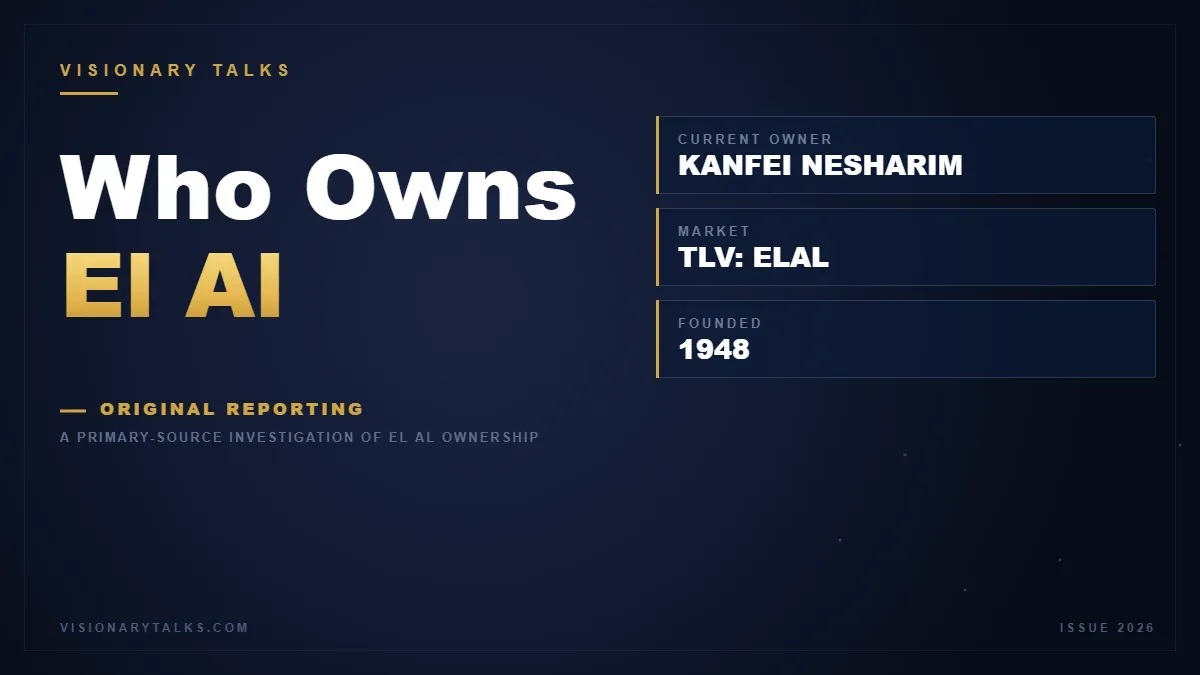
El Al Israel Airlines Ltd. is Israel’s flag carrier and a
public company listed on the Tel Aviv Stock Exchange (TASE) under the symbol ELAL. While the company trades publicly, it has a clear controlling shareholder and an unusual governance feature: a
Special State Share (often called a “golden share”) held by the State of Israel.
Quick answer
- Controlling owner: Kanfei Nesharim Aviation Ltd., owned by Eli Rozenberg (often discussed together with his father, Kenny Rozenberg), is the controlling shareholder.
- Public ownership: The rest of El Al’s shares are held by institutions and the public through the stock market.
- State control lever (not ordinary ownership): The State of Israel retains a Special State Share that grants special rights and approvals in areas tied to Israel’s security, aviation rights, and continuity of service.
Who owns El Al today?
Below is the most useful way to think about “who owns El Al” in practice: who controls votes and board influence, and what limits exist on that control.
Current ownership snapshot (based on the most recent public disclosures)
| Owner / stakeholder |
What they hold |
What it means in practice |
| Kanfei Nesharim Aviation Ltd. (Eli Rozenberg) |
~high-40% stake (roughly 47%–49% depending on the date and calculation) |
Controls the company as the largest shareholder and the key “interested party.” |
| Institutional investors + general public |
The remaining shares |
Provide liquidity and governance pressure, but do not control the company without coordinating. |
| State of Israel (Special State Share) |
A non-ordinary special share |
Gives the state special approvals/veto-like rights tied to security, foreign ownership, operational capacity, and other “vital interests.” |
Ownership percentages can move due to share issuances, option exercises, and market transactions. For the cleanest “official” number, rely on El Al’s latest periodic report, ESG report, or TASE filings.
The Rozenberg / Kanfei Nesharim story (why it matters)
El Al’s modern ownership structure is largely a story about the airline’s COVID-era crisis and recapitalization:
- In September 2020, El Al raised capital and control shifted to Kanfei Nesharim, a company associated with the Rozenberg family.
- Eli Rozenberg became the public face of control through Kanfei Nesharim, while reporting often notes the family context and the role of his father, Kenny Rozenberg, in the background.
- In 2024–2025, public reporting and company disclosures continued to describe Kanfei Nesharim as the controlling shareholder with a stake in the high 40% range.
El Al’s ownership model explained
El Al is not a typical “one person owns the airline” company. It is best described as a
publicly traded airline with a controlling shareholder and state-protective governance rights.
1) Public company on the stock exchange
El Al’s ordinary shares are traded publicly on the
TASE. This gives it:
- A large base of retail and institutional shareholders
- Market pricing and disclosure obligations
- The ability to raise capital through offerings (shares and warrants)
2) Controlling shareholder structure
In Israel, many public companies have a dominant “controlling shareholder.” El Al fits this model:
- A single shareholder group (Kanfei Nesharim) holds a large enough stake to control most shareholder votes in practice.
- That control typically translates into meaningful influence over board composition and major corporate decisions.
3) The Special State Share (“golden share”)
El Al’s Special State Share is designed to protect “vital interests” even after privatization. In plain English, it is a
state backstop intended to keep the airline aligned with national interests.
While the exact legal language is in El Al’s articles and periodic reports, the Special State Share is generally associated with:
- Restrictions and approvals on changes in influence/control (including holding certain amounts of shares or voting rights)
- Protection of aviation rights and operating licenses (including concerns about foreign ownership)
- Minimum operational capacity requirements tied to emergency or security needs
- Information and oversight provisions related to security-sensitive areas
What this means practically
Even if a private party wants to buy a major stake, there are
extra hurdles beyond ordinary securities rules. Conversely, even if the state does not “own” most of El Al’s ordinary shares, it still holds a meaningful lever on specific strategic issues.
Ownership and governance timeline (history)
1948–2003: Founded and government-backed
El Al was established in the first year of Israel’s independence and began with government and Jewish organizational backing.
- September 1948: The airline’s first high-profile flight carried Chaim Weizmann from Geneva to Israel.
- November 15, 1948: El Al was incorporated, with shareholders including the Israeli government and Jewish-owned organizations in Israel.
For decades, El Al operated as the national carrier under heavy state involvement.
2003–2005: Privatization begins, shares listed, control transfers
In the early 2000s, Israel moved toward privatizing El Al:
- June 2003: The privatization process began with an initial public offering, listing a portion of shares on the TASE.
- 2004–2005: Control shifted to Knafaim-Arkia Holdings (associated with the Borovich family), marking a key transition away from direct state control.
- During this period, the state retained the Special State Share structure to protect strategic interests.
2005–2020: Privatized operations under a controlling shareholder
For much of this period, El Al remained public but controlled by major shareholders (including Knafaim-related holdings), while navigating competitive pressures, labor issues, security costs, and modernization investments.
2020: Control changes hands during COVID-era recapitalization
COVID-19 severely damaged global airlines, and El Al was no exception. Capital raising and rescue arrangements became pivotal:
- September 2020: Kanfei Nesharim acquired a controlling stake (around the low-to-mid 40% range at the time), and El Al effectively entered a new ownership era.
- The state played a role through rescue mechanisms and continued to hold the Special State Share.
2022–2025: Recovery, state arrangements, and stake adjustments
As air travel recovered and later as demand and competitive dynamics shifted, El Al’s financial performance improved materially.
Key governance-related themes in this period included:
- The airline’s evolving agreements with the government on security cost participation.
- Restrictions and later easing around dividends and certain transactions, tied to prior state support arrangements.
- Public reporting about Kanfei Nesharim’s stake moving within the high 40% range, including option exercises.
El Al founders
El Al’s origins are institutional rather than a classic “two founders in a garage” story:
- Founded: 1948
- Original founding stakeholders: The State of Israel and Jewish-owned organizations in Israel (as early shareholders)
- Early mission: Establish and maintain air links for a new state, including strategic and humanitarian aviation needs.
FAQ
Is El Al government-owned?
Not in the usual sense. El Al is a
public company with a
private controlling shareholder. However, Israel retains a
Special State Share that grants special rights on strategic matters.
Can the government force El Al to do things?
The government’s influence mainly comes from regulation, security arrangements, and the Special State Share provisions. These can be powerful in specific scenarios (security, foreign ownership, continuity of service), but they are not the same as owning a majority of ordinary shares.
Why does the Special State Share exist?
Because El Al is tightly linked to
national security, international aviation rights, and emergency logistics. The Special State Share is meant to ensure continuity and protect vital interests even after privatization.
How can I verify who owns El Al right now?
Check:
- El Al’s latest periodic/annual reports and investor relations releases
- The TASE security page and filings
- El Al’s latest ESG report (often includes an ownership breakdown)
Bottom line
Today, El Al is best understood as:
- A publicly traded airline
- With a clear controlling shareholder (Kanfei Nesharim / Eli Rozenberg)
- Operating under a distinctive Israeli framework where the State’s Special State Share can shape who can gain influence and what strategic actions require approval
That blend of
market ownership plus
state-protective governance is the key to understanding “who owns El Al.”