
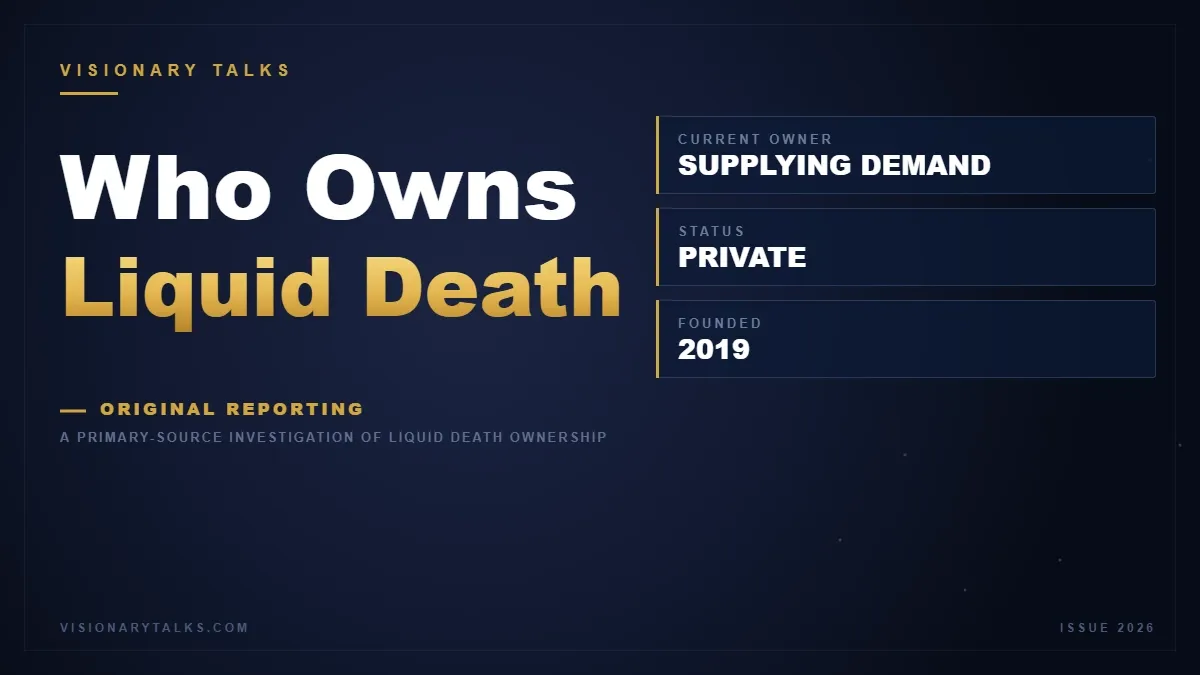
The Zero-Click Answer: Who Owns Liquid Death Right Now?
Because Liquid Death is private, exact ownership percentages are not publicly disclosed. What is clear is that it is not owned by Coca-Cola, PepsiCo, or any public beverage conglomerate.
The Portfolio Effect: Liquid Death Is a Startup That Sells a Beverage Platform
Liquid Death is not a classic “one parent company owns everything” story. It is closer to a venture-backed startup building a multi-category beverage platform under one brand.
The company has publicly highlighted strong retail performance. Reporting and investor materials commonly cite $263 million in retail scanned sales in 2023 across the platform.
| Product line under the Liquid Death brand | Year launched | Estimated value or revenue signal |
|---|---|---|
| Still Mountain Water | 2019 | Part of the core business that helped drive company-wide retail scanned sales momentum |
| Sparkling Mountain Water | 2020 | Expanded beyond still water into sparkling |
| Soda-style flavored sparkling line | 2022 | Positioned as a bridge between seltzer and soda |
| Iced Tea | 2023 | Category expansion beyond water |
| Death Dust (electrolyte drink mix) | 2024 | Move into hydration mixes and higher-margin add-ons |
| Sparkling Energy | 2026 | Planned retail rollout into energy drinks |
The Origin Story: How Liquid Death Was Built
Liquid Death founders
Liquid Death was founded by Mike Cessario, an advertising creative who treated canned water like a cultural product.
The idea was simple but unusually effective. Make water look like something you would drink at concerts and parties, not something you have to “announce” as a healthy choice. That brand thesis is why Liquid Death attracted entertainment and distribution power, not just traditional beverage money.
The funding rounds that shaped ownership
Liquid Death grew through funding rounds and strategic partnerships. Each round brought in new owners, but the company remained independent.
Key ownership milestones (publicly reported):
- 2019: A seed round was reported as led by Science.
- 2020: A Series A round was reported as supporting retail expansion.
- 2021: A round included Live Nation as an equity investor, paired with a major venue partnership. Celebrity investors in that round were reported to include Tony Hawk.
- 2022: Reporting described larger growth rounds and rising valuations as the brand expanded distribution.
- 2024: Liquid Death announced a new round at a reported $1.4B valuation, with named investors including SuRo Capital and follow-on participation from investors including Science and Live Nation.
The Strategy: Why This Ownership Structure Exists
It is financed like software, not like a beverage company
Most CPG brands expand slowly and protect margins. Liquid Death expanded like a startup. Raise capital, buy attention, widen distribution, then add adjacent categories like tea, hydration mixes, and energy.
This is why the “owner” is not a beverage giant. It is a group of venture investors and strategic partners who fund growth in exchange for equity.
Live Nation is not just an investor, it is a distribution wedge
Live Nation’s equity stake mattered because it came with access. Venue partnerships turn into sampling at scale, recurring visibility, and high-volume trial in the exact moments when people want a can in their hand.
That is a form of structural advantage. Not by owning factories, but by owning consumption moments.
Science, Inc. signals the growth engine DNA
Science is a venture studio known for building and scaling consumer growth mechanics. Having Science involved early reinforced that Liquid Death was designed as a brand and distribution machine from day one.
Who Owns the Owner? The Inception Layer
Liquid Death is private, so percentages are not public
There is no public shareholder registry for Liquid Death. What you can verify is the list of named investors disclosed across funding rounds.
Disclosed investors have included:
- Science, Inc. (early investor and follow-on participation reported)
- Live Nation (equity investor since 2021, reported follow-on involvement later)
- SuRo Capital (announced as an investor in the 2024 round)
- Celebrity investors reported in coverage, including Tony Hawk
One layer deeper: Live Nation is public
Live Nation is a public company listed on the NYSE under the ticker LYV. If you follow ownership from Liquid Death into Live Nation, you end up in the public markets, where major institutional investors commonly own large stakes.
Key Takeaways for Entrepreneurs
- If you want to stay independent, stack strategic investors instead of selling early. Liquid Death paired growth capital with distribution advantages.
- Distribution can be your moat. Venue access is structural, not just marketing.
- Build a platform, not a single product. Category expansion under one brand is a common path to venture-scale valuation.