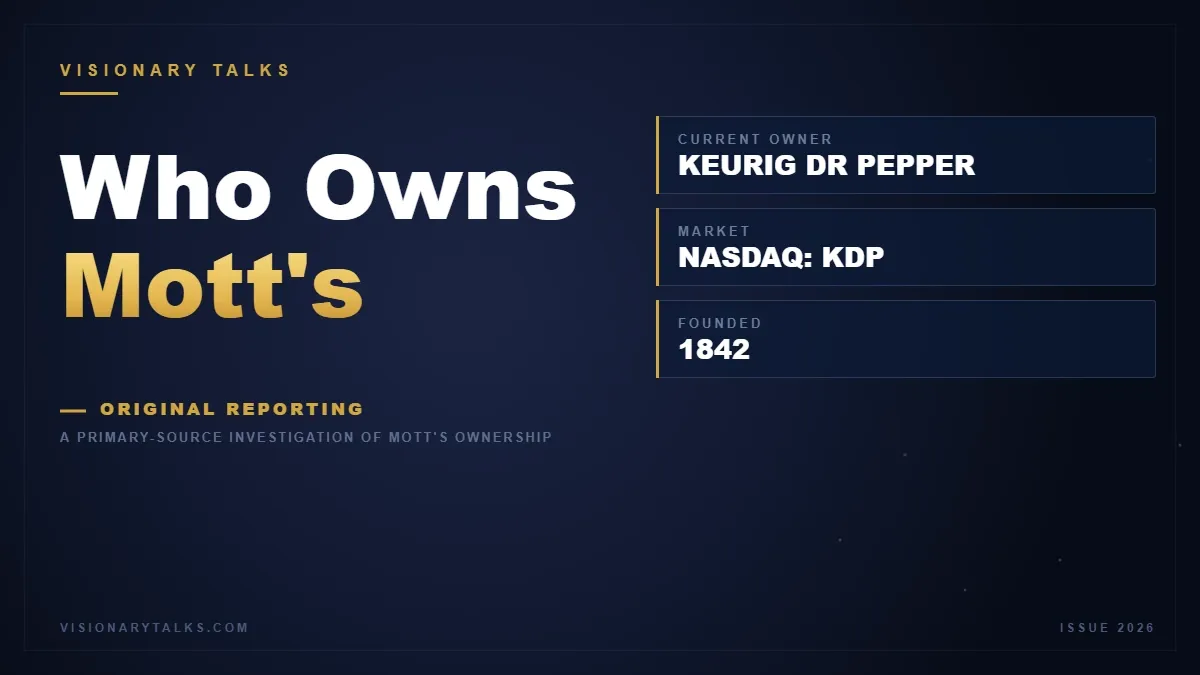
As of 2026, Mott's is 100 percent owned by Keurig Dr Pepper Inc., a publicly traded beverage and packaged food company listed on the Nasdaq under the ticker KDP. Mott's is not an independent company, nor is it privately held. It operates as a wholly owned brand within Keurig Dr Pepper’s extensive North American portfolio.
Confused about which cola giant makes what? See the full
Coke vs Pepsi vs Dr Pepper brand map, covering 60 US beverage brands and their true parents.
This ownership matters because when investors analyze Mott's, they are really analyzing KDP’s capital allocation, distribution muscle, and category strategy. Mott's cash flows, brand equity, and innovation pipeline sit inside a much larger corporate engine. For founders and operators, this is a case study in how legacy grocery brands become strategic assets inside multinational distribution platforms.
Who Owns Mott's Right Now?
Mott's today is controlled entirely by Keurig Dr Pepper Inc. KDP owns the brand outright and integrates it into its U.S. refreshment and packaged beverage system. There is no minority partner and no separate publicly traded Mott's entity.
KDP itself was formed in 2018 through the merger of Keurig Green Mountain and Dr Pepper Snapple Group. Mott's came into that transaction as part of Dr Pepper Snapple Group, which had previously acquired Cadbury Schweppes’ Americas Beverages division in 2008. That deal included Mott's alongside brands such as Dr Pepper, Snapple, and Canada Dry.
You can verify KDP’s corporate structure and filings through its investor relations and SEC documentation at
SEC.gov company filings for Keurig Dr Pepper. Mott's is not listed as a separate reporting entity because it operates as a brand within the consolidated structure.
Ownership Snapshot
| Entity |
Ownership Stake |
Notes |
| Keurig Dr Pepper Inc. |
100% |
Publicly traded on Nasdaq as KDP |
The Portfolio: The Illusion of Choice
If you walk through a grocery store aisle, Mott's feels like a standalone food brand. Its applesauce cups, apple juice bottles, and snack packs sit in a seemingly independent space next to private labels and legacy food brands.
But step back and you see the platform play. Mott's is one SKU cluster within KDP’s broader ecosystem, which includes carbonated soft drinks, bottled water, ready to drink tea, single serve coffee systems, and mixers. The consumer experiences choice. The investor sees portfolio optimization.
This is what I call the illusion of choice. Different packaging, different shelf sets, different target demographics. Same ultimate corporate parent allocating resources across categories.
Parent Company Brand Portfolio
| Brand |
Segment |
Positioning |
| Dr Pepper |
Carbonated Soft Drinks |
Flagship soda brand |
| Snapple |
Tea and Juice Drinks |
Premium flavored beverages |
| Canada Dry |
Ginger Ale and Mixers |
Mainstream refreshment |
| Keurig |
Single Serve Coffee Systems |
Home brewing platform |
| Mott's |
Juice and Applesauce |
Family and child focused fruit brand |
Founders and Ownership Timeline
Long before public market filings and portfolio integration, Mott's began as a small family venture. The origin story is old school American manufacturing.
Mott's Founders
Mott's was founded in 1842 by Samuel R. Mott in Bouckville, New York. He started by producing apple cider vinegar from locally grown apples. Over time, the company expanded into apple juice and eventually applesauce, which became its most recognizable product.
By the early 20th century, Mott's had grown into a recognized name in fruit processing. The brand capitalized on America’s agricultural scale and increasing household demand for shelf stable foods.
Ownership History Timeline
| Year |
Event |
Ownership Impact |
| 1842 |
Founded by Samuel R. Mott |
Family owned operation |
| 1982 |
Acquired by Cadbury Schweppes |
Shift to multinational ownership |
| 2008 |
Cadbury spins off Americas Beverages as Dr Pepper Snapple Group |
Mott's becomes part of new public company |
| 2018 |
Merger of Dr Pepper Snapple and Keurig Green Mountain |
Mott's enters Keurig Dr Pepper portfolio |
Reuters covered the 2018 merger between Keurig Green Mountain and Dr Pepper Snapple Group, which created KDP and consolidated brands like Mott's under one umbrella. You can read a summary of that transaction at
Reuters coverage of the Keurig and Dr Pepper Snapple merger.
Current Leadership and CEO
Mott's does not have an independent CEO. Strategic direction flows from Keurig Dr Pepper’s executive team. Brand managers oversee Mott's within broader business units.
As of 2026, the Chief Executive Officer of Keurig Dr Pepper is Tim Cofer. He succeeded Bob Gamgort and now oversees all brands in the KDP portfolio, including Mott's.
Leadership Snapshot
| Role |
Name |
Since |
| CEO, Keurig Dr Pepper |
Tim Cofer |
2024 |
For operators, this means Mott's strategy is shaped by leaders with beverage, CPG, and distribution scale experience. Decisions about innovation, pricing, and channel expansion are made at the corporate level, not the brand silo.
Why This Ownership Structure Exists
KDP follows a conglomerate style portfolio strategy within beverages and adjacent categories. The company aggregates strong regional or legacy brands, then leverages its distribution network to drive margin expansion and scale efficiencies.
Mott's fits neatly into this system. It extends KDP’s footprint into the shelf stable juice and applesauce category, particularly in family and child oriented segments. It diversifies revenue away from carbonated soft drinks without forcing KDP to dilute its beverage identity.
The Business Genius
The strategic advantage lies in distribution leverage. KDP’s direct store delivery system and retail relationships create bargaining power. When Mott's negotiates for shelf space, it is backed by a portfolio that includes Dr Pepper and Snapple.
That cross brand leverage increases resilience. If carbonated volume softens, applesauce and juice can partially offset category headwinds. For investors, it creates smoother revenue streams and protects free cash flow.
The Risk
The risk is strategic dilution. As conglomerates expand, individual brands can lose focus or fail to receive innovation capital. A heritage brand like Mott's must compete internally for resources against higher growth segments such as energy drinks or premium coffee systems.
There is also regulatory and consumer sensitivity risk. Fruit juice and applesauce face scrutiny around sugar content. Portfolio owners must adapt formulations and marketing or risk erosion among health conscious buyers.
Tracing the Ownership Chain
To fully understand who owns Mott's, you need to trace one level higher. Mott's is owned by Keurig Dr Pepper. Keurig Dr Pepper is a publicly traded corporation with widely distributed institutional ownership.
KDP’s largest shareholders typically include major institutional investors such as Vanguard Group, BlackRock, and State Street. These firms hold significant stakes through mutual funds and index funds, but they do not actively manage individual brand decisions. Control rests with the KDP board and executive leadership.
Ownership Layers
| Layer |
Owner |
Control |
| Mott's |
Keurig Dr Pepper Inc. |
100% |
| Keurig Dr Pepper Inc. |
Public shareholders |
Widely held, no single 100% owner |
Historically, JAB Holding Company, the investment arm of Germany’s Reimann family, held a significant stake in Keurig and later in the merged KDP entity. While its ownership has evolved over time through share sales, JAB has remained an influential long term shareholder. That layer adds another dimension to Mott's indirect ownership narrative.
Debunking the Common Misconception
The most common misconception is that Mott's operates as a standalone food brand. It feels independent because its identity is rooted in apples, orchards, and family imagery. Packaging reinforces that pastoral narrative.
In reality, it is embedded inside a publicly traded beverage conglomerate. Marketing, procurement, logistics, and capital planning are coordinated at the KDP level. The orchard story is consumer facing. The ownership story is Wall Street facing.
Key Takeaways for Entrepreneurs
- Brand independence and ownership independence are not the same thing. Always trace the corporate parent before analyzing strategy or valuation.
- Distribution scale can be more valuable than product novelty. Mott's longevity is tied to the platforms that distribute it, not just its recipe.
- Exits often turn legacy brands into portfolio assets. Founders should plan for how their company fits inside a larger system long before a sale occurs.
Mott's began as a 19th century cider operation and now sits inside a 21st century beverage conglomerate. The applesauce giant does not stand alone. It stands beside Dr Pepper, Snapple, and Keurig under the KDP umbrella. For investors and operators, the lesson is clear. Follow the ownership chain, because that is where strategic power truly resides.