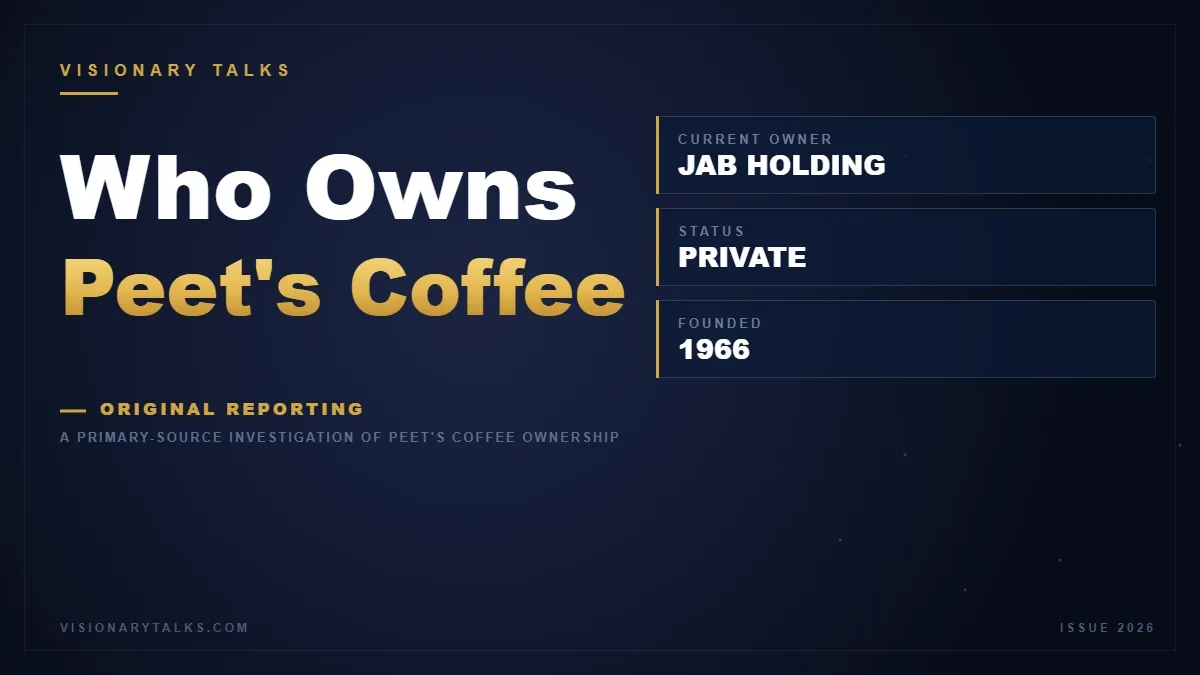
Peet's Coffee is owned by JDE Peet's N.V., a publicly listed global coffee and tea conglomerate controlled by JAB Holding Company, which remains the largest shareholder with effective control as of 2026.
This ownership matters because Peet's is often perceived as an independent, premium coffee roaster, yet its strategic decisions, capital allocation, and long term brand direction ultimately flow from a multinational portfolio owner. For investors and operators, Peet's is a case study in how legacy craft brands are scaled inside industrial coffee platforms.
Who Owns Peet's Coffee Right Now?
Peet's Coffee operates as a wholly owned operating subsidiary of JDE Peet's N.V., the Amsterdam listed coffee and tea group formed in 2020 through the merger of Jacobs Douwe Egberts and Peet's Coffee. While Peet's brand retains its own management team, it does not have independent equity ownership.
JDE Peet's itself is not independent. It is controlled by JAB Holding Company, the private investment vehicle of the Reimann family. JAB is known for consolidating consumer brands with strong repeat purchase behavior, particularly in coffee, food, and pet care.
Ownership Snapshot
| Entity |
Ownership Stake |
Notes |
| JDE Peet's N.V. |
100% |
Full operating and economic ownership of Peet's Coffee |
| JAB Holding Company |
Approx. 34 to 35% |
Largest shareholder with effective control of JDE Peet's |
The Portfolio: The Illusion of Choice
One of JAB's most effective strategies is allowing portfolio brands to appear independent and culturally distinct. Consumers choose between brands believing they are voting with values, while the profits consolidate at the holding level.
Peet's Coffee occupies the premium, craft positioned end of the portfolio, even as its supply chain, procurement, and global strategy increasingly mirror mass market economics.
Parent Company Brand Portfolio
| Brand |
Segment |
Positioning |
| Peet's Coffee |
Premium retail and DTC |
Craft heritage, dark roast authority |
| Jacobs |
Mainstream retail |
Mass market European coffee |
| L'OR |
Premium capsules |
High margin home consumption |
| Senseo |
Value pods |
Everyday convenience coffee |
Founders and Ownership Timeline
Peet's did not start as a global brand. It began as a single minded rebellion against weak American coffee.
Peet's Coffee Founders
Alfred Peet founded Peet's Coffee in 1966 in Berkeley, California. A Dutch immigrant with a deep respect for European coffee traditions, Peet focused on darker roasts, better beans, and education, influencing an entire generation of coffee entrepreneurs.
Several early Peet's customers went on to found Starbucks, making Peet's arguably the intellectual origin of modern American specialty coffee.
Ownership History Timeline
| Year |
Event |
Ownership Impact |
| 1966 |
Company founded by Alfred Peet |
Founder owned and operated |
| 1984 |
Alfred Peet sells company to Sal Bonavita |
Transition to growth focused ownership |
| 2001 |
IPO on NASDAQ |
Public shareholders introduced |
| 2012 |
Acquired by JAB Holding Company |
Taken private, full JAB control |
| 2020 |
Merged into JDE Peet's |
Subsidiary of public global group |
Current Leadership and CEO
Today, strategic decisions about Peet's Coffee are aligned with group level priorities set by JDE Peet's. Brand management exists, but capital and growth mandates come from the parent.
Leadership Snapshot
| Role |
Name |
Since |
| CEO, JDE Peet's N.V. |
Fabien Simon |
2022 |
Why This Ownership Structure Exists
This is a classic global consumer goods roll up. JAB acquires trusted brands, centralizes operations, and monetizes scale while preserving the storytelling of independence at the brand layer.
The Business Genius
Coffee is a habitual product with low switching friction but strong emotional attachment. By owning multiple brands across price tiers and channels, JAB captures consumer value regardless of taste shifts or economic cycles.
For Peet's, this means access to capital, sourcing leverage, and international reach no independent roaster could match.
The Risk
The danger is brand dilution. When operational efficiency overtakes product obsession, premium brands risk becoming expensive versions of mass coffee.
There is also strategic risk. In early 2026, market reports suggested that large beverage players, including Keurig Dr Pepper, had evaluated strategic options around parts of the JDE Peet's portfolio. Even exploratory discussions can distract management and unsettle long term brand building.
Tracing the Ownership Chain
To understand who truly controls Peet's, you have to follow the equity one layer higher.
Ownership Layers
| Layer |
Owner |
Control |
| Peet's Coffee |
JDE Peet's N.V. |
100% |
| JDE Peet's N.V. |
JAB Holding Company |
Largest shareholder, effective control |
JDE Peet's is publicly traded on Euronext Amsterdam, with additional institutional investors holding minority positions. JAB's stake gives it decisive influence over board appointments and strategic direction, as disclosed in public filings and investor materials available via the
JDE Peet's investor relations site.
According to
Reuters coverage of JDE Peet's, JAB remains the anchor shareholder as of 2026, anchoring the group within a broader private holding strategy.
Debunking the Common Misconception
Peet's Coffee is not an independent coffee chain. While its branding, store design, and storytelling emphasize craft and heritage, the company is financially and strategically controlled by a global conglomerate.
This does not make the coffee worse, but it does mean decisions are optimized at the portfolio level, not the neighborhood roastery level.
Key Takeaways for Entrepreneurs
- Independence can be a brand posture, not an ownership reality, and customers often cannot tell the difference.
- Strategic acquirers value emotional brands with repeat purchase behavior more than raw growth alone.
- If you plan to sell, understand that post-acquisition autonomy narrows over time, even when culture is preserved at first.
Peet's Coffee shows how a founder-led philosophy can outlive its ownership, but also how quiet control can shift upward. For founders and investors watching the food and beverage space, the lesson is clear. In modern consumer markets, the real power often sits several layers above the logo on the cup.