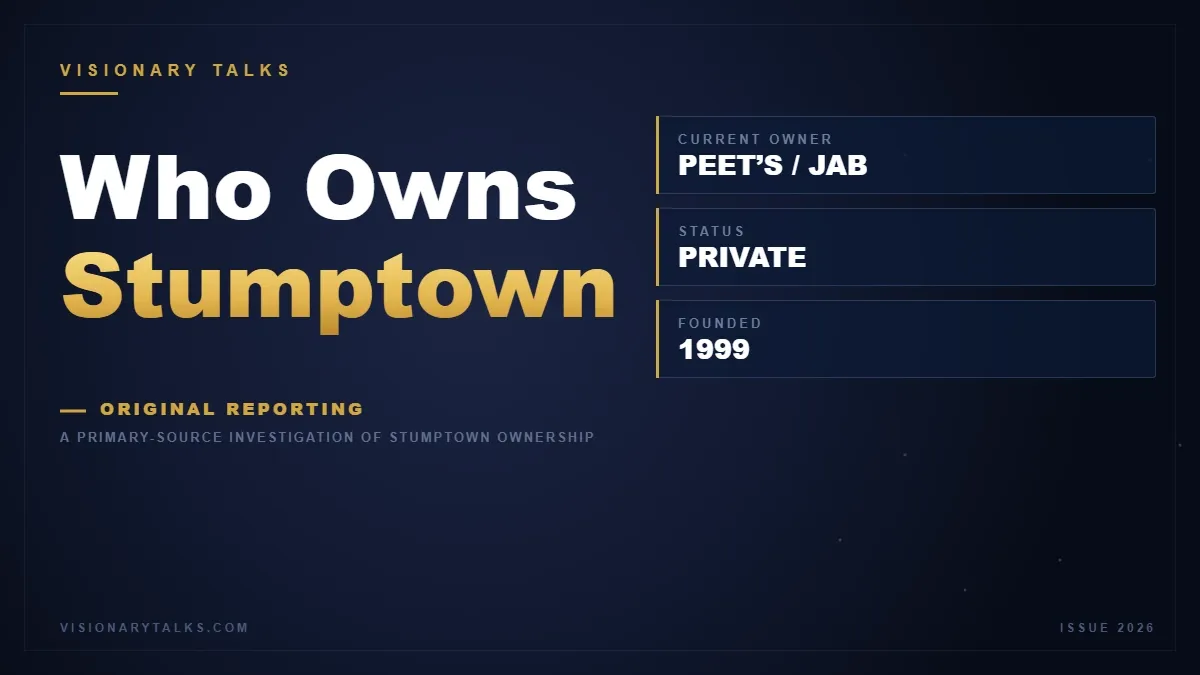
Stumptown Coffee Roasters is owned by Peet’s Coffee & Tea, which in turn is owned by JAB Holding Company. As of 2026, Stumptown is a wholly owned subsidiary of Peet’s, making JAB the ultimate controlling owner behind the brand. Despite its indie branding and third wave coffee narrative, Stumptown is firmly embedded inside one of the largest private consumer goods empires in the world.
This ownership matters because coffee is no longer just a lifestyle category, it is a scaled consumer packaged goods business. Investors and operators need to understand how capital, distribution, and brand control actually flow. Stumptown is a case study in how authenticity is preserved while ownership quietly consolidates.
Who Owns Stumptown Right Now?
Stumptown Coffee Roasters is owned by
Peet’s Coffee & Tea, which acquired the brand outright in 2015. Peet’s itself is fully controlled by JAB Holding Company, the privately held investment firm based in Luxembourg. There is no partial stake, minority investor, or public float involved.
Operationally, Stumptown runs as a standalone brand with its own leadership and sourcing philosophy. Financially and strategically, it sits inside Peet’s portfolio, which rolls up results to JAB. That separation between brand autonomy and capital control is intentional.
Ownership Snapshot
| Entity |
Ownership Stake |
Notes |
| Peet’s Coffee & Tea |
100% |
Acquired Stumptown in 2015, full operational control |
| JAB Holding Company |
100% of Peet’s |
Ultimate parent and capital allocator |
The Portfolio: The Illusion of Choice
JAB has mastered the art of making conglomerate ownership feel invisible. Consumers believe they are choosing between independent brands, when in reality they are selecting from a tightly curated house of labels. Stumptown’s voice feels distinct, but its balance sheet is not.
This is not accidental. JAB allows brands to maintain sourcing standards, visual identity, and cultural touchpoints while centralizing finance, real estate leverage, and global distribution strategy.
Parent Company Brand Portfolio
| Brand |
Segment |
Positioning |
| Stumptown Coffee Roasters |
Specialty coffee |
Third wave, craft, ethically sourced |
| Peet’s Coffee |
Premium retail coffee |
High quality, approachable, mass premium |
| Caribou Coffee |
Chain coffee |
Regional scale, lifestyle oriented |
| Intelligentsia Coffee |
Specialty coffee |
Craft focused, urban coffee culture |
Founders and Ownership Timeline
Before private equity scale and global portfolios, Stumptown was a founder driven experiment in better coffee. Understanding that origin explains why the brand still resonates with consumers who would never willingly buy from a conglomerate.
Stumptown Founders
Stumptown Coffee Roasters was founded in 1999 in Portland, Oregon by Duane Sorenson. Sorenson built the company around direct trade sourcing, lighter roasts, and a community centered café culture. For over a decade, Stumptown helped define what Americans now call third wave coffee.
As the brand grew nationally, capital demands increased. Roasting infrastructure, distribution, and labor intensive sourcing models pushed Stumptown beyond the financial comfort zone of a founder owned business.
Ownership History Timeline
| Year |
Event |
Ownership Impact |
| 1999 |
Stumptown founded by Duane Sorenson |
100% founder owned |
| 2011 |
Minority investment from TSG Consumer Partners |
Founder retains control, growth capital added |
| 2015 |
Acquired by Peet’s Coffee |
Founder exit, 100% sold |
| 2015 |
Peet’s controlled by JAB Holding |
Stumptown becomes part of JAB portfolio |
Current Leadership and CEO
After the acquisition, Stumptown transitioned away from founder led management. Professional operators with experience inside large consumer companies now run the business. This shift reflects the priorities of a scaled owner, not a neighborhood roaster.
Leadership focuses on brand consistency, profitability, and measured expansion rather than experimental growth. That discipline comes from Peet’s oversight and JAB’s capital expectations.
Leadership Snapshot
| Role |
Name |
Since |
| CEO |
Erin McCarthy |
2021 |
Why This Ownership Structure Exists
This structure is a textbook example of a brand led roll up inside a vertically integrated consumer platform. JAB acquires emotionally resonant brands, then supports them with global scale while preserving their cultural surface.
For Peet’s, Stumptown acts as both a halo brand and an innovation lab. For JAB, it is another durable cash generating asset with pricing power.
The Business Genius
The genius lies in separation of perception and control. Consumers experience authenticity, craft, and community. Owners experience margin expansion, purchasing power, and portfolio diversification.
By keeping Stumptown visually and operationally distinct, JAB protects the very qualities that justify premium pricing.
The Risk
The risk is brand erosion if consumers connect the dots. Specialty coffee customers are unusually sensitive to ownership narratives. If corporate influence becomes too visible, loyalty can unwind quickly.
There is also operational risk. Craft supply chains do not always scale cleanly, and maintaining quality at volume requires constant investment.
Tracing the Ownership Chain
To understand who really controls Stumptown, you have to move up one level at a time. Each layer adds capital discipline and distance from the café counter.
Ownership Layers
| Layer |
Owner |
Control |
| Stumptown Coffee Roasters |
Peet’s Coffee & Tea |
100% |
| Peet’s Coffee & Tea |
JAB Holding Company |
100% |
JAB Holding Company is privately owned by the Reimann family of Germany. There are no public shareholders and no quarterly earnings calls. According to reporting by
Reuters coverage of JAB’s consumer strategy, the firm manages tens of billions in assets across coffee, food, and consumer services.
Because JAB is private, institutional ownership disclosures do not exist in the way they would for a public company. Control is highly centralized, long term, and family driven.
Debunking the Common Misconception
The most common misconception is that Stumptown remains an independent roaster. It is not. Independence ended in 2015 when the brand was acquired by Peet’s.
What consumers experience today is brand autonomy, not ownership independence. Those are very different things, and conflating them benefits the owner more than the buyer.
Key Takeaways for Entrepreneurs
- Authenticity can survive acquisition if governance and brand boundaries are respected.
- Capital scale often requires surrendering ownership, even in culture driven industries.
- The best acquirers invest in invisibility, not rebranding.
Stumptown’s story is not about selling out. It is about what happens when a beloved craft brand collides with global capital. As an investigative business journalist, I see Stumptown as a clear signal of where modern consumer brands are headed, founder soul on the surface, institutional ownership underneath.
For investors, it is a reminder that brand equity compounds best inside disciplined portfolios. For founders, it is proof that independence is often a phase, not a destination. And for operators, it shows how quietly power can change hands while the café still feels the same.