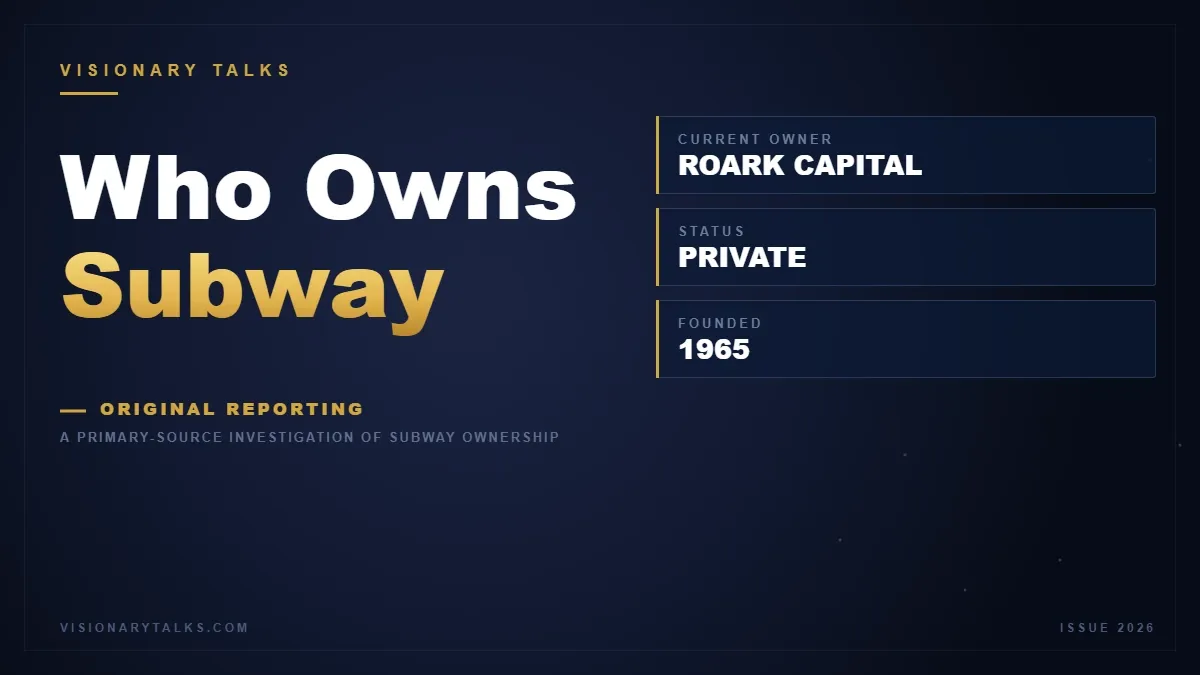
Subway is owned 100 percent by Roark Capital Group, a U.S. based private equity firm that completed its acquisition of the company in 2024, ending more than 60 years of DeLuca family control.
This ownership shift matters because Subway is not just another restaurant brand. It is one of the world’s largest franchise systems by unit count, and its strategic direction affects tens of thousands of operators, landlords, suppliers, and investors across the food service ecosystem.
Who Owns SubwayRight Now?
As of 2026, Subway is a privately held company owned outright by funds managed by Roark Capital. There are no public shares, no listed ticker, and no remaining family ownership stake.
The transaction was announced in 2023 and formally closed in 2024 after regulatory approvals. The buyer was Roark Capital Group, an Atlanta headquartered private equity firm specializing in franchise and consumer service businesses.
From an ownership perspective, Subway now sits squarely inside a private equity portfolio. Strategic decisions are driven by Roark’s investment committees, operating partners, and long term return targets.
Ownership Snapshot
| Entity |
Ownership Stake |
Notes |
| Roark Capital managed funds |
100% |
Acquired Subway in 2024, fully private ownership |
The Portfolio: The Illusion of Choice
One of the most fascinating aspects of Roark’s strategy is how independent its brands appear from the outside. Most consumers have no idea that many competing food concepts share the same financial owner.
From an operator’s perspective, this creates an illusion of market diversity. In reality, capital allocation, vendor negotiations, and long term growth strategy are centralized at the private equity level.
Subway is now part of a broader platform of franchise driven businesses. That platform emphasizes predictable cash flow, asset light models, and scalable unit economics.
Parent Company Brand Portfolio
| Brand |
Segment |
Positioning |
| Subway |
Quick service |
Global sandwich franchise |
| Arby’s |
Quick service |
Meat focused fast food |
| Dunkin |
Beverage and bakery |
Mainstream coffee franchise |
| Jimmy John’s |
Quick service |
Fast delivery sandwiches |
| Buffalo Wild Wings |
Casual dining |
Sports bar and wings |
Founders and Ownership Timeline
To understand why the sale was so consequential, you have to return to Subway’s origin story. This was not a Silicon Valley startup or a financial roll up. It was a simple, founder led business for decades.
Subway Founders
Subway was founded in 1965 by Fred DeLuca, then a 17 year old college student, and financed with help from family friend Dr. Peter Buck. The first store opened in Bridgeport, Connecticut under the name Pete’s Super Submarines.
DeLuca built Subway into a franchising powerhouse by emphasizing low startup costs, simple operations, and aggressive international expansion. Dr. Buck remained a key owner and advisor for decades.
For most of its history, Subway was controlled by the DeLuca and Buck families through privately held entities. There were no outside institutional shareholders and no public market pressure.
Ownership History Timeline
| Year |
Event |
Ownership Impact |
| 1965 |
Subway founded |
Owned by Fred DeLuca and Peter Buck |
| 1974 |
Franchising expansion begins |
Founders retain full control |
| 2015 |
Fred DeLuca passes away |
Family trusts assume control |
| 2021 |
Peter Buck passes away |
Ownership consolidated under DeLuca family interests |
| 2023 |
Sale announced to Roark Capital |
Agreement to exit family ownership |
| 2024 |
Transaction closes |
Roark Capital takes 100 percent ownership |
Current Leadership and CEO
With private equity ownership came a reshaped leadership structure. The board shifted from family stewardship to professionalized, performance driven oversight.
Operational leadership focuses on unit economics, franchise profitability, menu simplification, and digital ordering penetration. These priorities mirror playbooks already used across Roark’s portfolio.
Leadership Snapshot
| Role |
Name |
Since |
| Chief Executive Officer |
Doug Fry |
2024 |
| North America President |
Doug Fry |
2023 |
Why This Ownership Structure Exists
Subway fits perfectly into a private equity franchise roll up model. It generates royalty revenue rather than owning most stores, which keeps capital requirements low and margins more stable.
Roark specializes in businesses where scale improves negotiating power without adding operational complexity. Subway’s massive footprint amplifies that advantage.
The Business Genius
The brilliance of this structure lies in alignment. Franchisees fund store build outs, while the parent company collects fees, controls branding, and optimizes supply chains.
Roark can apply centralized technology investments, supply sourcing leverage, and menu engineering across its portfolio. Each brand benefits from lessons learned elsewhere.
For Subway, this means access to capital and operational expertise that family ownership could not easily replicate at global scale.
The Risk
The downside is tension. Private equity seeks returns within defined time horizons, while franchisees often think in decades.
Cost cutting, store closures, and contract renegotiations can strain relationships. If not managed carefully, the very scale that attracts private equity can amplify discontent.
Tracing the Ownership Chain
Subway itself is not the ultimate owner. It is one operating company inside a layered private equity structure designed for capital efficiency and investor governance.
At the top sit limited partners such as pension funds, endowments, and sovereign wealth vehicles that commit capital to Roark managed funds.
Ownership Layers
| Layer |
Owner |
Control |
| Subway |
Roark Capital portfolio entity |
100% |
| Roark managed funds |
Institutional limited partners |
Economic ownership via fund commitments |
Because Roark is private, there are no publicly disclosed shareholder lists like those found on SEC filings. Control rests with Roark’s general partners, who make investment and operational decisions.
The sale was widely covered by financial media including
Reuters reporting on the Roark acquisition of Subway. Details around valuation remain undisclosed but analysts estimate a purchase price north of nine billion dollars.
Debunking the Common Misconception
A persistent myth is that Subway is still owned by the founding DeLuca family. That is no longer true.
While the family controlled the business for decades and shaped its DNA, they exited ownership entirely with the Roark transaction. Today, there is no equity stake held by Fred DeLuca’s heirs.
This confusion persists because Subway remains private and retains founder era branding. Private does not mean family owned, and in Subway’s case, private now means private equity.
Key Takeaways for Entrepreneurs
- Family ownership can endure for generations, but scale eventually attracts institutional capital, especially in asset light businesses.
- Franchise models are highly attractive to private equity when unit economics are predictable and cash flows are diversified.
- Selling control is not failure, it is often a strategic liquidity event that reshapes governance and growth priorities.
Subway’s ownership story is ultimately a case study in business evolution. What began as a single sandwich shop became a global system, then a private equity platform asset.
For founders and operators watching from the sidelines, the lesson is clear. Ownership structures change when scale, succession, and capital needs intersect.
As Subway moves further into the Roark era, its next chapter will be written not by a family kitchen table, but by investment committees, franchise councils, and global operational metrics.