
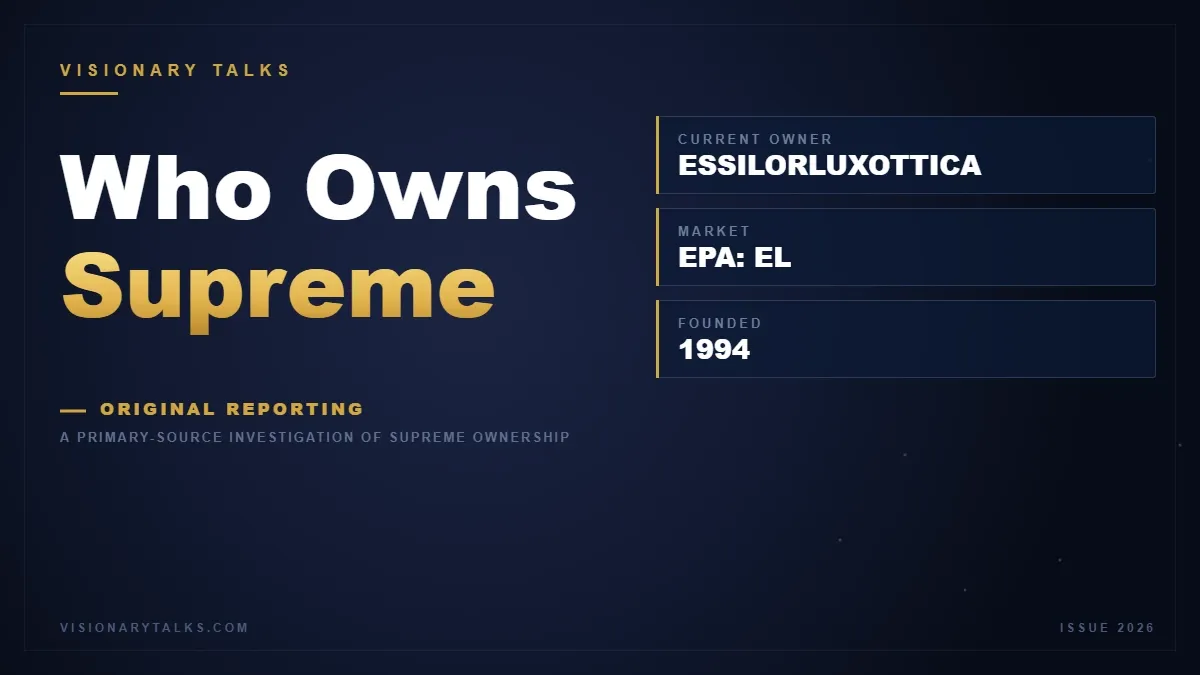
The Zero-Click Answer: Who Owns Supreme Right Now?
The Portfolio Effect: What Else Does EssilorLuxottica Own?
EssilorLuxottica does not just own eyewear brands. It operates a full stack that includes iconic consumer brands, lens technology, and the retail storefronts where product gets sold. Supreme now sits inside that machine as a cultural brand built on scarcity and collaborations.
Here are some of the major brands and retail banners inside the parent company’s ecosystem (plus Supreme):
| Brand or Banner (Parent company: EssilorLuxottica) | Year acquired or formed | Estimated value or revenue metric (publicly reported) |
|---|---|---|
| Supreme | 2024 | Bought for $1.5B (cash) |
| Ray-Ban | 1999 | Bought from Bausch & Lomb eyewear brands for $640M |
| Oakley | 2007 | Acquisition valued at about $2.1B (all-cash) |
| Sunglass Hut | 2001 | Deal: about $462M equity plus assumed about $191M debt (about $653M enterprise value) |
| LensCrafters (via Luxottica) | 1995 | Acquired as a strategic move into retail distribution control |
| Essilor plus Luxottica (the core platform) | 2018 | Company created through the Essilor–Luxottica combination |
Research-grade clarity: EssilorLuxottica also runs a large licensing business (making eyewear for luxury fashion houses under contract). Those licensed brands are not subsidiaries. Supreme is different because it was acquired outright and sits as a subsidiary within the group.
The Ownership Timeline: How Supreme Changed Hands
2017: Private equity enters the picture
Private equity firm Carlyle bought a roughly 50 percent stake in Supreme in a deal that fashion business coverage described as valuing the company around about $1.1 billion enterprise value.
2020: VF Corporation buys Supreme for $2.1 billion
VF Corporation (owner of brands like Vans and The North Face) agreed to acquire Supreme. The deal later closed in December 2020 for $2.1 billion, making Supreme a wholly owned subsidiary of VF.
2024: EssilorLuxottica buys Supreme for $1.5 billion in cash
VF sold Supreme to EssilorLuxottica. The transaction closed on October 2, 2024 for an aggregate base purchase price of $1.5 billion in cash (subject to customary adjustments).
Was it hostile, or was it a strategic deal?
This was a negotiated, strategic M&A transaction, not a hostile takeover. It followed the typical pattern of an agreed purchase agreement, regulatory approvals, and a clean closing.
The Strategy: Why an Eyewear Giant Bought a Streetwear Icon
EssilorLuxottica’s core advantage is vertical integration. It can develop lens technology, own and operate branded frames, and sell through a large direct retail footprint and online channels.
So why buy Supreme, a streetwear brand, if you are known for eyewear?
Supreme is not just a brand, it is a demand engine
Supreme is a demand creation system disguised as apparel.
- It runs on limited releases and high signal collaborations.
- It monetizes identity and belonging, not just fabric and logos.
- It can create premium willingness to pay without competing on price.
For EssilorLuxottica, that kind of cultural momentum can be an asset that travels. It can support category expansion, collaboration programs, and long-lived brand equity across geographies.
Is this a conglomerate move, or a platform adjacency bet?
This looks less like a classic conglomerate that buys unrelated assets and more like a platform adjacency bet.
- It adds diversification beyond eyewear.
- It still fits a pattern of owning brands with global consumer reach, then scaling distribution and monetization.
The big risk: scaling without losing credibility
Supreme’s value historically came from scarcity plus credibility. A large corporate parent can add operational power and distribution leverage, but growth can also dilute the signal if the brand feels overextended.
Who Owns EssilorLuxottica? The Inception Layer
Because EssilorLuxottica is a public company, the ultimate answer to “who owns Supreme” is the shareholder base that controls EssilorLuxottica.
EssilorLuxottica market cap and ownership structure
EssilorLuxottica trades on Euronext Paris. Around early 2026, it is commonly reported at roughly about €128B to €132B market cap, depending on the day.
As of disclosures around the end of 2024, the company’s shareholding has been described roughly as:
- Public and institutional shareholders: about 63 percent
- Delfin (the Del Vecchio family holding company): about 32 percent
- Employees and others: about 4 percent
The controlling anchor is Delfin (Del Vecchio family)
Delfin is the investment vehicle tied to the Luxottica founder Leonardo Del Vecchio’s family. It is the most important long-term anchor shareholder and a key reason EssilorLuxottica has a stable control layer even as a public company.
Major institutional shareholders you will often see
Large global asset managers and long-only funds commonly appear in shareholder lists for a company of this size. Public ownership databases often show names such as Capital Research, BlackRock, and Vanguard among notable holders.
Key Takeaways for Entrepreneurs: What to Learn From Supreme’s Ownership Journey
- Build the demand engine, not just the product. Supreme’s value is the repeatable system for scarcity, community, and cultural relevance.
- Distribution control is leverage. EssilorLuxottica shows how owning the channel can be as strategic as owning the brand.
- M&A is a strategy, not a headline. Supreme moved from founder-led to private equity to a public portfolio owner. Each step monetized a different advantage, including culture, scale, and portfolio fit.