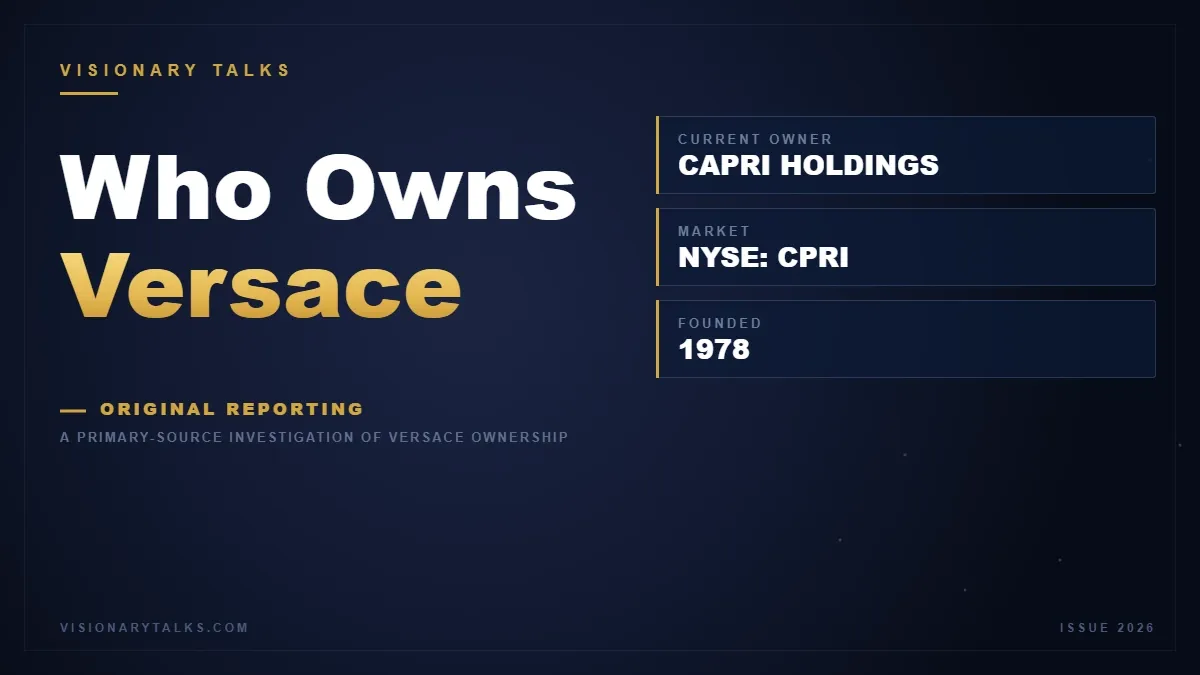
Versace is owned 100 percent by Capri Holdings Limited as of 2026, a publicly traded global luxury group formerly known as Michael Kors Holdings. Despite persistent speculation about a return to Italian ownership, including reported talks with Prada, Versace has not yet changed hands and remains fully controlled by Capri.
This ownership matters because Versace is not simply a fashion house, it is a strategic asset inside a publicly listed luxury portfolio navigating growth pressure, brand positioning challenges, and activist investor scrutiny. For investors, founders, and operators, Versace is a case study in how legacy brands live or die under conglomerate control.
Who Owns VersaceRight Now?
As I write this in 2026, Versace sits fully inside Capri Holdings Limited, trading on the New York Stock Exchange under the ticker CPRI. Capri acquired Versace in 2018 and has never sold down a minority stake or spun it out.
That means Versace is not independently owned, not family controlled, and not privately held. Every strategic decision, from executive appointments to capital allocation, ultimately flows through Capri’s board and shareholder base.
The confusion comes from two places. First, Capri’s former name, Michael Kors Holdings, leads many to assume Michael Kors personally owns Versace. Second, ongoing media coverage about potential buyers, especially Prada, creates the illusion that a deal has already happened.
Ownership Snapshot
| Entity |
Ownership Stake |
Notes |
| Capri Holdings Limited |
100% |
Acquired Versace in 2018, retains full operational and financial control |
The Portfolio: The Illusion of Choice
Capri Holdings has mastered the art of making its brands feel independent while tightly controlling the financial engine underneath. To consumers, Versace feels nothing like Michael Kors or Jimmy Choo. To investors, they are revenue lines on the same earnings call.
This illusion of choice is deliberate. Capri allows distinct creative languages and retail strategies, but centralizes supply chain, finance, real estate negotiations, and investor messaging.
From the outside, this looks like brand freedom. From the inside, it is a classic luxury conglomerate operating model optimized for margin leverage.
Parent Company Brand Portfolio
| Brand |
Segment |
Positioning |
| Versace |
Luxury fashion |
Italian heritage, bold aesthetics, high fashion runway influence |
| Michael Kors |
Accessible luxury |
Global lifestyle brand, handbags and accessories led |
| Jimmy Choo |
Luxury footwear |
High end shoes and accessories with red carpet credibility |
Founders and Ownership Timeline
To understand why Versace ownership is so emotionally charged, you have to start with its founding. Versace was not built as a portfolio asset. It was built as a personal expression of one designer.
Versace Founders
Gianni Versace founded Gianni Versace S.p.A. in Milan in 1978. He was not just the creative director, he was the brand itself, shaping a maximalist aesthetic that came to define late twentieth century luxury.
After Gianni Versace’s murder in 1997, the company passed into family control. Donatella Versace stepped into the creative lead, while Santo Versace managed the business side.
For two decades, Versace remained family owned, fiercely independent, and culturally Italian, even as financial pressures mounted.
Ownership History Timeline
| Year |
Event |
Ownership Impact |
| 1978 |
Versace founded by Gianni Versace |
Founder owned and controlled |
| 1997 |
Gianni Versace dies |
Ownership and leadership pass to Versace family |
| 2014 |
Blackstone acquires minority stake |
Family dilutes ownership, brings in financial partner |
| 2018 |
Capri acquires Versace |
100 percent ownership transferred to Capri Holdings |
Current Leadership and CEO
While Capri owns Versace financially, day to day control sits with a dedicated leadership team designed to preserve brand equity while hitting public market targets.
This separation of ownership and management is typical for conglomerate held luxury brands. It also creates tension between creative ambition and quarterly performance.
Leadership Snapshot
| Role |
Name |
Since |
| CEO |
Emmanuel Gintzburger |
2022 |
| Chief Creative Officer |
Dario Vitale |
2023 |
Why This Ownership Structure Exists
The primary model here is a publicly traded luxury conglomerate optimized for scale. Capri Holdings is not a venture builder or a private equity roll up. It is a holding company seeking predictable cash flows and brand appreciation.
Versace fits this model because it offers global brand equity, pricing power, and category expansion potential. The theory is straightforward, professionalize operations, invest in retail expansion, and unlock margin upside.
The Business Genius
The genius lies in capital efficiency. Under Capri, Versace gained access to global distribution infrastructure, real estate leverage, and public market capital without bearing those risks alone.
For a brand as operationally complex as Versace, this backing allowed faster expansion into Asia and the Middle East than family ownership likely could have funded.
The Risk
The risk is cultural dilution. When a brand rooted in creative rebellion answers to earnings calls, its sharp edges can soften.
There is also timeline mismatch. Public market investors think in quarters and years. Luxury brands thrive over decades.
Who Owns the Owner?
Since Versace is wholly owned by Capri Holdings, the real question becomes who owns Capri. Capri Holdings Limited is a public company listed on the NYSE.
No single individual controls Capri through majority ownership. Control is distributed among institutional investors, mutual funds, and retail shareholders.
Ownership Layers
| Layer |
Owner |
Control |
| Versace |
Capri Holdings Limited |
100% |
| Capri Holdings |
Public shareholders |
Dispersed institutional ownership |
Capri’s largest shareholders typically include major asset managers such as Vanguard and BlackRock, according to regulatory filings with the US Securities and Exchange Commission. These investors exert influence through board governance rather than direct operational control.
The Owned by Michael Kors (Capri Holdings)Misconception
One of the most common misconceptions I encounter is that Versace is owned by Michael Kors the designer. This is incorrect.
Michael Kors Holdings rebranded as Capri Holdings in 2019 to reflect its multi brand strategy. Michael Kors the individual does not personally own Versace.
Versace is owned by Capri the corporation, not by the founder of the Michael Kors brand. That distinction matters, especially when analyzing strategic priorities and exit possibilities.
It is also where the Prada rumors gain traction. In 2024 and 2025, several outlets including Reuters reported exploratory discussions between Capri and Prada regarding Versace, framed as a potential return to Italian ownership. Those talks did not result in a completed transaction as of 2026.
For reference, Capri’s own investor disclosures continue to list Versace as a wholly owned subsidiary on its corporate site and filings, which can be reviewed via
Capri Holdings investor relations and corroborated by coverage from
Reuters reporting on luxury sector M&A.
Key Takeaways for Entrepreneurs
- Brand independence can be an illusion, ownership structure defines strategic freedom more than creative messaging.
- Public market ownership accelerates scale but compresses patience, plan accordingly when selling to a listed buyer.
- Misconceptions persist when brand names and holding companies blur, always separate narrative from cap table reality.
Versace today is not the scrappy Italian house it once was, nor is it simply a logo inside a spreadsheet. It is a global luxury brand navigating the tension between creative legacy and corporate ownership.
Until a deal is signed and closed, Versace remains firmly inside Capri Holdings. For operators and investors, that reality is far more important than the romance of a rumored homecoming.