
This ownership matters because Vice was once valued at $5.7 billion and positioned as the future of digital media. Its collapse into creditor ownership is a case study in how venture scale, media economics, and debt structures collide.
Who Owns Vice MediaRight Now?
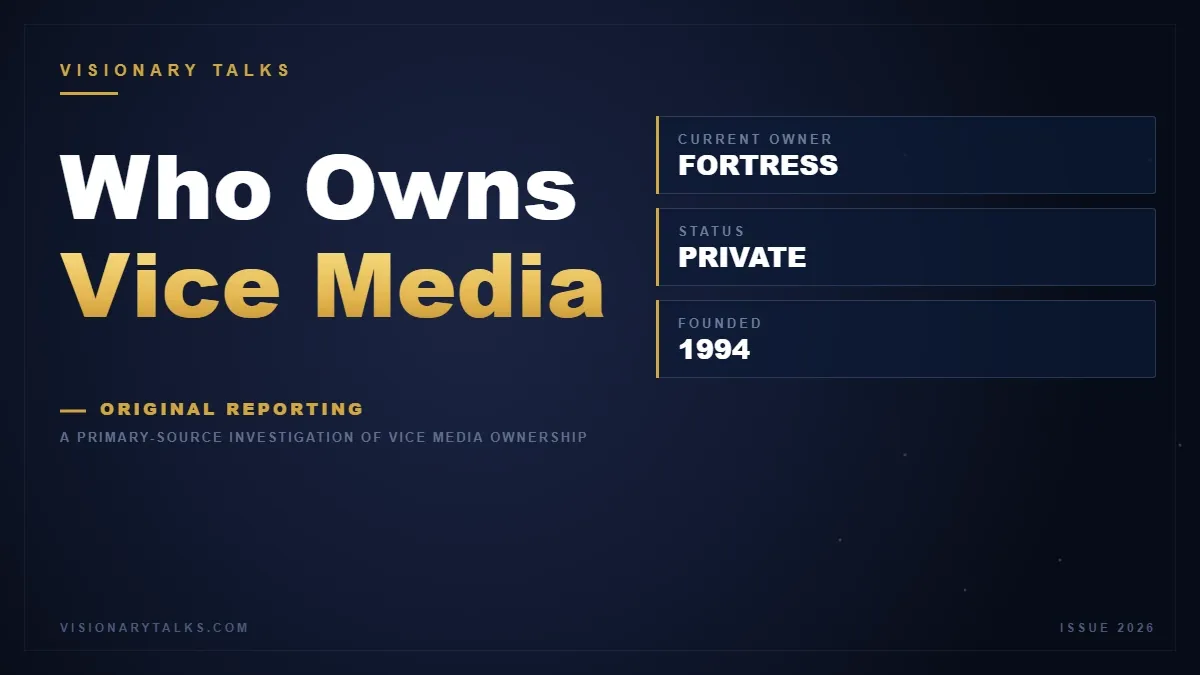
Vice Media is privately owned by Fortress Investment Group through funds it manages, primarily special situations and credit vehicles. The firm became the controlling shareholder after leading Vice’s restructuring process and debt conversion in 2023.
I want to be explicit here because the ownership structure is often misreported. Vice is not owned by Disney, Fox, or any traditional media conglomerate. It is owned by a financial sponsor that specializes in distressed assets.
Fortress did not buy Vice in a traditional cash acquisition. It assumed control by converting existing debt into equity through the bankruptcy court process, wiping out prior equity holders.
That distinction explains nearly every strategic decision Vice has made since emerging from court protection. The company is now optimized for cash discipline, asset monetization, and survival rather than hypergrowth.
Ownership Snapshot
| Entity | Ownership Stake | Notes |
|---|---|---|
| Funds managed by Fortress Investment Group | Majority control | Acquired via Chapter 11 credit bid and debt conversion |
| Management and rollover stakeholders | Minority | Equity incentives tied to performance post restructuring |
The Portfolio: The Illusion of Choice
One of Vice’s enduring strengths has been its portfolio of brands that feel independent, rebellious, and editorially distinct. Under Fortress ownership, that illusion still exists for audiences, but economically the company is now centralized.
From an investor perspective, this is classic financial sponsor playbook. Preserve brand identity outwardly while consolidating finance, advertising operations, and content spend internally.
The risk is cultural erosion, but the benefit is operational efficiency. Fortress is not trying to reinvent Vice’s voice. It is trying to make the math work.
Parent Company Brand Portfolio
| Brand | Segment | Positioning |
|---|---|---|
| Vice | News and culture | Youth focused global journalism |
| Vice TV | Entertainment | Documentary and factual programming |
| Virtue | Creative agency | Brand storytelling and marketing services |
| Refinery29 | Lifestyle media | Women led digital culture and commerce |
Founders and Ownership Timeline
To understand how Vice ended up owned by a distressed investor, you have to understand how it started. Vice began as an anarchic magazine and turned itself into a global media empire without ever mastering sustainable profitability.
Vice Media Founders
Vice was founded in 1994 in Montreal by Shane Smith, Gavin McInnes, and Suroosh Alvi. The original publication, Voice of Montreal, was funded by a government grant and positioned as a counterculture magazine.
Shane Smith eventually emerged as the dominant executive and public face of the company. Under his leadership, Vice expanded aggressively into digital video, international bureaus, television, and branded content.
That expansion attracted blue chip investors and massive capital inflows, but it also created a cost structure that depended on perpetual growth.
Ownership History Timeline
| Year | Event | Ownership Impact |
|---|---|---|
| 1994 | Company founded in Montreal | Founder ownership |
| 2013 | Fox invests $70M | Minority stake sold to strategic investor |
| 2015 to 2017 | Disney acquires stake through A&E | Vice valued at over $5B |
| 2018 to 2022 | Revenue growth slows | Debt increases, valuations compress |
| 2023 | Chapter 11 bankruptcy filing | Equity wiped out |
| 2023 | Sale to Fortress Investment Group | Control transfers to creditors |
Current Leadership and CEO
Post bankruptcy, Vice’s leadership structure is far leaner and more financially oriented. Fortress retained portions of the existing executive team while installing tighter board oversight.
The emphasis is no longer empire building. It is stabilization, margin improvement, and asset durability.
Leadership Snapshot
| Role | Name | Since |
|---|---|---|
| CEO | Bruce Dixon | 2023 |
| President | Laurel Touby | 2023 |
| Board Control | Fortress appointees | 2023 |
Why This Ownership Structure Exists
Vice’s current ownership structure exists because venture capital is poorly suited to capital intensive media businesses. The economics simply could not sustain the burn required to justify its peak valuation.
Fortress specializes in exactly this outcome. It acquires control when growth stories collapse under their own debt and cost structures.
The Business Genius
From Fortress’s perspective, Vice still has global brand equity, valuable IP, and a scaled production infrastructure. By buying the company at a fraction of its former valuation, the downside risk is reduced.
The firm can rationalize costs, sell non core assets, and focus on high margin distribution channels. This is financial engineering applied to media.
The Risk
The risk is that cost cutting erodes the very cultural credibility that made Vice valuable. Media brands are not factories. Strip them too aggressively and audience loyalty disappears.
If Vice loses its edge, Fortress may be left with assets that look good on a balance sheet but cannot command attention.
Tracing the Ownership Chain
Ownership does not stop at Fortress Investment Group. To truly understand who controls Vice, you have to go one level higher.
Fortress itself is owned by sovereign and institutional capital, which adds another layer of strategic distance between Vice’s newsroom and its ultimate shareholders.
Ownership Layers
| Layer | Owner | Control |
|---|---|---|
| Vice Media | Fortress managed funds | Majority |
| Fortress Investment Group | Mubadala Investment Company | Majority |
Mubadala Investment Company is the Abu Dhabi sovereign wealth fund, which acquired a controlling stake in Fortress from SoftBank. This means Vice ultimately sits within a globally diversified institutional portfolio rather than a media conglomerate.
For confirmation of the bankruptcy transaction and creditor led sale, I recommend reviewing the reporting by Reuters on Vice Media’s bankruptcy and sale to Fortress. It provides clear documentation of the ownership shift.
Debunking the Common Misconception
The most common misconception I still hear is that Vice is an independent media company or secretly owned by Disney or Fox. That was once partially true, but it is no longer accurate.
Disney exited its stake well before the bankruptcy. Fox’s involvement was limited and long gone by the time Vice entered court protection.
As of 2026, Vice is neither independent nor strategically owned by a content conglomerate. It is controlled by a financial sponsor whose incentives are fundamentally different.
Key Takeaways for Entrepreneurs
- Valuation is not ownership security, debt structures ultimately decide control.
- Media businesses require cost structures aligned with reality, not hype fueled growth.
- When creditors become owners, strategy shifts from vision to viability.
Vice Media’s ownership story is a cautionary tale for founders and investors alike. I have covered dozens of media companies over the years, and Vice stands out because its cultural impact far outpaced its financial discipline.
Fortress Investment Group did not buy Vice to reignite its mythology. It bought Vice because the assets, at the right price, still make sense.
For operators and capital allocators, the lesson is clear. Ownership is not about who tells the best story during a funding round. It is about who is left standing when the bill comes due.