
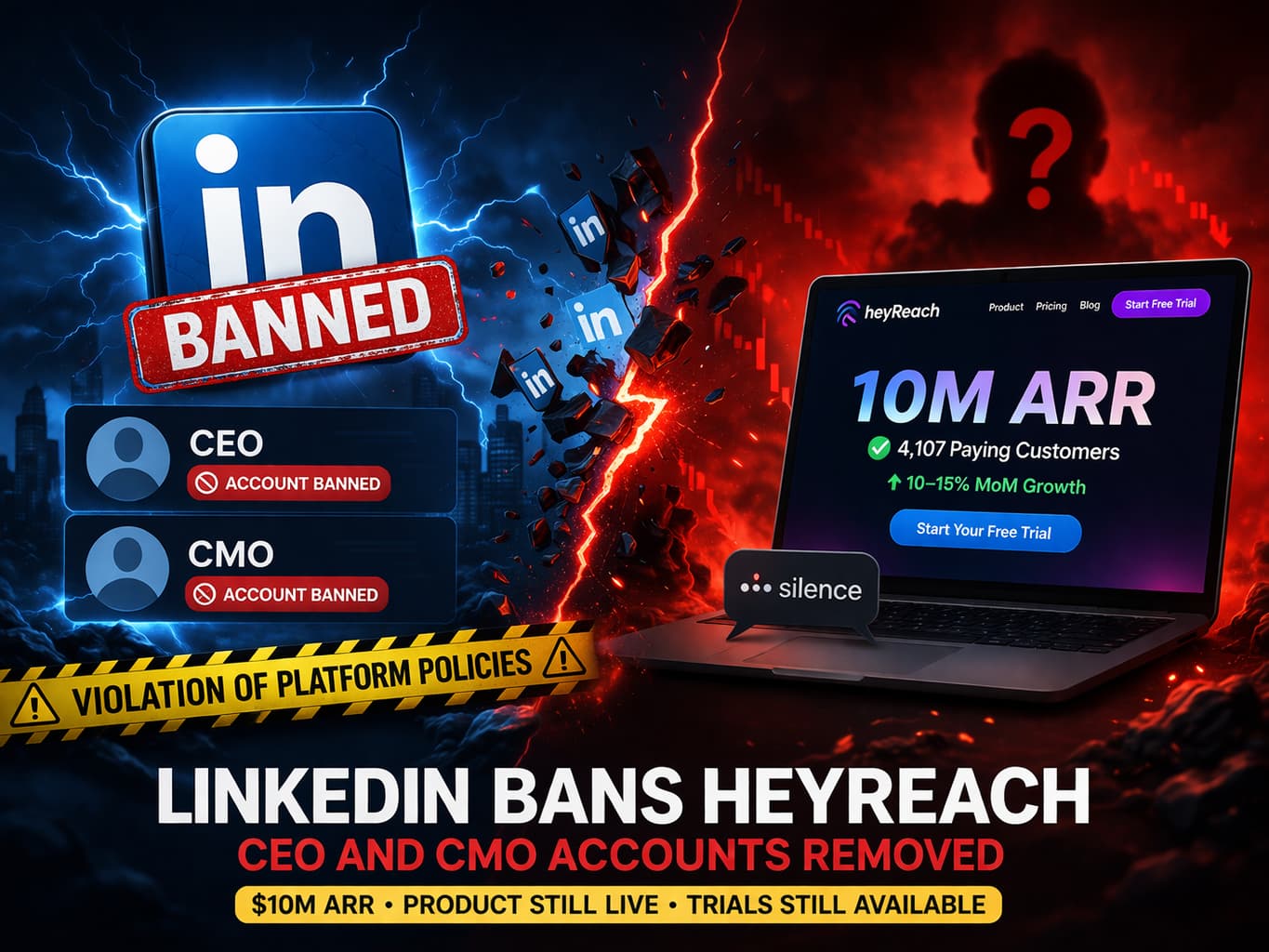
When I looked into the latest wave of posts about LinkedIn banning HeyReach, I found a story that is bigger than HeyReach itself. On the surface, this looked like another sales tech drama cycle. A fast-growing outreach tool gets knocked off the platform, people on LinkedIn argue about whether automation is evil or inevitable, and the product team says customers are still fine.
But the real story is more important. LinkedIn is showing, again, that it wants total control over who gets to build on top of its graph, who gets to extract value from its data, and who gets punished for trying to scale around its limits.
That is why this matters now. HeyReach had just publicly celebrated crossing $10 million in annual recurring revenue, which made the timing especially striking. This was not a tiny tool getting quietly throttled. This was a fast-growing company that had found real product-market fit in one of the most profitable gray zones in B2B software.
The core question I set out to answer was simple: what exactly happened to HeyReach, and what does it tell us about the future of LinkedIn automation?
What most commentary misses is that this is not really a morality play about spam. It is a control story. LinkedIn is not merely fighting bad actors. It is defending the economic boundaries of its platform, especially around data access, outreach automation, premium subscriptions, and the user experience inside its own walls.
Key takeaways
- LinkedIn appears to have removed HeyReach’s company presence on the platform, while public reports from people close to the company said the product itself kept running.
- The exact list of restricted HeyReach accounts has not been publicly detailed by LinkedIn, which leaves room for rumor and overstatement.
- The timing was notable because HeyReach had just announced it crossed $10 million ARR after rapid growth.
- This looks less like an isolated punishment and more like part of LinkedIn’s broader campaign against scraping, browser extensions, and third-party automation.
- Apollo, Seamless.ai, Amplemarket, and other vendors have faced similar platform pressure, removals, or restrictions in the last year.
- The biggest strategic risk for HeyReach is not one bad week of PR. It is long-term platform dependency.
What happened to HeyReach on LinkedIn?
One important update I need to add based on the latest evidence: this was not limited to a company page issue.
Both the CEO (Nick Velkovski) and the CMO (Vukašin Vukosavljević) appear to have had their LinkedIn profiles banned or made inaccessible at the same time the company presence disappeared.
That detail changes the interpretation significantly.
When a platform removes not just a company page but also senior leadership profiles, it is usually not a cosmetic action. It is a signal that enforcement is targeting behavior patterns tied to accounts, not just branding or visibility.
Based on the screenshots and public discussion:
- HeyReach’s company page became unavailable
- The CEO’s LinkedIn profile (Nick Velkovski) was reported as banned
- The CMO’s LinkedIn profile (Vukašin Vukosavljević) was also reported as banned
This suggests a coordinated enforcement action rather than a random or isolated moderation event.
Several public posts described the company page as removed. At least some of the chatter also suggested that one or more personal profiles associated with the company were unavailable at the same time. I have not seen LinkedIn publish a formal public explanation naming every affected account, so I would be careful not to overstate what is fully confirmed.
What seems most credible at this stage is the following:
- HeyReach’s company visibility on LinkedIn was disrupted or removed
- Public comments attributed to HeyReach said customer campaigns were still running
- The market interpreted the move as part of LinkedIn’s ongoing crackdown on automation and scraping-adjacent tools
That distinction matters. A platform ban can mean different things. It can mean a company page disappears. It can mean employee accounts are restricted. It can mean API or extension access is blocked. Or it can mean a tool’s core workflow becomes unusable. In HeyReach’s case, the signal so far looks more reputational and strategic than instantly existential.
What HeyReach said, and what I think that means
Another important point I want to clarify based on what I could verify directly.
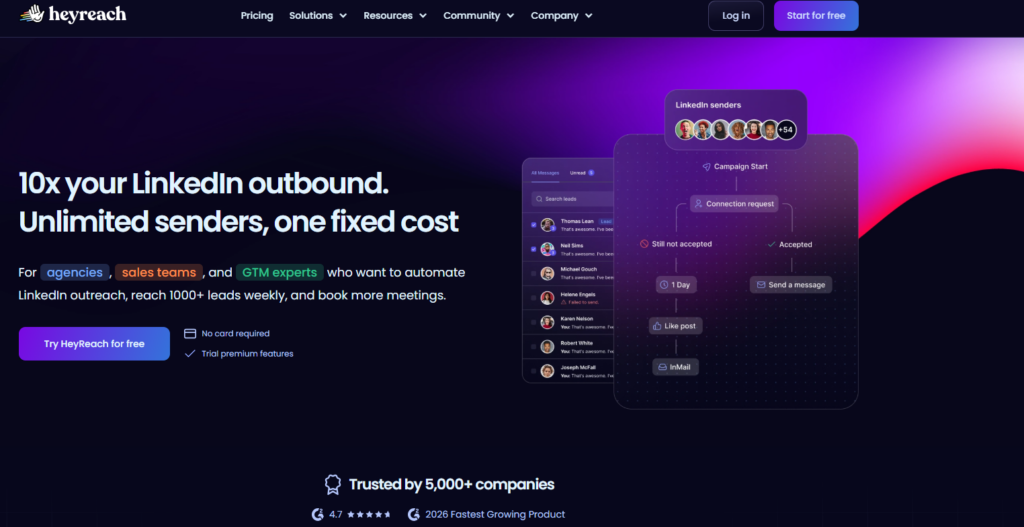
As of now, there is no clear public statement on HeyReach’s website addressing the LinkedIn ban. The site is still live, and the product is still being actively promoted, including offering a free trial.
That creates an interesting disconnect.
On one hand, the external narrative on LinkedIn suggests enforcement against the company and its leadership accounts. On the other hand, the official product surface gives no indication of disruption and continues to operate as usual.
So the most accurate way to frame it right now is:
- The HeyReach website is still live
- The free trial is still being offered
- There is no formal public statement on the site about the incident
- Based on available signals, the product appears to still be running, but I cannot independently confirm the full extent of impact
This uncertainty is important. In platform-dependent businesses, the gap between what is publicly visible and what is operationally happening behind the scenes can be significant.
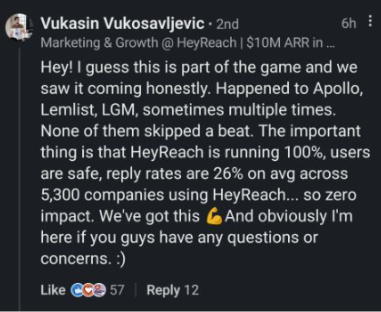
The most widely shared defense from the HeyReach side was that the tool was still operating, users were safe, and performance data across customers remained strong. In the screenshots shared around the incident, a HeyReach representative framed the event as something that had happened to other tools before and argued there was effectively zero impact on customers.
I would read that claim in two parts.
First, it may be true operationally in the very short run. A company can lose its LinkedIn page and still have a functioning SaaS product. That is not contradictory.
Second, it may be too optimistic strategically. When a platform starts making examples out of companies in your category, the real risk is not just whether campaigns run this week. The real risk is whether your acquisition, compliance posture, product roadmap, and customer trust become harder to maintain over the next 6 to 18 months.
This is especially true for a company like HeyReach, whose core value proposition is tied directly to scaling activity across multiple LinkedIn accounts.
Why the timing matters so much after the $10 million ARR milestone
The most interesting part of this story is the timing.
HeyReach had only recently celebrated crossing $10 million ARR. Publicly shared figures around that milestone pointed to a very fast climb, with thousands of paying customers and strong month-over-month growth. That made the LinkedIn action feel less like routine moderation and more like a reminder of platform power.
Here is the strategic contrast I see:
| Metric or event | What was publicly claimed | Why it matters |
|---|---|---|
| ARR milestone | $10 million ARR | Shows HeyReach is no niche experiment |
| Paying customers | 4,107 at milestone announcement | Suggests meaningful market adoption |
| Reported growth rate | 10% to 15% month over month | Indicates strong momentum before the controversy |
| Public product defense after ban chatter | Users unaffected, campaigns still running | Attempts to reassure market and customers |
| Platform action | LinkedIn presence reportedly removed or restricted | Reveals core dependency on a hostile platform |
That table gets to the heart of the issue. HeyReach reached scale in a category that LinkedIn has been telling the market, for years, it does not really want to exist.
A lot of founders read growth as validation. Platforms often read it as a threat.
Was HeyReach actually violating LinkedIn’s rules?
Here is where the debate gets noisy, but the official policy is not ambiguous.
LinkedIn explicitly says it does not permit third-party tools, browser extensions, bots, scripts, or other technologies that scrape data, modify the site, or automate activity. It also says fake accounts and algorithm manipulation are prohibited. From LinkedIn’s point of view, this is not a gray area. It is spelled out in its help documentation and user agreement.
That does not automatically answer every factual question about HeyReach’s internal methods. But it does explain why LinkedIn has broad discretion to act against products in this category.
This is where many founders and users talk past each other.
Users often say, “But the tool is safe if I stay within limits.”
LinkedIn’s position is not really about whether your daily volume feels reasonable. Its position is that unauthorized automation itself is the problem.
That difference is crucial. Many tools in this market pitch themselves as compliant because they pace actions, use proxies, warm up accounts, or distribute activity across multiple profiles. But a safer violation is still a violation if the platform decides to enforce strictly.
Why LinkedIn is intensifying the war on third-party tools
I do not think this is just about keeping spam down, although spam absolutely matters.
I think LinkedIn has at least four motives operating at the same time.
1. It wants to protect member data
LinkedIn has repeatedly framed scraping as a member privacy issue. That is not just PR language. In 2025, LinkedIn publicly highlighted legal action against Proxycurl over scraping and fake accounts. That tells me the company is willing to move beyond quiet moderation and into formal legal escalation when it sees industrial-scale extraction.
2. It wants to defend premium product economics
LinkedIn monetizes access, intent, and workflow through products like Sales Navigator, recruiter tools, and advertising. Any third-party vendor that helps users bypass friction, pull more data, or automate outreach at lower cost threatens that monetization stack.
This is why I do not buy the simplistic narrative that the issue is only “bad spammy tools.” Even a polished tool that users love can still be strategically unwelcome if it weakens LinkedIn’s pricing power.
3. It wants to preserve feed and messaging quality
LinkedIn knows what happened to email. Once automation becomes too cheap and too easy, the channel fills with low-effort outreach. Trust falls. Response rates fall. Platform quality falls.
That logic was reflected in several of the public reactions to the HeyReach story. Even some people sympathetic to founders in this space admitted the channel gets worse when too many tools industrialize outbound.
4. It wants full control over product innovation on top of its graph
This is the point many operators ignore. Platforms rarely like it when outsiders innovate faster on core use cases than they do. If LinkedIn wants AI assistance, prospecting workflows, drafting tools, or sequencing capabilities inside its own ecosystem, the last thing it wants is a thriving external layer normalizing that value capture elsewhere.
HeyReach is not alone, and that is the bigger signal
The public commentary around the HeyReach ban repeatedly referenced other companies that have already been hit, including Apollo.io, Seamless.ai, Amplemarket, and others in the broader lead generation and sales automation stack.
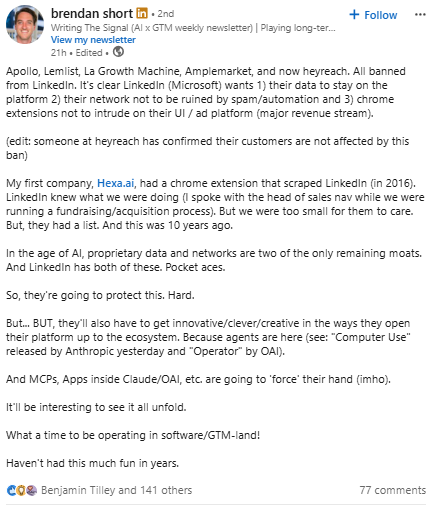
I want to be careful here. Not every rumor in this category is equally well documented, and different companies have faced different kinds of enforcement. Some saw company pages disappear. Some were accused of scraping. Some changed product messaging. Some kept operating while losing platform-level visibility.
Still, the pattern is clear enough to matter.
| Company | Publicly reported issue | My read on the signal |
|---|---|---|
| Apollo.io | Company page removal and scraping-related scrutiny | LinkedIn will go after very large, well-known vendors |
| Seamless.ai | Similar public reports to Apollo | Big brand size does not protect you |
| Amplemarket | Public chatter about disappearance from LinkedIn | The crackdown is not limited to one product style |
| Artisan | Restriction followed by return after changes | LinkedIn can use pressure to force concessions |
| HeyReach | Company presence reportedly removed while product kept running | Even fast-growing specialists are exposed |
That last row is the most interesting one to me. It suggests LinkedIn does not need to “kill” a tool outright to send a message. Sometimes it only needs to demonstrate that your visibility, reputation, and distribution are rented, not owned.
What does this mean for HeyReach’s future?
This is where the analysis gets more nuanced.
I do not think the most likely outcome is that HeyReach simply disappears tomorrow. Fast-growing B2B tools often prove surprisingly resilient, especially when their customers already have embedded workflows, trained teams, and real ROI.
But I do think the company now faces three serious strategic problems.
Distribution risk gets worse
If LinkedIn becomes more aggressive about removing company presence, restricting profiles, or discouraging public promotion of these tools, customer acquisition gets harder. That does not mean impossible. It means more expensive, less direct, and less durable.
Trust risk goes up
Even when existing customers stay put, prospective buyers start asking a different question. They stop asking whether the tool works. They start asking whether the tool is survivable.
That is a much harder objection to beat, especially for agencies and revenue teams managing multiple client accounts.
Product risk compounds over time
A tool built around multiple senders, account rotation, and scaled LinkedIn activity becomes structurally vulnerable if LinkedIn tightens detection, identity checks, browser fingerprinting, or policy enforcement.
In other words, the product may keep working while the long-term margin of safety keeps shrinking.
The uncomfortable truth about “safe” LinkedIn automation
This is where I think the market has been misleading itself.
A lot of outreach software positions itself as “safe,” “compliant,” or “built within limits.” But that language often confuses practical risk reduction with actual platform permission.
Those are not the same thing.
A tool can reduce the odds of triggering enforcement while still living inside a category LinkedIn has explicitly prohibited.
That is exactly why this story matters. HeyReach did not get targeted because the market had no demand for the product. Quite the opposite. It got attention because the demand is real, the product category is valuable, and the platform owner does not want outside companies controlling that layer.
My bottom line on the HeyReach ban
After reviewing the available public evidence, I think the cleanest way to say it is this:
LinkedIn’s move against HeyReach looks less like an isolated moderation event and more like another episode in a long-running campaign to fence off its data, its workflow layer, and its monetization model from third-party capture.
HeyReach’s recent growth makes the story more interesting, not less. Crossing $10 million ARR proved there is real market appetite for scaled LinkedIn outreach infrastructure. The ban chatter proved that product-market fit does not remove platform risk. In some categories, it increases it.
What I am watching next is whether LinkedIn escalates from page and profile enforcement to deeper disruption of how these products operate, and whether vendors in this category diversify hard enough to reduce their dependence on LinkedIn alone.
The biggest uncertainty is not whether outbound automation demand will persist. It will. The uncertainty is which companies can keep monetizing that demand when the platform underneath them is openly hostile.
For HeyReach, the next chapter is not just about surviving a ban cycle. It is about proving that a company built in LinkedIn’s shadow can still build a future outside LinkedIn’s control.
Sources I reviewed while reporting this
I reviewed LinkedIn’s official policy pages on prohibited software, automated activity, and the user agreement. I also reviewed LinkedIn’s 2025 statement on legal action against Proxycurl, public reporting from MarTech and TechCrunch on related enforcement actions, public milestone posts from HeyReach leadership on the company’s $10 million ARR achievement, and the LinkedIn screenshots and posts you shared showing how the HeyReach incident was being discussed in real time.
Relevant reading: