
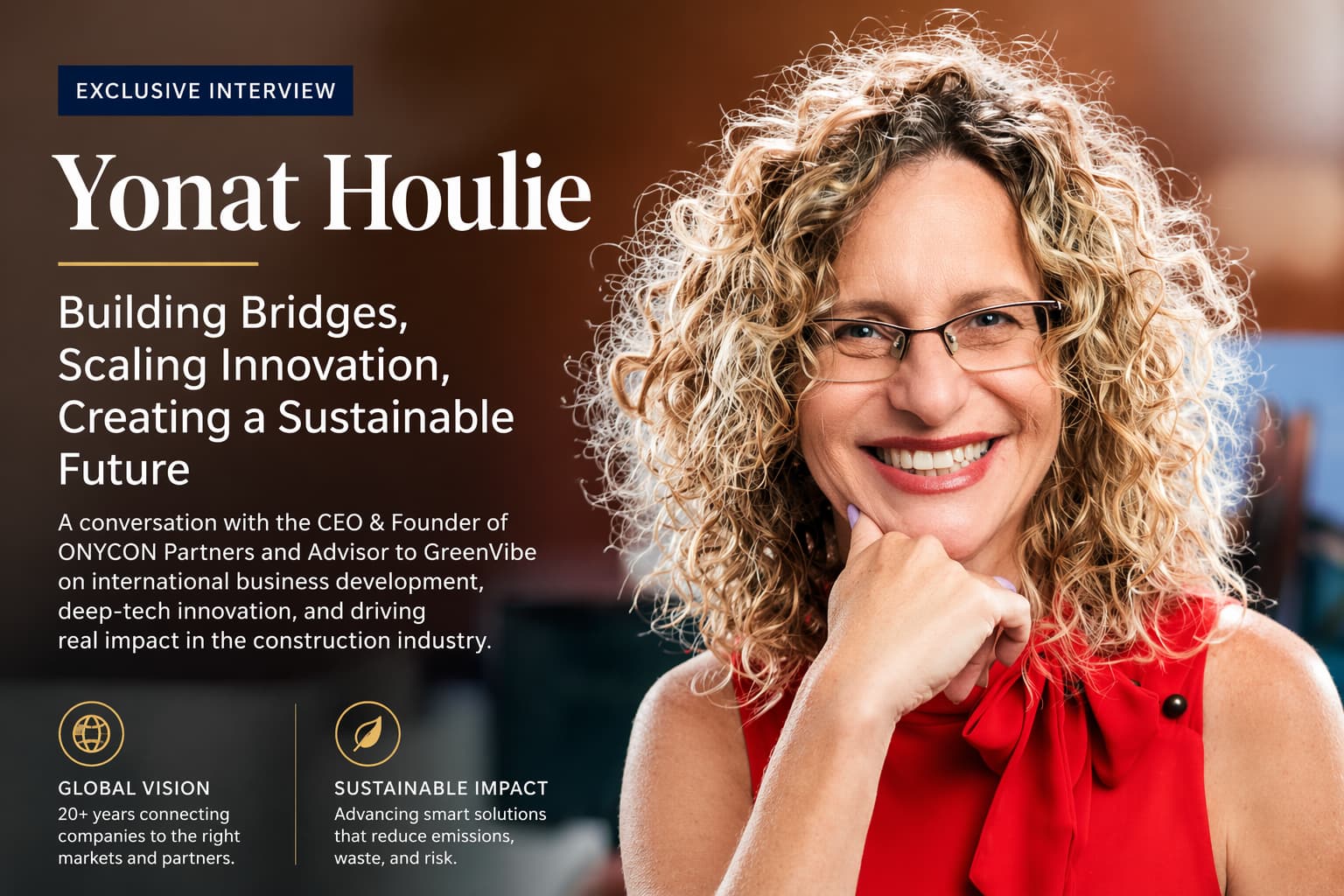
When I look at the people who stand out in international business development, I usually find the same pattern. They do more than open doors. They understand markets, build trust across cultures, and know how to connect innovation with real commercial opportunity.
That is exactly what stood out to me about Yonat Houlie.
As the CEO and Founder of ONYCON Partners, and an advisor to GreenVibe, Yonat works at the intersection of international growth, strategic partnerships, and sustainable innovation. Her work spans new market entry, cross-border dealmaking, and the commercialization of technologies that solve real-world problems. In GreenVibe’s case, that means smarter concrete monitoring and a more data-driven, lower-waste construction industry.
I spoke with Yonat about what great business development actually looks like today, why sustainability needs stronger commercial storytellers, and what companies still get wrong when trying to expand internationally.
Interview with Yonat Houlie
Q: You have spent years working across international markets. What drew you into business development in the first place?
What drew me in was the human side of growth.
Business development is often described as sales, partnerships, or market expansion. For me, it has always been about building bridges. Between companies and markets. Between innovation and execution. Between a strong product and the people who actually need it.
I realized early on that many companies do not fail because their product is weak. They fail because they do not know how to enter a market properly, how to build the right relationships, or how to translate their value in a way that resonates locally.
That is where I found my space. I love helping companies move from potential to traction.
Q: How do you define great business development today?
Great business development is not about sending more emails or having a bigger contact list.
It is about understanding where a company can create real value, then building the right path to get there. That includes strategy, positioning, timing, cultural awareness, and trust.
Too many people think business development starts when you pitch. In reality, it starts much earlier. It starts with listening well, understanding the market, and knowing how to create relevance.
The best business development professionals are not just connectors. They are translators. They help companies speak the language of a new market, a new sector, or a new kind of buyer.
Q: You advise GreenVibe, a company focused on smart concrete sensors. What interested you about that opportunity?
GreenVibe immediately stood out to me because it sits at the intersection of technology, infrastructure, and sustainability.
Construction is one of the world’s most traditional industries, but it is also one of the sectors where better data can create enormous impact. When you bring real-time monitoring, more accuracy, and better decision-making into concrete processes, you are not only improving efficiency. You are also reducing waste, saving energy, and helping lower the carbon footprint of construction.
That is the kind of innovation I believe in.
I am especially drawn to companies that are solving meaningful industrial problems, not just creating noise. GreenVibe has the potential to modernize an industry that urgently needs smarter and more sustainable solutions.
Q: Sustainability has become a major business theme. What separates a real sustainable solution from a marketing story?
A real sustainable solution delivers measurable operational value.
That is the difference.
If a company talks about sustainability only in brand language, I become cautious. But when a solution helps reduce waste, improve precision, lower unnecessary resource use, or create better long-term efficiency, that is where sustainability becomes commercially powerful.
The strongest sustainable solutions are not built on slogans. They are built on performance.
That is also why I believe sustainability and business development need to be much more connected. If we want meaningful solutions to scale, we need people who can translate technical and environmental value into commercial momentum.
Q: What do companies usually get wrong when they try to expand internationally?
The biggest mistake is assuming that what worked in one market will automatically work in another.
It will not.
Every market has its own rhythm, expectations, decision-making structures, and relationship dynamics. Companies often underestimate how much local understanding matters. They focus on the product and ignore the context.
Another common mistake is rushing into introductions without a clear strategy. You do not need more meetings. You need the right meetings, with the right positioning, at the right stage.
International growth is not about being everywhere. It is about entering the right places with discipline and credibility.
Q: You work across cultures and industries. How important is trust in business development?
Trust is everything.
I do not think deals are built on presentations alone. They are built on credibility, consistency, and the ability to understand people across different backgrounds and business cultures.
Cross-cultural negotiation is not just about language. It is about tone, expectations, pace, and respect. It is about knowing when to move fast and when to give a relationship time to develop.
In international business development, trust turns introductions into partnerships. Without it, even a great opportunity usually stalls.
Q: What makes business development especially powerful in deep-tech and sustainability?
In both of those areas, the challenge is rarely just the technology itself.
The challenge is adoption.
A company can have an outstanding solution, but if the market does not understand it, trust it, or know how to implement it, growth becomes much harder. That is why business development matters so much in deep-tech and sustainability. These sectors often need someone who can bridge the gap between technical excellence and commercial reality.
You need to show not only why the technology is impressive, but why it matters in practice. How it reduces risk. How it saves time. How it lowers costs. How it supports a broader shift toward smarter and more responsible industries.
Q: What do you look for before helping a company grow internationally?
I look at three things first.
The first is whether the company solves a real problem.
The second is whether the leadership is serious about long-term market building, not just short-term wins.
The third is whether there is a clear value proposition that can travel.
Not every business is ready to expand. Sometimes the product is strong, but the message is not ready. Sometimes the ambition is there, but the go-to-market model is still too vague.
The companies that scale best are usually the ones willing to combine vision with discipline.
Q: What is your advice to someone who wants to build a career in business development?
Be curious, and build depth.
A lot of people approach business development as networking. Networking matters, of course, but it is not enough. You need to understand industries. You need to understand how buyers think. You need to know how deals actually move.
Learn how to listen. Learn how to identify real opportunity. Learn how to communicate value with clarity.
And most importantly, build a reputation for substance. In the long run, people remember who created real value, not who talked the most.
Q: What excites you most about the future of sustainable innovation?
What excites me is that sustainable innovation is becoming more practical, more measurable, and more commercially relevant.
We are moving beyond the stage where sustainability was treated as a nice extra. Today, in many sectors, it is becoming part of how competitive companies operate. Better data, lower waste, smarter processes, and more efficient resource use are no longer side benefits. They are becoming business priorities.
That creates enormous opportunity for companies that can deliver real solutions and for business development leaders who know how to bring those solutions to market globally.
Final Thoughts
What I found most compelling in speaking with Yonat is that her view of business development is both strategic and grounded. She does not talk about growth as a vague ambition. She talks about it as a disciplined process of understanding markets, building trust, and helping meaningful innovation reach the people and industries that need it most.
For companies in deep-tech, construction, sustainability, and B2B innovation, that mindset matters.
And for anyone looking for serious business development leadership, Yonat Houlie makes a strong case for what modern BD should actually look like: international, relationship-driven, commercially sharp, and closely tied to solutions that create measurable impact.