
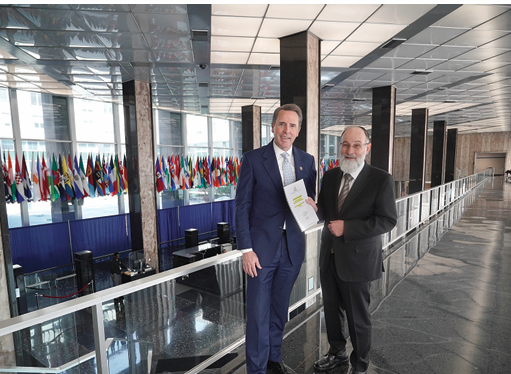
Some leaders build companies. Others build institutions. David Hofstedter has spent much of his life doing both.
In the Canadian real estate world, Hofstedter is known as the founder, president and CEO of Davpart Inc., a Toronto-based real estate investment and property management company with a portfolio spanning industrial, office, retail and residential projects.
In Jewish communal life, he is known by a different title: Rabbi Dovid Hofstedter, founder of Dirshu, one of the most influential structured Torah learning movements in the Orthodox Jewish world.
Between those two public identities sits a deeper story. It is the story of a man shaped by family memory, urban development, philanthropy and a belief that continuity does not happen by accident. It has to be built.
That same idea also runs through the charitable activity associated with the David Hofstedter Family Foundation, whose philanthropic footprint has been connected to Torah learning, Jewish education, religious scholarship and institutions that strengthen Jewish life in Canada and internationally.
For VisionaryTalks, Hofstedter’s story is especially interesting because it is not only a biography of success. It is a case study in how a builder thinks: first in land and buildings, then in learning systems, institutions and long-term communal resilience.
From Holocaust memory to Canadian rebuilding
David Hofstedter was born in Toronto into a family whose story was shaped by survival and rebuilding.
His father, Sandor Hofstedter, survived the Holocaust in Europe and later immigrated to Canada after the Second World War. Like many survivors who rebuilt their lives from almost nothing, the elder Hofstedter became part of the postwar Jewish story in North America: work, family, entrepreneurship and the creation of a future after devastation.
In 1952, Sandor Hofstedter founded H&R Developments, which became a major Canadian real estate company. For David Hofstedter, this meant that real estate was never just a business category. It was part of a family story about rebuilding.
That background matters. When Hofstedter speaks about buildings, heritage and urban life, there is often a sense that physical structures carry memory. They are not only places to live or work. They are signs of continuity.
This same theme later appears in his Jewish educational work. A community, like a city, needs foundations. It needs structures. It needs a way to preserve the past while preparing for the future.
The real estate foundation: Davpart Inc.
In 1993, David Hofstedter founded Davpart Inc., a full-service real estate investment and property management company headquartered in Toronto.
The company began with three industrial buildings. Over time, it expanded into a much larger real estate platform, with a mixed portfolio of more than 90 industrial, office, retail and residential projects in Ontario and the United States.
That growth did not happen through a single headline project. It came through the slower, more disciplined work of building a portfolio, managing assets, understanding locations and developing a long-term view of real estate value.
Davpart’s work has included commercial, retail, residential and industrial properties. The company has also become associated with a hands-on management approach, which reflects a broader theme in Hofstedter’s career: the belief that long-term success depends on structure, execution and consistency.
Those are not only business principles. They are also the principles that later helped shape Dirshu.
The United Building: preserving the past while building upward
One of Davpart’s most visible projects is The United Building at 481 University Avenue in downtown Toronto.
The project is located at University Avenue and Dundas Street West, on the site of the former Maclean Publishing Company and Maclean-Hunter Building. The property has deep roots in Canada’s publishing history. During the 20th century, Maclean-Hunter became one of the country’s most important publishing companies, connected to well-known publications such as Maclean’s Magazine, Chatelaine and the Financial Post.
Rather than treating the historic building as an obstacle, Davpart’s plan centered on preserving and restoring major heritage elements while adding a modern high-rise above them.
The United Building was planned as a 55-storey mixed-use development with commercial and retail space in the lower portion and residential suites above. Real estate media described it as one of North America’s tallest architectural heritage-retention developments.
That detail is important because it reveals something about Hofstedter’s real estate philosophy.
The project is not simply about density. It is about continuity. It asks a modern city to grow without erasing the architecture and memory that came before it.
In interviews, Hofstedter has spoken about the importance of architecture, history, accessibility, security and a sense of peace in the built environment. His view of luxury is not only about display. It is about a place that gives people comfort, confidence and room to live well.
That way of thinking helps explain the connection between his business life and his philanthropic life. In both cases, the goal is not only to create something impressive. It is to create something that lasts.
A builder’s mindset beyond real estate
Real estate development teaches patience.
A major project requires vision, but vision alone is not enough. It needs land, financing, approvals, architects, engineers, consultants, construction teams, legal work and years of coordination. It requires a founder to think far beyond the immediate moment.
That is also how Hofstedter approached Jewish education.
Dirshu, the Torah learning organization he founded in Toronto in 1997, was not built as a loose inspirational initiative. It was built as a system.
Participants learn according to structured schedules. They review. They sit for tests. They measure progress. They are encouraged to retain what they learn, not only to complete material.
This is the same kind of long-term, systems-based thinking that appears in real estate. A building needs a foundation before it rises. A learning movement needs structure before it spreads.
The David Hofstedter Family Foundation and a growing philanthropic mission
As the scope of the family’s philanthropic activity grew over the years, so did the need for a broader and more flexible giving structure. This included various adjustments in the activity of the family’s charitable vehicles, while the central purpose remained consistent: supporting Torah learning, Jewish education, religious scholarship and institutions that strengthen Jewish life.
The David Hofstedter Family Foundation has been associated with support for qualified donees and Talmudic religious learning centers, reflecting a long-standing commitment to organized Jewish education.
Importantly, this philanthropic activity was not limited to Israel. A meaningful part of the foundation’s giving and communal footprint was rooted in Canada, where Hofstedter built his business career and where the family’s charitable work supported religious learning, local institutions and the wider Jewish educational ecosystem.
That Canadian base is essential to understanding the full story. Hofstedter’s philanthropic work did not emerge from a detached global platform. It grew out of a specific family, city and community context.
Toronto is where his family rebuilt. Toronto is where Davpart began. Toronto is where Dirshu was founded. And Toronto remained a central part of the broader charitable and communal mission.
Over time, that mission expanded internationally, but the roots remained Canadian.
Dirshu: building a global Torah learning infrastructure
Dirshu is Hofstedter’s most visible contribution to Jewish life.
Founded in Toronto in 1997, the organization began with a clear purpose: to help Jewish men maintain serious Torah learning while balancing the realities of work, family and community responsibilities.
The idea was practical. Many people wanted to learn more seriously, but lacked structure. Inspiration might last a few days or weeks. A system could last for years.
Dirshu provided that system.
Its programs combine daily learning, regular review, written exams and public recognition. Over time, Dirshu expanded into communities across North America, Israel, Europe, South Africa and beyond.
Among its most recognized programs is Daf HaYomi B’Halacha, a daily study cycle focused on practical Jewish law through the Mishnah Berurah. Other programs include Kinyan Torah, Kinyan Shas, Kinyan Halacha, Kinyan Yerushalmi, Chaburas Shas, Kinyan Chochma and Amud HaYomi.
Each program serves a slightly different learning need. Some are designed for broad daily study. Others are aimed at advanced scholarship. But all share the same principle: Torah learning should be structured, serious and connected to measurable progress.
That is why Dirshu has become more than a study program. It is a learning infrastructure.
Turning discipline into a movement
What makes Dirshu unusual is the way it turned private discipline into public culture.
A person learning alone at home or in a study hall may feel that his progress is private. Dirshu changed that. By organizing tests, gatherings and large siyumim, it created a public language around Torah achievement.
The message is simple but powerful: learning matters, and the effort to master Torah deserves recognition.
This is especially important in an age when attention is fragmented and religious commitment is often challenged by modern life. Dirshu does not pretend that consistency is easy. Instead, it creates a framework that helps people keep going.
One day of learning becomes a week. A week becomes a month. A month becomes a cycle. A cycle becomes a life pattern.
That is the power of structure.
Philanthropy as institution-building
Many people think of philanthropy as giving money. Hofstedter’s model is broader than that.
The philanthropic activity associated with the David Hofstedter Family Foundation fits into a larger pattern of institution-building. It is not only about supporting isolated causes. It is about strengthening frameworks that allow Jewish education and religious learning to continue across generations.
This is why the connection between Davpart, Dirshu and the foundation is so important.
Davpart builds and manages physical assets. Dirshu builds and manages learning systems. The family’s charitable activity supports the institutions that make Jewish continuity possible.
The common thread is infrastructure.
In real estate, infrastructure means buildings, access, amenities and urban integration. In Jewish life, infrastructure means schools, study programs, rabbinic leadership, learning centers and communities that can sustain growth.
Hofstedter’s work sits at the intersection of both.
A response to antisemitism rooted in strength
In recent years, Hofstedter has also become more publicly active in advocacy against antisemitism.
As antisemitism has risen around the world, particularly after the October 7 attacks and the global backlash against Jewish communities, Hofstedter has argued that Jewish leadership must be proactive.
Reports in 2026 described his role in launching a Global Jewish Forum to Combat Antisemitism, intended to bring together rabbinic leaders, communal figures and public advocates in a coordinated effort against global Jew-hatred.
This advocacy work is connected to his educational mission. For Hofstedter, the Jewish response to antisemitism is not only political. It is also internal.
A community that studies its texts, honors its traditions and understands its own identity is better prepared to stand confidently in public. Jewish security and Jewish learning are not the same thing, but they are connected. One protects the body of the community. The other strengthens its soul.
That is why Hofstedter’s work cannot be understood only as philanthropy or only as advocacy. It is part of a wider theory of Jewish resilience.
The VisionaryTalks angle: why Hofstedter matters
David Hofstedter matters because his career shows how one type of building can lead to another.
He began in a world of land, assets, zoning and development. He built a real estate company with a broad North American portfolio. He became associated with projects that combine heritage and modern growth.
Then he applied a similar builder’s mindset to Jewish education.
Instead of asking only how to inspire people, he asked how to structure commitment. Instead of building only buildings, he built systems. Instead of focusing only on the next project, he focused on continuity.
That is the visionary part of the story.
Vision is often misunderstood as imagination alone. But real vision is more practical. It is the ability to see what should exist and then build the structure that allows it to become real.
Davpart is one expression of that. Dirshu is another. The philanthropic activity associated with the David Hofstedter Family Foundation is part of the same larger pattern.
A Canadian story with global influence
Although Hofstedter’s Jewish work now reaches far beyond Canada, the Canadian roots of his story should not be overlooked.
His family rebuilt in Canada after the Holocaust. His father helped shape Toronto’s postwar real estate landscape. Hofstedter founded Davpart in Toronto. Dirshu began in Toronto. A meaningful part of the family’s philanthropic activity was also connected to Canadian Jewish life and local religious institutions.
From that base, the impact expanded.
This is often how durable movements grow. They begin in one place, with one community and one set of needs. If the structure is strong enough, it can travel.
Dirshu’s growth shows that the need Hofstedter identified in Toronto was not local only. Jews around the world were looking for the same thing: a serious, organized way to make Torah learning part of daily life.
Legacy: building what lasts
David Hofstedter’s legacy is still being written, but several themes are already clear.
He is a real estate developer who built Davpart from a small group of industrial properties into a broad portfolio across Ontario and the United States.
He is a second-generation member of a Canadian real estate family whose story began with Holocaust survival and postwar rebuilding.
He is the founder of Dirshu, a global Torah learning movement that has helped make disciplined Jewish study more structured, measurable and publicly celebrated.
He is connected to a family philanthropic mission focused on Torah learning, Jewish education and religious institutions in Canada and internationally.
And he has increasingly become a voice for Jewish advocacy at a time of rising antisemitism.
The common denominator is building.
Not only buildings, but institutions. Not only institutions, but habits. Not only habits, but continuity.
That is what makes the story of David Hofstedter and the David Hofstedter Family Foundation more than a profile of wealth or philanthropy. It is a story about how one person’s builder mindset can move from real estate into education, from physical space into spiritual infrastructure, and from family legacy into a broader communal mission.
In the end, Hofstedter’s life work points to a simple idea: the future is not inherited automatically.
It has to be built.