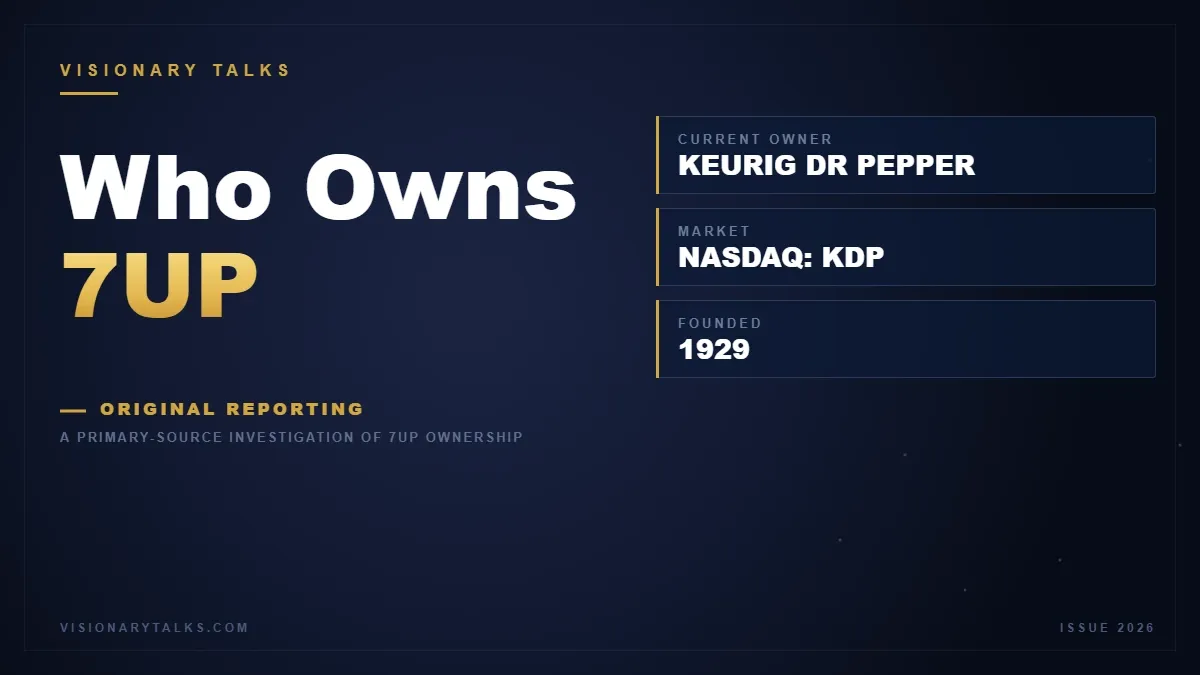
As of September 2026, 7UP in the United States is owned 100 percent by
Keurig Dr Pepper (NASDAQ: KDP), while outside the United States it is owned and distributed by PepsiCo. The brand has been split geographically since 1986, and it was split by a regulator rather than by choice: the Federal Trade Commission moved to block PepsiCo from buying the US business, PepsiCo kept the international rights, and the two halves have never been reunited.
Confused about which cola giant makes what? See the full
Coke vs Pepsi vs Dr Pepper brand map, covering 60 US beverage brands and their true parents.
This unusual ownership structure matters because it shapes distribution power, pricing strategy, and competitive dynamics in the global soft drink market. For investors and operators, 7UP is a case study in how intellectual property, bottling networks, and regional contracts can redefine who truly owns a brand.
What changed in 2026
Neither half of 7UP changed hands in 2026. The US owner is being restructured around it, and the change is real.
On June 11, 2026, JAB BevCo B.V., a subsidiary of JAB Holding Company, announced it had sold its remaining stake in Keurig Dr Pepper, about 59.1 million shares or roughly 4.3 percent of KDP's outstanding common stock, in an unregistered block trade run by J.P. Morgan Securities LLC. That was the last of it. The investment group behind the 2018 merger that handed KDP the US rights to 7UP now owns none of the company.
KDP also closed its roughly 15.7 billion euro acquisition of JDE Peet's in April 2026, and in a June 23, 2026 leadership update confirmed it is separating into two independent public companies, Beverage Co. and Global Coffee Co., now targeted for early 2027. US 7UP is named in the Beverage Co. portfolio, next to Dr Pepper, Canada Dry, Mott's, A&W, Snapple and Clamato. Global Coffee Co. is the tax-free spin-off, so Beverage Co. keeps the existing KDP listing: the ticker that owns US 7UP does not change, but the company behind it will be roughly half the size.
Who Owns 7UP Right Now?
As of September 2026, 7UP in the US is part of the Keurig Dr Pepper portfolio. Keurig Dr Pepper, publicly traded on the NASDAQ under the ticker KDP, gained the US 7UP brand through the 2018 merger of Dr Pepper Snapple Group and Keurig Green Mountain.
Internationally, 7UP is owned and distributed by PepsiCo, and has been since 1986. PepsiCo has integrated the brand into its global bottling and distribution system, placing it alongside Pepsi, Mountain Dew, and Mirinda in many markets.
This split means that when you buy a can of 7UP in New York, you are supporting KDP. When you buy one in London, Dubai, or Mumbai, you are supporting PepsiCo.
Ownership Snapshot
| Entity |
Ownership Stake |
Notes |
| Keurig Dr Pepper |
100 percent of US rights |
As of September 2026; moves to Beverage Co. in the planned early 2027 split |
| PepsiCo |
100 percent of international rights |
Owns and distributes 7UP outside the US |
The Portfolio: The Illusion of Choice
To the average consumer, 7UP feels like an independent lemon lime soda. In reality, it is embedded within two beverage giants that compete aggressively against each other.
Keurig Dr Pepper positions 7UP in the US as a complementary product to Dr Pepper, A and W, Canada Dry, and Sunkist. PepsiCo, internationally, uses 7UP as a direct rival to Coca Cola’s Sprite, often playing a challenger brand role in markets where Pepsi needs a non cola anchor.
This is what I call the illusion of choice. Consumers believe they are choosing between distinct brands, but investors see portfolio optimization across multiple labels controlled by a handful of conglomerates.
Parent Company Brand Portfolio
| Brand |
Segment |
Positioning |
| 7UP |
Lemon lime soda |
Mainstream citrus alternative |
| Dr Pepper |
Spiced cola |
Flagship brand in KDP US portfolio |
| Pepsi |
Cola |
Core global cola brand |
| Mountain Dew |
Citrus soda |
Youth oriented energy positioning |
Founders and Ownership Timeline
7UP was not born inside a conglomerate. It began as an entrepreneurial product during the Great Depression, when branding was experimental and the soda fountain was king.
7UP Founders
7UP was created in 1929 by Charles Leiper Grigg in St. Louis, Missouri. Originally named Bib Label Lithiated Lemon Lime Soda, the drink contained lithium citrate, which was later removed.
Grigg built the brand through his company, The Howdy Corporation. The formula and branding evolved, but the citrus positioning remained consistent.
Ownership History Timeline
| Year |
Event |
Ownership Impact |
| 1929 |
7UP founded by C L Grigg |
Independent ownership |
| 1967 |
Acquired by Westinghouse |
Becomes corporate subsidiary |
| 1978 |
Sold to Philip Morris |
Integrated into consumer conglomerate |
| 1986 |
Merges with Dr Pepper |
Creates Dr Pepper 7UP |
| 1986 |
Philip Morris sells international 7UP to PepsiCo; FTC moves to block the US half; Hicks & Haas buys the US business |
Split global ownership, created by antitrust intervention |
| 2018 |
Keurig merges with Dr Pepper Snapple |
US rights move to Keurig Dr Pepper |
| Jun 2026 |
JAB sells its last 4.3 percent of KDP |
No strategic blockholder left above US 7UP |
| Early 2027 (planned) |
KDP separates into Beverage Co. and Global Coffee Co. |
US 7UP assigned to Beverage Co., which keeps the KDP listing |
The 1986 transaction is the pivotal moment, and it did not go the way PepsiCo planned. Philip Morris, which bought The Seven-Up Company in 1978, agreed in January 1986 to sell most of it to PepsiCo for a reported $380 million. The Federal Trade Commission sought an injunction, arguing that letting PepsiCo take 7UP while Coca-Cola took Dr Pepper would hand roughly 80 percent of the US soft drink market to two companies. PepsiCo abandoned the domestic half under threat of suit and kept the international business. The US brand went to an investment group led by Hicks & Haas, passed through Dr Pepper Snapple, and reached KDP in 2018. The geographic split is a forty-year-old antitrust remedy nobody has undone.
Current Leadership and CEO
Because 7UP is divided geographically, leadership oversight depends on location. In the US, strategic direction flows through Keurig Dr Pepper’s executive team. Internationally, it sits under PepsiCo’s beverage leadership.
Leadership Snapshot
| Role |
Name |
Since |
| Chairman and CEO, Keurig Dr Pepper |
Bob Gamgort |
2018 |
| Chairman and CEO, PepsiCo |
Ramon Laguarta |
2018 |
KDP’s corporate governance and ownership structure are publicly available through filings on
SEC EDGAR for Keurig Dr Pepper. PepsiCo’s global brand portfolio and reporting can be reviewed through its investor relations page and annual filings.
Why This Ownership Structure Exists
The split ownership model is not accidental. It is the result of strategic asset reshuffling during the consolidation waves of the 1980s and 1990s.
When global beverage players competed for distribution scale, owning brands outright mattered less than controlling bottling networks. PepsiCo prioritized international distribution rights because its global infrastructure could monetize 7UP more efficiently outside the United States.
Meanwhile, Dr Pepper retained US rights, eventually merging into what is today Keurig Dr Pepper. The result is a distribution driven ownership structure, not a brand purity structure.
The Business Genius
The genius lies in territorial optimization. Each company monetizes 7UP where it holds distribution power and shelf leverage.
KDP uses 7UP to strengthen negotiations with US retailers. PepsiCo uses it internationally to compete more effectively against Coca Cola’s Sprite in markets where brand heritage is less tied to US corporate history.
The Risk
The primary risk is brand inconsistency. Marketing, formulation tweaks, and innovation strategies can diverge between regions.
From an investor perspective, this fragmentation caps the ability to build a unified global brand strategy. It also limits synergies that a single global owner might extract.
Tracing the Ownership Chain
To understand who truly owns 7UP, we need to go one level higher and look at who owns KDP and PepsiCo.
Ownership Layers
| Layer |
Owner |
Control |
| 7UP US |
Keurig Dr Pepper |
100 percent US rights |
| KDP |
Public shareholders |
Publicly traded company |
| 7UP International |
PepsiCo |
100 percent international rights |
| PepsiCo |
Public shareholders |
Publicly traded company |
Keurig Dr Pepper’s largest shareholders include institutional investors such as Vanguard and BlackRock, based on recent filings. PepsiCo’s top institutional holders are similarly large asset managers, as disclosed in its annual Form 10 K filings available via
PepsiCo investor relations.
Both parent companies are widely held public corporations. Ultimate control therefore rests with dispersed shareholders, guided by executive leadership and boards of directors.
Debunking the Common Misconception
A common misconception is that PepsiCo owns 7UP globally. That is not correct.
PepsiCo owns 7UP outside the United States. Inside the United States, 7UP belongs to Keurig Dr Pepper. This geographic split has existed for decades and remains in place as of 2026.
Confusion persists because PepsiCo markets 7UP aggressively in many large international markets, creating the perception of universal ownership. But in the US soda aisle, 7UP competes under a completely different corporate parent.
Key Takeaways for Entrepreneurs
- Brand ownership can be territorial, not global. Intellectual property and distribution rights may be sliced by geography, creating unexpected competitive dynamics.
- Distribution infrastructure often determines ownership outcomes. The player with the stronger route to market frequently captures the rights that matter most.
- Perception and reality diverge. Consumers think in brands, but investors must think in portfolios and contracts.
7UP is a simple lemon lime soda on the surface. Underneath, as of September 2026, it is a shared asset split between two beverage giants by a 1986 antitrust decision, and shaped since by mergers, divestitures, and strategic distribution plays. For founders and operators, the lesson is clear. Ownership structures can be as important as product quality, and sometimes the most powerful asset is not the recipe but the route to the shelf.