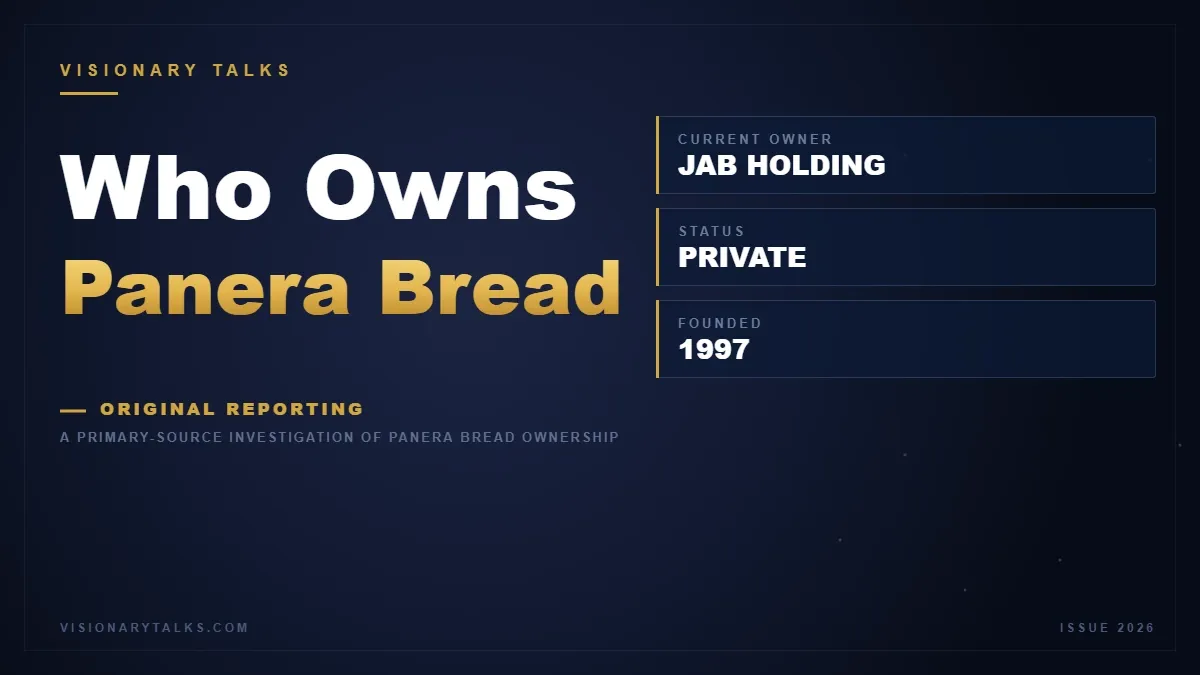
Panera Bread is owned 100 percent by JAB Holding Company SE as of 2026, through its food and beverage platform Panera Brands. It is not a public company and it is not independently owned, despite frequent speculation about an IPO. Ultimate control sits with the Reimann family, one of Europe’s wealthiest private dynasties.
This ownership matters because Panera’s strategic decisions, from pricing to store format to digital investments, are ultimately set by a global consumer conglomerate, not by a standalone bakery cafe operator. For investors, founders, and operators, Panera is a case study in how modern food empires quietly consolidate everyday brands into powerful cash flow machines.
Who Owns Panera Bread Right Now?
Panera Bread is controlled by JAB Holding Company SE, a privately held investment firm based in Luxembourg with deep roots in Germany. JAB acquired Panera Bread in 2017 in a deal valued at roughly $7.5 billion, taking the company private and removing it from public market scrutiny.
Since that acquisition, Panera Bread has been operated under Panera Brands, a holding structure created by JAB in 2021. Panera Brands also houses Einstein Bros. Bagels and Caribou Coffee, allowing shared infrastructure while maintaining separate brand identities.
As of 2026, JAB retains full ownership and voting control. While Panera has explored a return to public markets through an IPO filing, no shares have been sold to the public and no dilution of JAB’s control has occurred.
Ownership Snapshot
| Entity |
Ownership Stake |
Notes |
| JAB Holding Company SE |
100% |
Ultimate owner through Panera Brands structure |
| Panera Brands |
100% |
Parent company overseeing Panera Bread operations |
The Portfolio: The Illusion of Choice
One of JAB’s most effective strategies is creating the feeling of competitive choice while quietly owning entire meal occasions. To the average consumer, Panera feels distinct from Krispy Kreme, Einstein Bros., or Caribou Coffee.
From an ownership perspective, these brands sit inside a tightly coordinated portfolio optimized for breakfast, coffee, and fast casual dining. The consumer sees variety, while JAB sees share of stomach and frequency.
This illusion allows JAB to test pricing elasticity, loyalty programs, and digital ordering tools across brands without overexposing any single concept. Panera benefits from scale without sacrificing its premium positioning.
Parent Company Brand Portfolio
| Brand |
Segment |
Positioning |
| Panera Bread |
Fast Casual Bakery |
Premium, health forward, digital first |
| Einstein Bros. Bagels |
Quick Service Breakfast |
Value oriented, morning focused |
| Caribou Coffee |
Coffeehouse |
Specialty coffee, regional loyalty |
| Krispy Kreme |
Dessert and Breakfast |
Mass distribution, indulgence driven |
Founders and Ownership Timeline
Panera’s origins look nothing like the corporate structure it sits in today. The company began as a modest bakery concept with a focus on fresh bread, long before algorithms and subscription coffee became core drivers.
Panera Bread Founders
Panera Bread traces its roots to Ken Rosenthal, who founded Au Bon Pain Co. in 1978. In 1987, Ron Shaich joined Au Bon Pain, eventually acquiring the Saint Louis Bread Company in 1993.
Shaich rebranded Saint Louis Bread Company as Panera Bread in 1997 and led the company through rapid national expansion. Under his leadership, Panera became one of the early pioneers of fast casual dining, emphasizing quality ingredients and a cafe environment.
Ownership History Timeline
| Year |
Event |
Ownership Impact |
| 1978 |
Au Bon Pain founded |
Private ownership under Ken Rosenthal |
| 1997 |
Panera Bread brand launched |
Subsidiary of Au Bon Pain |
| 1999 |
Au Bon Pain sold, Panera independent |
Panera becomes standalone public company |
| 2017 |
JAB acquires Panera Bread |
Company taken private |
| 2021 |
Panera Brands formed |
Panera moved under holding structure |
Current Leadership and CEO
While JAB controls the company, day to day operations are run by a professional management team with deep experience in scaled restaurant brands. Governance expectations are closer to private equity discipline than founder led experimentation.
Panera’s leadership structure reflects its role as a cornerstone asset inside a much larger portfolio. The CEO answers to Panera Brands leadership, which in turn reports into JAB’s investment committee.
Leadership Snapshot
| Role |
Name |
Since |
| CEO, Panera Bread |
José Alberto Dueñas |
2023 |
| Founder and Chairman Emeritus |
Ron Shaich |
Advisor role post acquisition |
Why This Ownership Structure Exists
JAB operates less like a traditional holding company and more like a long term operating partner. Its preferred model is majority or full control of consumer brands with durable demand and repeat purchase behavior.
Food service, particularly coffee and breakfast, offers daily frequency and predictable cash flow. Panera fits this model perfectly with its subscription programs, digital ordering, and catering business.
The Business Genius
By owning Panera outright, JAB avoids the quarterly earnings pressure that can distort long term decision making. This allows Panera to invest aggressively in technology, supply chain simplification, and menu reinvention.
The structure also enables shared procurement, real estate analytics, and labor strategies across multiple brands. From a systems perspective, Panera is far more powerful inside JAB than it would be alone.
The Risk
The downside of this structure is cultural dilution. Operators sometimes underestimate how quickly a brand’s soul can erode when financial optimization outweighs founder intuition.
There is also IPO risk. If Panera returns to public markets, JAB must balance valuation storytelling with operational reality, a tension that has tripped up similar consumer spinoffs.
Tracing the Ownership Chain
To truly understand who owns Panera Bread, you have to go one level higher than Panera Brands. JAB Holding Company SE is controlled by the Reimann family through a network of trusts and investment vehicles.
The Reimanns rarely appear in media, but their influence shapes global consumer behavior every morning. Coffee, baked goods, pet care, and household staples all roll up to the same family balance sheet.
Ownership Layers
| Layer |
Owner |
Control |
| Panera Bread |
Panera Brands |
100% |
| Panera Brands |
JAB Holding Company SE |
100% |
| JAB Holding Company SE |
Reimann family |
Controlling interest |
Because JAB is private, there is no public shareholder list like you would find in SEC filings. Control is centralized, long term, and largely insulated from activist influence.
When Panera confidentially filed for an IPO, it confirmed ongoing private ownership while signaling potential future dilution. Reuters covered this development in detail, noting JAB’s continued dominance over voting power and strategy, as reported by
Reuters coverage of Panera’s confidential IPO filing.
Debunking the Common Misconception
The most persistent misconception about Panera Bread is that it operates as a standalone bakery chain. This belief is understandable because the brand narrative emphasizes warmth, craft, and neighborhood cafes.
In reality, Panera is an engineered asset inside one of the most sophisticated consumer portfolios in the world. Its choices are not isolated, they are coordinated.
This does not make Panera less authentic, but it does explain why pricing power, menu standardization, and digital adoption move with such precision across the system.
Key Takeaways for Entrepreneurs
- Brand independence can be maintained even under full ownership if incentives are aligned. Structure matters as much as strategy.
- Private ownership can unlock long term investment that public markets often punish, especially in operationally complex businesses.
- Understanding who truly controls your category may reveal competitive dynamics you cannot see from the surface.
Panera Bread is not just a bakery cafe, it is a strategic node in a global consumption network. JAB’s ownership explains the brand’s resilience, its discipline, and its quiet dominance of everyday dining moments.
For investors and operators, the lesson is clear. The most powerful brands are often privately held, patiently scaled, and hidden in plain sight. Panera is one of them, and its real owner has been winning the breakfast table for decades.