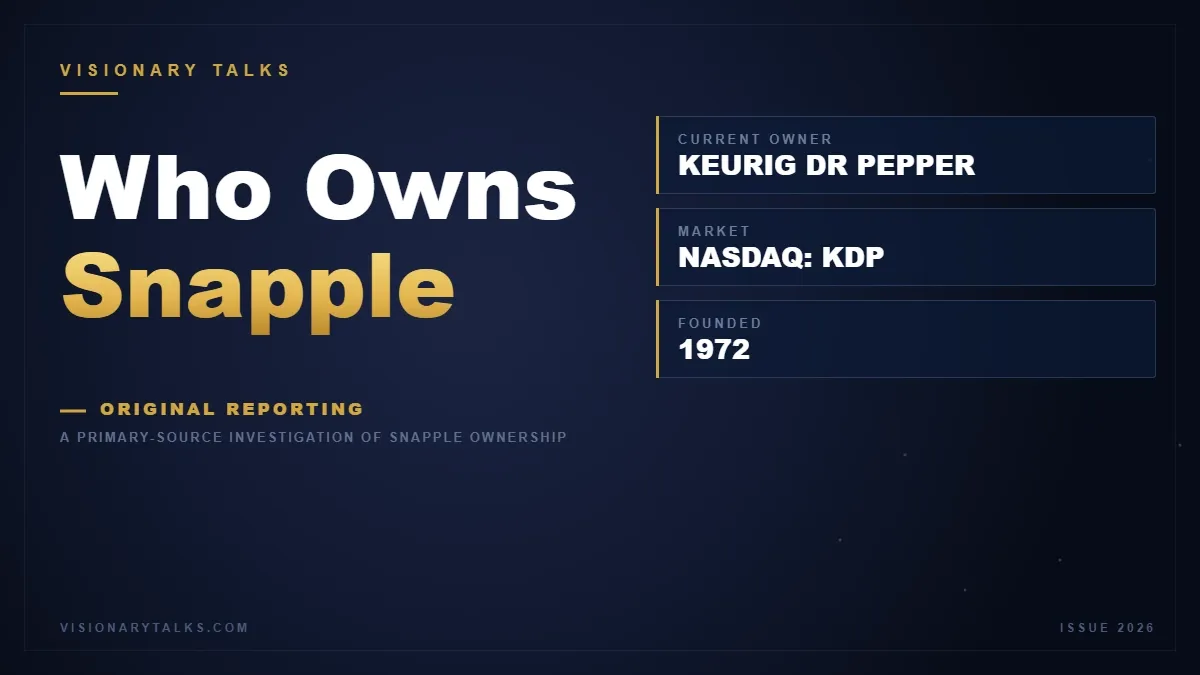
Snapple is owned entirely by
Keurig Dr Pepper Inc., a publicly traded beverage giant listed on the NASDAQ under the ticker KDP. As of 2026, Snapple operates as a wholly owned brand within Keurig Dr Pepper’s beverage portfolio, not as an independent company and no longer under any ownership stake by Quaker Oats. In practical terms, 100 percent of Snapple’s equity sits inside Keurig Dr Pepper’s corporate structure.
Confused about which cola giant makes what? See the full
Coke vs Pepsi vs Dr Pepper brand map, covering 60 US beverage brands and their true parents.
This ownership matters because Snapple’s quirky, indie image often masks its position inside one of the largest beverage distribution systems in North America. For investors, founders, and operators, Snapple is a case study in how legacy brands migrate from entrepreneurial roots into global beverage platforms. Beneath the playful bottle caps and “Real Facts” lies a consolidated ownership story driven by scale economics, distribution power, and capital markets strategy.
Who Owns Snapple Right Now?
Right now, Snapple is wholly owned by Keurig Dr Pepper Inc. Keurig Dr Pepper, often abbreviated as KDP, is a publicly traded company formed in 2018 through the merger of Keurig Green Mountain and Dr Pepper Snapple Group. After that merger, Snapple became one of hundreds of beverage brands under the combined enterprise.
KDP is listed on the NASDAQ exchange, and its ownership is dispersed among institutional and retail shareholders. There is no separate Snapple stock, no partial spinout, and no minority stake holders at the brand level. From a legal standpoint, Snapple is a brand inside Keurig Dr Pepper, not a standalone subsidiary with outside investors.
According to Keurig Dr Pepper’s investor materials and SEC filings, Snapple is grouped under its U.S. Refreshment Beverages segment. You can verify Keurig Dr Pepper’s corporate structure and financial disclosures directly through its filings on
SEC.gov, where Snapple appears as part of consolidated brand reporting.
Ownership Snapshot
| Entity |
Ownership Stake |
Notes |
| Snapple |
100% |
Wholly owned brand within Keurig Dr Pepper |
| Keurig Dr Pepper Inc. |
Publicly traded |
Listed on NASDAQ as KDP |
The Portfolio: The Illusion of Choice
When you walk into a convenience store, Snapple feels independent. The label design, the cap facts, the glass bottle heritage all signal authenticity and distance from multinational corporate ownership. That perception is engineered.
Keurig Dr Pepper is a master at brand segmentation. It owns legacy carbonated soft drinks like Dr Pepper and 7UP in certain markets, premium coffee systems under Keurig, flavored waters, teas, and juices including Snapple and Mott’s. To the consumer, these brands appear to compete across categories. To the company, they sit on the same balance sheet.
Parent Company Brand Portfolio
| Brand |
Segment |
Positioning |
| Dr Pepper |
Carbonated Soft Drinks |
Mainstream flagship soda |
| 7UP |
Lemon Lime Soda |
Classic citrus soft drink |
| Canada Dry |
Ginger Ale |
Premium mixer brand |
| Keurig |
Coffee Systems |
Single serve brewing platform |
| Snapple |
Ready to Drink Tea and Juice |
Quirky, heritage flavored beverage brand |
This structure creates what I call the illusion of choice. Shelf space appears competitive. In reality, a significant percentage of that shelf is financed, distributed, and negotiated by the same parent. Snapple’s independence is a branding decision, not an ownership fact.
Founders and Ownership Timeline
To understand how Snapple ended up inside a beverage conglomerate, you have to rewind to its scrappy New York beginnings. The company started far from Wall Street and even farther from global supply chains.
Snapple Founders
Snapple was founded in 1972 by Leonard Marsh, Hyman Golden, and Arnold Greenberg in Brooklyn, New York. The trio originally ran a food distribution business before pivoting into flavored juices and teas. The name “Snapple” came from a carbonated apple juice product, a blend of the words snappy and apple.
Through the 1980s and early 1990s, Snapple became a cultural icon. The brand leaned into humor, offbeat advertising, and grassroots distribution. It built massive recognition without the infrastructure of a Coca Cola or PepsiCo, which made it both powerful and vulnerable.
Ownership History Timeline
| Year |
Event |
Ownership Impact |
| 1972 |
Company founded |
Privately owned by founders |
| 1992 |
IPO |
Public shareholders acquire stakes |
| 1994 |
Acquired by Quaker Oats for 1.7 billion USD |
Becomes wholly owned subsidiary of Quaker |
| 1997 |
Sold to Triarc Companies |
Ownership shifts to Triarc |
| 2000 |
Triarc creates Cadbury Schweppes Americas Beverages |
Snapple integrated into larger beverage group |
| 2008 |
Dr Pepper Snapple Group spun off from Cadbury |
Public independent beverage company formed |
| 2018 |
Merger with Keurig Green Mountain |
Snapple becomes part of Keurig Dr Pepper |
The 1994 acquisition by Quaker Oats is where the misconception begins. Quaker paid 1.7 billion USD at the peak of Snapple’s growth. The integration failed, sales declined, and Quaker sold the brand just three years later at a steep loss.
As reported by
Reuters coverage of the 2018 Keurig and Dr Pepper merger, the final step in Snapple’s ownership chain came when Dr Pepper Snapple Group combined with Keurig Green Mountain. That transaction locked Snapple into its current corporate home.
Current Leadership and CEO
Snapple does not have its own standalone CEO. Instead, strategic decisions flow from Keurig Dr Pepper’s executive leadership team. Brand level marketing heads and general managers operate within the broader corporate governance of KDP.
Leadership Snapshot
| Role |
Name |
Since |
| Chairman and CEO, Keurig Dr Pepper |
Bob Gamgort |
2018 |
| CFO, Keurig Dr Pepper |
Monica Luechtefeld |
2022 |
Bob Gamgort, who previously led Keurig Green Mountain, has overseen the company since the 2018 merger. His mandate has centered on portfolio optimization, margin expansion, and disciplined capital allocation. Snapple is one lever in that broader financial machine.
Why This Ownership Structure Exists
Snapple’s place inside Keurig Dr Pepper reflects a classic beverage industry model, conglomerate ownership supported by distribution scale. Beverage brands require shelf placement, bottling partnerships, transportation logistics, and retailer leverage. Few independent brands can sustain that infrastructure in 2026 without strategic backing.
Rather than operate Snapple as a separate public company with its own cost base, KDP folds it into shared services. Procurement, distribution contracts, and retail negotiations happen at scale. This lowers per unit costs and expands access to national chains.
The Business Genius
The genius lies in maintaining brand personality while centralizing everything else. Snapple keeps its heritage marketing voice. Meanwhile, KDP leverages consolidated manufacturing and a vast direct store distribution network.
This allows KDP to play both offense and defense. It can experiment with product extensions under Snapple while countering competitors in ready to drink teas without launching entirely new brands.
The Risk
The risk is portfolio dilution. When too many brands sit under one corporate roof, management attention becomes scarce. If Snapple underperforms relative to energy drinks or coffee systems, capital may shift elsewhere.
There is also category risk. Consumer preferences continue to migrate toward functional beverages, low sugar formulations, and alternative hydration. Legacy sweetened teas face pressure unless innovation keeps pace.
Tracing the Ownership Chain
To fully answer who owns Snapple, we need to move one step higher. Snapple is owned by Keurig Dr Pepper. Keurig Dr Pepper itself is owned by its shareholders.
KDP is a Delaware incorporated public company. Its shares trade on NASDAQ, and ownership is dispersed across institutional investors such as Vanguard Group, BlackRock, and State Street, alongside individual investors. No single retail investor controls Snapple. Control is exercised through corporate governance mechanisms typical of large cap U.S. public companies.
Ownership Layers
| Layer |
Owner |
Control |
| Snapple |
Keurig Dr Pepper Inc. |
100% |
| Keurig Dr Pepper Inc. |
Public Shareholders |
Dispersed ownership via publicly traded shares |
Institutional investors collectively own a majority of KDP’s outstanding shares, according to recent proxy statements. While there are historically significant shareholders tied to the company’s formation, governance today reflects a broadly held public corporation model.
Debunking the Common Misconception
Many consumers still believe Snapple is owned by Quaker Oats. That belief stems from the highly publicized 1994 acquisition. However, Quaker Oats sold Snapple in 1997, absorbing a significant financial loss.
Others assume Snapple returned to independence after that failed merger. It did not. After Triarc, Cadbury, and Dr Pepper Snapple Group ownership phases, the brand ultimately became part of Keurig Dr Pepper in 2018. As of 2026, Snapple is neither independent nor owned by Quaker Oats.
Key Takeaways for Entrepreneurs
- Brand independence does not equal ownership independence. Always trace the cap table beyond the marketing story.
- Distribution scale often determines long term survival in consumer packaged goods more than brand charisma alone.
- Exit outcomes can redefine legacy. Founders may build culture, but conglomerates often control the future.
Snapple’s journey from Brooklyn startup to public market portfolio asset captures the arc of many consumer brands. The bottles still say Snapple, but the balance sheet says Keurig Dr Pepper. For investors and operators, that distinction is the real story.