
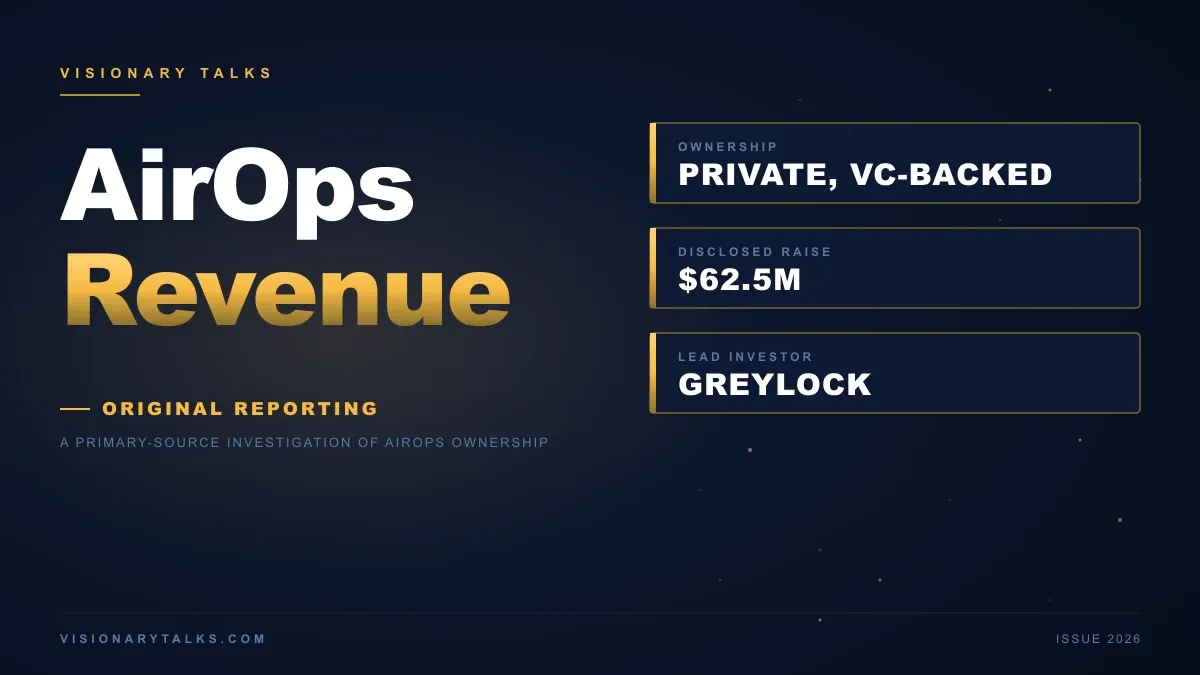
AirOps is a private company, controlled by its founders and its venture investors, with $62.5 million raised across three disclosed rounds as of September 2026. Its chief executive and cofounder is Alex Halliday. The company sells brands a way to be visible inside AI-generated answers, and its largest disclosed round was a $40 million Series B led by Greylock on November 14, 2025.
Key takeaways
- Disclosed funding totals $62.5 million: a $7 million seed, a $15.5 million Series A led by Unusual Ventures, and the $40 million Series B led by Greylock on November 14, 2025.
- AirOps has never published a revenue figure. Sacra estimates $13 million of ARR for 2025, up from roughly $2.5 million at the end of 2024, and those are estimates, not disclosures.
- The Series B valuation was not disclosed by the company. Sacra estimates $225 million post-money.
- AirOps says its platform has data from 6 billion citations, 47 million actions and 1.5 billion prompts.
- Customers named by the company include Ramp, Webflow, Chime, HubSpot, Carta, Brex, Wiz, Kayak, monday.com, Asana, Rippling and LegalZoom.
This article is based on primary sources: AirOps' own funding announcements and product posts on airops.com, including the 14 November 2025 Series B post, and the customer results the company publishes. Revenue, valuation and total-funding figures that come only from Sacra are labelled as estimates every time they appear. Full source list at the bottom.
Who Owns AirOps and Who Runs It
AirOps is privately held. There is no ticker, no public filing, and no beneficial ownership table, so the precise split between founders, employees and funds is not public and no honest article can tell you what it is.
What is public is the investor list, and it is unusually specific because the company published it. Alex Halliday is cofounder and chief executive. The seed round was led by Wing VC. The $15.5 million Series A was led by Sandhya Hegde at Unusual Ventures, with Wing VC, Founder Collective, Xfund and Alt Capital participating, alongside angels including David Rogier, the founder of MasterClass, and JD Ross. The $40 million Series B was led by Mike Duboe at Greylock, with Unusual Ventures, Wing VC, Frontline, Xfund, Village Global and Founder Collective returning, plus more than two dozen chief marketing officers and marketing leaders investing personally.
That last detail is the one worth noticing. Getting two dozen CMOs onto a cap table is a distribution strategy disguised as a financing. AirOps sells to marketing leaders, and it put marketing leaders on the inside of the company before it asked them to buy.
Halliday has said the Series B term sheet closed in five days.
What AirOps Actually Sells
The product answers a question that did not exist three years ago: when someone asks an AI assistant which tool or service to use, how does a brand end up in the answer?
AirOps calls this AI discovery strategy, and frames the goal as earning an agent's trust rather than chasing a visibility score. The platform tells a brand where it stands with the buyers that matter, identifies which channels move AI answers for it, and then runs the work to change them, measuring each action against the citation outcome.
The scale claim behind it is the real asset. AirOps says it draws on 6 billion citations, 47 million actions and 1.5 billion prompts. Nobody else sells that dataset to marketers, which is the moat if there is one.
Its own published customer results are specific enough to be checkable, which is rare in this category. Chime tripled its citation rate. LegalZoom cut $750,000 a year in production costs while multiplying conversion from LLM traffic fivefold. Airbnb Experiences Paris moved seven percentage points in the categories that mattered most to it. Asana recorded a 93% increase in ChatGPT citations within two weeks of deploying the company's agent.
AirOps Revenue: What Is Disclosed, and What Is Estimated
Here is the honest position, and it is the reason this section is shorter than it looks like it should be.
AirOps has never disclosed revenue. It is private, it has no obligation to, and it has not done so in any funding announcement or product post. Every AirOps revenue figure in circulation traces back to one source.
| Figure | Period | Status |
|---|---|---|
| ~$1M ARR | Q1 2024 | Sacra estimate |
| ~$2.5M ARR | End of 2024 | Sacra estimate |
| $13M ARR | 2025 | Sacra estimate |
| 420% growth | 2025 year on year | Sacra estimate |
| $60K to $250K | Annual contract value range | Sacra estimate |
| $225M post-money | Series B, November 2025 | Sacra estimate, not disclosed by the company |
Treat that table as one analyst's model, not as accounts. If the $13 million ARR estimate is roughly right, the arithmetic is the interesting part: a $225 million estimated valuation on $13 million of estimated revenue is about 17 times revenue, and investors paid it in a market where mature software trades nearer 6 to 8 times.
For contrast at the other end of the same category, SpaceX paid $60 billion for a company with somewhere between $2.6 billion and $3 billion of annualized revenue in the Cursor acquisition, roughly 20 to 23 times. AirOps, at a fraction of the size, was priced on a comparable multiple. Both prices say the same thing: investors are buying the position, not the current revenue.
The Bet: Brands Will Pay to Exist Inside AI Answers
The thesis is that discovery is moving inside AI assistants, and that brands will pay to be found there the way they paid to be found in search results for twenty-five years.
Two numbers AirOps publishes make the case better than any argument. Creator citations in AI answers doubled to 6% in a year. And in fintech, 53% of ChatGPT answers now carry ads, up from near zero in April 2026. The second matters most: once the answer layer carries paid placement, it is an advertising channel, and every brand needs a strategy for it whether it wants one or not. The structures behind that layer are worth understanding on their own terms, traced in our breakdown of who owns OpenAI.
The contrarian read is that AirOps is selling shovels in a gold rush that is burying the previous gold rush. The customer for AI search visibility is largely the same marketing leader who spent a decade buying SEO. AirOps did not need to create demand. It needed to be standing there when the budget moved, which is the reason a $13 million revenue estimate can support a nine-figure valuation. To follow the people arguing this out in public, our list of AI voices to follow is a reasonable start.
Here is the honest limitation. This is a category that could be a feature rather than a company. Every claim AirOps makes about improving citations depends on the behaviour of models it does not control, and those models change without notice. A single ranking or attribution change inside ChatGPT can invalidate a quarter of optimisation work, and the assistants have every incentive to sell the placement themselves rather than let a third party arbitrage it. AirOps is building on rented land, and the landlords are the most capitalised companies in the world.
What Quill Says About Where This Goes
Quill is AirOps' answer to that risk, and it tells you where the company thinks the money is.
Quill is an AI agent the company describes as a captain rather than a tool: it finds the gaps, decides when to act and when to pull a human in, and measures every action against a citation metric. Alongside it sits Page360, which treats pages as living assets to be continuously updated for AI search rather than published once.
The logic is retention. Software that reports on your AI visibility is a dashboard, and dashboards get cancelled. An agent that does the work becomes the workflow, and workflows do not. Growth teams at Asana, Rippling, Bitly, Kong and Chime are named by the company as deploying it, with Asana at a 93% increase in ChatGPT citations in two weeks and Parallel at 165% more.
AirOps also now runs its own conference, AirOps Next, whose inaugural New York edition drew more than 200 marketing leaders and included a speaker from Anthropic. Companies at $13 million of estimated revenue do not usually launch user conferences. Doing it is a claim to be the category's centre of gravity before the category is fully formed, which is the same bet as everything else here.
AirOps FAQ
Who founded AirOps?
Alex Halliday is cofounder and chief executive. AirOps has been reported to have additional cofounders, but their names and roles could not be confirmed against a primary source for this article, so they are not listed here.
How much revenue does AirOps make?
AirOps has never published a revenue figure. Sacra estimates $13 million of ARR for 2025, up from roughly $2.5 million at the end of 2024. Those are estimates from an outside analyst, not company disclosures, and no audited or company-confirmed figure exists as of September 2026.
How much has AirOps raised?
$62.5 million across three disclosed rounds: a $7 million seed led by Wing VC, a $15.5 million Series A led by Unusual Ventures, and a $40 million Series B led by Greylock announced on November 14, 2025. Sacra additionally estimates a $55.5 million round in 2026, which would take the total near $118 million, but AirOps has not announced it and it does not appear in the company's own funding posts.
What does AirOps actually do?
It helps brands appear in AI-generated answers. The platform analyses where a brand stands with the buyers it cares about, identifies which channels influence AI assistants for that brand, and then executes and measures the work, using data the company says spans 6 billion citations, 47 million actions and 1.5 billion prompts.
What I am watching next
1. Whether the 2026 round is ever announced. A $55.5 million raise that appears in an analyst model but not in the company's own posts is either confidential or wrong, and which one matters.
2. Whether AirOps ever discloses revenue. Every number in this space is currently one analyst's estimate, repeated until it sounds like fact.
3. Whether the assistants close the gap. If OpenAI or Google sells AI answer placement directly, the independent optimisation layer gets squeezed from above.
Sources
1. AirOps Series B announcement, November 14, 2025 airops.com/blog/series-b. Establishes the $40 million raise, Greylock and Mike Duboe as lead, the participating funds, the more than two dozen CMO investors, the five-day term sheet, and that the valuation was not disclosed.
2. AirOps Series A announcement airops.com. Establishes the $15.5 million raise, Sandhya Hegde at Unusual Ventures as lead, and the participating funds and angels including David Rogier and JD Ross.
3. AirOps product and customer-results posts airops.com/blog. Establish Quill and Page360, the platform data claims of 6 billion citations, 47 million actions and 1.5 billion prompts, the Chime, LegalZoom, Airbnb Experiences Paris, Asana and Parallel results, and the AirOps Next conference.
4. AirOps homepage airops.com. Establishes the current positioning, the named customer list, the doubling of creator citations to 6%, and the 53% figure for ads in fintech ChatGPT answers.
Secondary sources:
5. Sacra company profile, AirOps sacra.com/c/airops. Source of every estimated figure in this article: the ARR series, the 420% growth rate, the $60,000 to $250,000 contract range, the $225 million Series B post-money valuation, the $7 million April 2023 seed, the estimated $55.5 million 2026 round, and the roughly $118 million total. Each is labelled as an estimate at the point of use because none is confirmed by AirOps.