
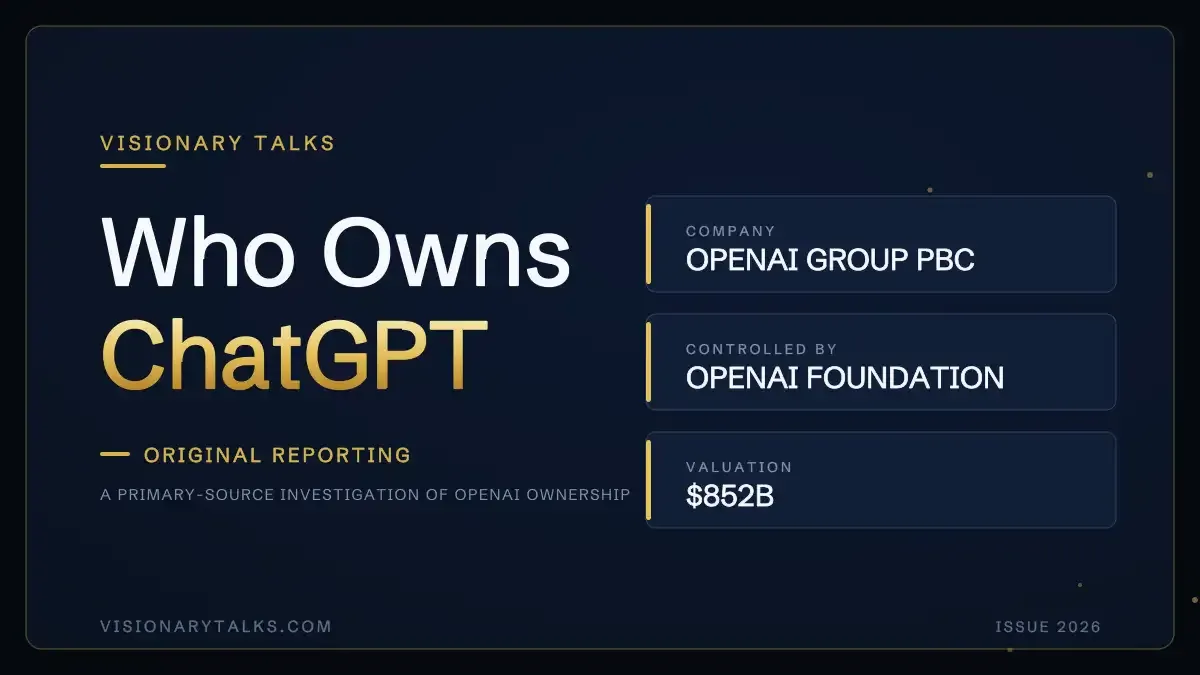
This piece separates them and dates every number, because in 2026 the numbers move fast. OpenAI restructured itself on October 28, 2025, raised the largest private funding round in history on March 31, 2026, and filed confidentially to go public in June 2026. Where a figure comes from a specific disclosure, I say so; where I compute one, I flag it as my arithmetic.
Key takeaways
- "ChatGPT" is a product and a brand, not a company. The ChatGPT trademark is held by an OpenAI operating subsidiary, OpenAI OpCo, LLC — not by a standalone "ChatGPT" entity.
- The company is OpenAI Group PBC, a Delaware public benefit corporation created in the October 28, 2025 recapitalization.
- Control sits with the OpenAI Foundation, the renamed nonprofit. It owns about 26% of the equity but has the right to appoint the entire PBC board. That is control without a majority.
- At the recap, Microsoft held roughly 27% on an as-converted, diluted basis; current and former employees plus other investors held about 47%.
- That 26 / 27 / 47 split is the recap-day disclosure. The March 2026 round diluted everyone, and no updated official cap table has been published.
- Sam Altman owns zero equity in OpenAI. Still true after the recap.
- OpenAI was valued at $852 billion in a $122 billion round that closed March 31, 2026 — the largest private financing on record.
- OpenAI submitted a confidential draft S-1 to the SEC in June 2026. There is no public ticker and no confirmed date; reporting in August 2026 pointed toward 2027.
- Elon Musk co-founded OpenAI, left in 2018, sued in 2024, and lost at trial in May 2026 on statute-of-limitations grounds.
This article is based on primary and near-primary sources: OpenAI's own October 28, 2025 restructuring announcement and structure page; Microsoft's October 28, 2025 partnership blog post; OpenAI's March 31, 2026 funding announcement and its June 2026 S-1 confirmation; the United States Patent and Trademark Office's Trademark Status & Document Retrieval (TSDR) record for the "ChatGPT" mark; and contemporaneous reporting from CNBC, Bloomberg, Reuters, NPR, NBC and TechCrunch. Full source list at the bottom.
ChatGPT vs OpenAI: what actually has an owner
The first mistake almost every "who owns ChatGPT" article makes is treating ChatGPT as a thing that can be owned on its own. It cannot. ChatGPT is a software product and a brand name. The owner of a product is the company that makes it, and here that company is OpenAI.
You can see this in the paperwork. The "ChatGPT" trademark application at the USPTO (Serial No. 97733261, filed December 27, 2022) lists the applicant as OpenAI OpCo, LLC — an operating subsidiary, not a public "ChatGPT Inc." As of late August 2026 that mark is still a pending application, approved for publication on the Principal Register rather than fully registered. So even the trademark that most literally represents "ChatGPT" is owned by a corporate arm of OpenAI, which is itself owned and controlled by layers above it.
The legal entity chain, from top to bottom, runs like this:
- OpenAI Foundation — the nonprofit (formerly "OpenAI, Inc."). It controls everything below it.
- OpenAI Group PBC — the Delaware public benefit corporation that holds the business, raises the money, and carries the $852 billion valuation.
- Operating subsidiaries such as OpenAI OpCo, LLC — the arms that actually hold assets like the ChatGPT trademark and run the product.
So when someone asks "who owns ChatGPT," the honest answer is a chain, not a name: OpenAI OpCo (the product) → OpenAI Group PBC (the company) → OpenAI Foundation (the controller). The rest of this article walks up that chain.
Who owns OpenAI right now?
Here is the ownership map as disclosed on the day of the recapitalization, October 28, 2025. Treat these as recap-day figures, because they have almost certainly shifted since (more on that below).
| Stakeholder | Stake at Oct 28, 2025 recap | Approx. implied value | Notes |
|---|---|---|---|
| OpenAI Foundation (nonprofit) | ~26% | ~$130 billion | Plus the right to appoint the entire PBC board |
| Microsoft | ~27% (as-converted, diluted) | ~$135 billion | Down from ~32.5%; ~$13.75B invested since 2019; no board seat |
| Employees + other investors | ~47% | — | Current and former staff plus venture and strategic investors |
The single most important line in that table is the Foundation's. It owns barely a quarter of the equity, yet it appoints every director of the company. Ownership and control are not the same thing at OpenAI, and the Foundation is the clearest example anywhere in tech of control without majority ownership.
The honesty caveat no competitor makes: the 26 / 27 / 47 split is the disclosure from recap day. On March 31, 2026 OpenAI raised $122 billion in fresh capital, which issued new shares and diluted every existing holder. OpenAI has not published an updated cap table since. Anyone quoting "Microsoft owns 27% of OpenAI" in mid-2026 is quoting a number that is five months and one giant funding round out of date. Post-round percentages can only be estimated, and I will not invent precise ones the company has not disclosed.
What the October 2025 recapitalization actually did
For most of its life OpenAI had an unusual structure: a nonprofit parent sitting on top of a "capped-profit" company. On October 28, 2025 that was rebuilt. Two things changed names and roles:
- The nonprofit ("OpenAI, Inc.") became the OpenAI Foundation.
- The for-profit business became OpenAI Group PBC, a Delaware public benefit corporation — a for-profit company legally bound to pursue a public-benefit mission alongside profit.
The recap dropped the old 100x profit cap and gave the Foundation a straightforward equity stake (~26%) plus the governance rights that matter: it appoints the PBC's board. This was the compromise that ended a year of fighting over whether OpenAI would abandon nonprofit control entirely. In May 2025 OpenAI had already reversed an earlier plan and said the nonprofit would stay in charge; the October recap is what that promise looks like in a cap table.
Does Sam Altman own OpenAI?
No. Sam Altman, OpenAI's CEO, holds zero equity in the company — and that remained true after the October 2025 recapitalization, even as Microsoft and employees received defined stakes. This is genuinely unusual for the founder-CEO of the most valuable private company on earth, and it is a fact Altman has repeated for years.
It comes with a caveat worth stating plainly: "no direct equity" is not the same as "no financial exposure." Altman has made venture investments across the technology industry, some in companies that do business with OpenAI, and those holdings are his. But in OpenAI itself — the PBC whose shares are being sold at an $852 billion valuation — his direct ownership is nil. If you are searching "does Sam Altman own OpenAI," the answer is that he runs it; he does not own a slice of it.
Is ChatGPT owned by Microsoft?
No — and this is the most common misconception of all. Microsoft is OpenAI's largest outside investor, with roughly 27% of the economics on an as-converted, diluted basis as of the October 2025 recap, built on about $13.75 billion committed since 2019. That is a huge financial stake. It is not ownership of ChatGPT, and it is not control of OpenAI.
The restructured Microsoft–OpenAI agreement announced alongside the recap on October 28, 2025 makes the boundaries explicit. Its key terms:
- Microsoft's exclusivity as OpenAI's cloud provider ended; OpenAI is free to buy compute elsewhere. In exchange OpenAI committed to purchase an incremental $250 billion of Microsoft Azure services.
- Microsoft keeps IP rights to OpenAI's models and products through 2032, including post-AGI models, subject to safety guardrails. Consumer hardware is carved out of those rights.
- A declaration that OpenAI has reached AGI — a threshold that changes the deal — must now be verified by an independent expert panel, not asserted unilaterally.
- Revenue-sharing payments between the companies are capped.
- Crucially: Microsoft holds no board seat and no control. The Foundation appoints the board.
So Microsoft is a very large, very entangled economic partner — cloud, IP, revenue share — that nonetheless cannot direct OpenAI's governance. If you want the wider context on why an investor would pour tens of billions into AI compute like this, our explainer on how leverage and margin calls work is a useful companion on the money side of the AI boom.
The $852 billion question: OpenAI's valuation and the March 2026 round
On March 31, 2026 OpenAI closed a $122 billion funding round at an $852 billion post-money valuation — the largest private financing in history. The round was first reported at around $110 billion in late February 2026 and grew before it closed, so if you saw the smaller figure earlier, the $122 billion number is the final, closed one.
The anchor investors:
- Amazon — $50 billion: $15 billion committed at close, plus $35 billion contingent on milestones tied to OpenAI's path toward an IPO or a declaration of AGI. Worth noting: Amazon is simultaneously the largest backer of Anthropic, OpenAI's chief rival — a hedge across both leading labs.
- NVIDIA — $30 billion.
- SoftBank — $30 billion, financed by a record $40 billion, 12-month unsecured bridge loan arranged by JPMorgan, Goldman Sachs, Mizuho, SMBC and MUFG.
- Microsoft, Andreessen Horowitz (a16z) and D.E. Shaw also participated, and roughly $3 billion came in through individual-investor bank channels — a rare retail on-ramp into a private company.
The financial backdrop puts that valuation in perspective. OpenAI stated revenue of roughly $2 billion per month around March 2026, which the research firm Sacra pegged at about a $25 billion annualized run rate. Greg Brockman has described a compute plan on the order of $50 billion for 2026, and the company's losses are heavy — net-loss estimates for 2026 run into the tens of billions, with the low end around $14 billion and higher-range GAAP figures far above that. OpenAI's CFO, Sarah Friar, has led the financing and IPO groundwork.
Is OpenAI going public? Can I buy OpenAI stock?
Not yet, and not through your brokerage. In June 2026 OpenAI confirmed it had submitted a confidential draft S-1 to the SEC (CNBC broke the news June 8; OpenAI's own confirmation and most coverage are dated June 9). A confidential filing is a real, formal step toward an IPO, but it sets no date and the document itself is not public — so the confirmation and reporting are what can be cited, not the filing's contents.
OpenAI initially eyed late 2026; by August 2026, CNBC reported the timeline was leaning toward 2027. Altman is reported to treat $1 trillion as the floor for an eventual IPO valuation. Until then there is no public ticker. The only way to hold OpenAI exposure is through accredited secondary markets — and even that is thin and pricey. In August 2026 OpenAI ran a roughly $7 billion employee tender offer at the same $852 billion implied valuation, and the secondary marketplace Forge Global quoted OpenAI shares near $721.85 in mid-August. For an ordinary retail investor, there is currently no legitimate way to "buy OpenAI stock."
Is ChatGPT owned by Elon Musk? The lawsuit, and how it ended
No. Elon Musk co-founded OpenAI in 2015 and was one of its earliest funders, but he left in 2018 after the board rejected his proposals to take control — including an idea to fold OpenAI into Tesla. He owns no part of OpenAI today, and he lost his bid to unwind its structure in court.
Musk sued Altman and OpenAI in 2024, arguing the company had betrayed its founding nonprofit mission. In February 2025 he led an unsolicited $97.4 billion bid for OpenAI's nonprofit assets, which the board rejected. The case went to trial in Oakland, and on May 18, 2026 a unanimous nine-member advisory jury — whose finding Judge Yvonne Gonzalez Rogers adopted — found all of Musk's claims barred by the three-year statute of limitations, after less than two hours of deliberation and 11 days of testimony from Altman, Brockman, Nadella and Musk himself. The related aiding-and-abetting claim against Microsoft failed on the same grounds.
The important nuance: the case was decided on timing, not merits. The court never ruled on whether OpenAI actually betrayed its mission — only that Musk waited too long to sue. Musk characterized the outcome as a "calendar technicality," and an appeal to the Ninth Circuit is pending. So "Musk lost" is true; "a court found OpenAI did nothing wrong" is not.
The governance wrinkle worth watching
The Foundation's control only means something if the Foundation is genuinely independent of the company it controls — and here critics have a point. As of the October 2025 recap, all but one member of the OpenAI Foundation's board also sat on the OpenAI Group PBC board. When the same people govern both the nonprofit controller and the for-profit it is supposed to check, the watchdog and the watched start to look like the same body. The advocacy group Public Citizen criticized the arrangement, arguing the nonprofit risked being little more than a rubber stamp.
OpenAI has since added directors (two more were appointed in July 2026), so the exact overlap shifts over time. But the structural question — can a board that overlaps this heavily truly hold the company to its mission? — is the layer-two skepticism that most ownership explainers skip, and it is the one most likely to matter before an IPO.
Ownership history: from nonprofit to $852 billion
| Date | Event | Ownership impact |
|---|---|---|
| Dec 2015 | OpenAI founded as a nonprofit; Musk among co-founders; ~$1B pledged | No equity; a nonprofit research lab |
| Feb 2018 | Musk departs after control / Tesla-merger proposals are rejected | Loses his most prominent early backer |
| 2019 | Capped-profit LP created (100x profit cap); Microsoft's first $1B investment (July 2019) | Outside capital enters for the first time |
| Nov 2022 | ChatGPT launches | Turns a research lab into a product company |
| Nov 2023 | Altman fired (Nov 17), reinstated within five days | Board control crisis; governance scrutiny begins |
| 2024 | Musk sues Altman and OpenAI | Legal challenge to the for-profit structure |
| Feb 2025 | Musk-led $97.4B unsolicited bid rejected | Board reaffirms it is not for sale |
| May 2025 | OpenAI reverses course: nonprofit will keep control | Sets up the recap terms |
| Oct 2, 2025 | $6.6B employee secondary at a ~$500B valuation | Staff liquidity ahead of the recap |
| Oct 28, 2025 | Recapitalization: OpenAI Foundation + OpenAI Group PBC; Microsoft deal restructured | Foundation ~26%, Microsoft ~27%, employees+investors ~47% |
| Mar 31, 2026 | $122B round at $852B post-money — largest private financing ever | Dilutes all existing holders; no new cap table published |
| Jun 2026 | Confidential S-1 submitted to the SEC | Formal step toward a public listing |
| Aug 2026 | ~$7B employee tender at the $852B implied price | More staff liquidity; secondary price near $721.85/share |
So who really owns ChatGPT and OpenAI?
Put the three layers back together. ChatGPT is a product, owned through operating subsidiaries like OpenAI OpCo, LLC. OpenAI Group PBC is the company those subsidiaries roll up into — the one worth $852 billion, roughly 27% economically tied to Microsoft, about 47% to employees and investors. And the OpenAI Foundation, a nonprofit owning around a quarter of the equity, controls the whole thing by appointing its board.
The reason so many articles get this wrong is that they pick one layer and call it the answer. "Microsoft owns OpenAI" grabs the biggest investor. "OpenAI is a nonprofit" grabs the controller. "Sam Altman's OpenAI" grabs the face. All three are fragments. The accurate sentence is longer and less satisfying: a nonprofit foundation controls a for-profit public benefit corporation whose largest economic stakeholder cannot vote it around. That is the structure — and it is exactly the kind of case where the ultimate controller and the largest owner are two different parties.
FAQ
Is ChatGPT owned by Microsoft?
No. Microsoft is OpenAI's largest outside investor — about 27% of the economics on an as-converted, diluted basis as of the October 2025 recap — but it holds no board seat and no control. It does not own ChatGPT; it owns a slice of the company that makes it.
Is ChatGPT owned by Elon Musk?
No. Musk co-founded OpenAI in 2015 and left in 2018. He owns no part of it. He sued to unwind its structure and lost at trial in May 2026 on statute-of-limitations grounds; an appeal is pending.
Does Sam Altman own OpenAI?
No. Altman is CEO but holds 0% direct equity in OpenAI, a fact that remained true after the October 2025 recapitalization.
Can I buy OpenAI stock?
Not on a public exchange. There is no ticker, and the S-1 filed in June 2026 is confidential. Exposure is only available to accredited investors through secondary markets, where shares traded near $721.85 in mid-August 2026.
Is OpenAI a nonprofit?
Partly. The controller is a nonprofit — the OpenAI Foundation. The company is not: OpenAI Group PBC is a for-profit Delaware public benefit corporation. The nonprofit controls the for-profit by appointing its board.
What I'm watching next
- The Ninth Circuit appeal. Musk's claims were dismissed on timing, not merits. If the appeals court revives them, the question of whether OpenAI's for-profit turn breached its founding mission gets litigated for real.
- IPO timing. The confidential S-1 exists; the date does not. Watching whether OpenAI targets 2027 and at what valuation — Altman's reported $1 trillion floor is the number to test.
- Whether the board overlap gets fixed. A nonprofit controller whose board mirrors the company's invites exactly the "rubber stamp" critique regulators dislike before an IPO. Watch for independent directors added to the Foundation specifically.
- Amazon's milestone tranches. $35 billion of Amazon's $50 billion is contingent on IPO-or-AGI milestones. When (and whether) those release will say a lot about how close OpenAI is to either.
For more on the people and money moving through this world, see our profile of Leopold Aschenbrenner's net worth, whose "Situational Awareness" thesis helped define how investors think about the race OpenAI now leads.
Who owns the AI companies
This is part of our ownership cluster on the companies building frontier AI:
Sources
- OpenAI, "Built to benefit everyone" / restructuring announcement and structure page, October 28, 2025. Establishes the OpenAI Foundation and OpenAI Group PBC names, the Foundation's ~26% stake and board-appointment rights, and the recap-day ownership split.
- Microsoft, "The next chapter of the Microsoft–OpenAI partnership," October 28, 2025. Establishes Microsoft's ~27% as-converted stake, the ~$13.75B cumulative investment, the end of Azure exclusivity, the $250B incremental Azure commitment, IP rights through 2032, the independent AGI-verification panel, the consumer-hardware carve-out, and that Microsoft holds no board seat.
- CNBC, "OpenAI completes for-profit recapitalization," October 28, 2025; and follow-up coverage, April 27, 2026. Corroborates the recap terms and the revenue-share cap detail.
- OpenAI funding announcement and CNBC / Bloomberg / TechCrunch coverage, March 31, 2026. Establishes the $122B round at $852B post-money, the Amazon $50B ($15B + $35B contingent), NVIDIA $30B and SoftBank $30B commitments, and the ~$3B retail channel. Bloomberg (March 27, 2026) establishes SoftBank's $40B bridge loan and its lenders.
- OpenAI S-1 confirmation and CNBC (June 8, 2026) / Fortune (June 9, 2026) coverage. Establishes the confidential draft S-1 submission and the absence of a set IPO date; CNBC (August 2026) establishes the lean toward 2027.
- Bloomberg / TechCrunch, August 10, 2026; Forge Global marketplace listing. Establishes the ~$7B employee tender at the $852B implied valuation and the ~$721.85 secondary price.
- NPR, NBC and Bloomberg Law coverage of Musk v. Altman, May 18–19, 2026. Establishes the advisory-jury verdict, Judge Yvonne Gonzalez Rogers, the statute-of-limitations basis, the failed Microsoft claim, and the pending Ninth Circuit appeal. CNBC (February 2025) establishes the rejected $97.4B bid.
- USPTO Trademark Status & Document Retrieval (TSDR), "ChatGPT," Serial No. 97733261. Establishes OpenAI OpCo, LLC as the applicant and the mark's pending, approved-for-publication status.
- Sacra research on OpenAI; Bloomberg (May 2026) on the $50B 2026 compute plan. Establishes the ~$2B/month revenue, ~$25B annualized run rate, and Greg Brockman's compute figure. CFO Sarah Friar per company disclosures.
Compare private AI ownership structures
A company partnership, investor and shareholder are different relationships. Our investigations of Groq’s Nvidia agreement, Mistral AI’s strategic investors and Cohere’s pending combination trace those differences through the dated records.
Workplace and professional software offer another comparison: Canva’s parent-company exchange, Glean’s venture shareholders, Notion’s employee tender and Harvey’s legal AI financing show why private liquidity and new company capital should be reported separately.
For capital-intensive AI businesses, follow Anduril’s stock-transfer rules, Crusoe’s infrastructure funding and Lambda’s equity and debt history. Their financing records help explain what ownership means before a possible public offering.