
Key takeaways
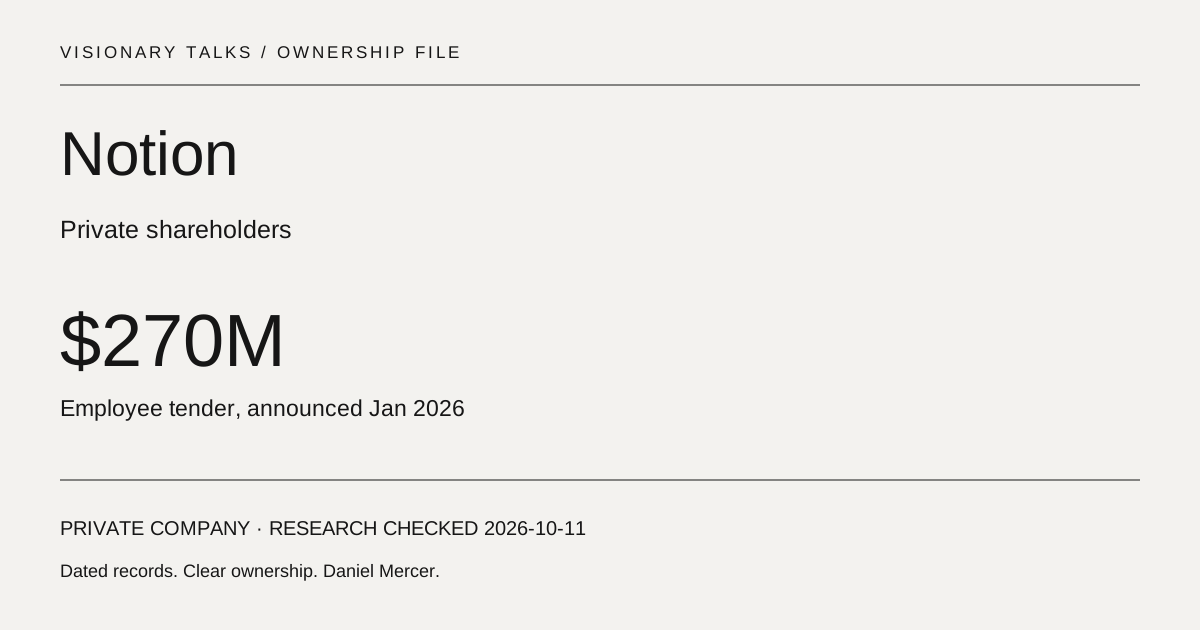
- January 26, 2026: Notion announced around $270M of employee share purchases.
- The transaction benchmark was $11B, not $11B of capital raised.
- GIC joined Sequoia and Index as tender buyers.
- The company waived a one-year option cliff for current employees participating in this event.
What changed in 2026
The CFO’s tender announcement establishes a secondary transaction with current and former employees. The announcement date is not necessarily the closing date: the post says the offer occurred over the preceding quarter.
That temporal detail matters to a current ownership article. The funds bought existing interests from employees, while this record does not describe an IPO. A private liquidity event can allow some holders to sell without making everyone’s shares continuously tradable.
Who owns Notion?
The table separates a named buyer from a complete current percentage. Sequoia and Index were returning investors, so their purchases in this event cannot be treated as their entire holdings. GIC’s addition establishes a new investor relationship, not a disclosed controlling interest.
The legal name appears in the company’s own site footer. The product, employment awards and equity issuer can be described at different levels of detail. I would verify the issuer named in an actual option agreement before attaching its shares to a financing benchmark.
| Holder | Type | Stake / basis | Voting rights | Source / date |
|---|---|---|---|---|
| Founders and other existing shareholders | Private holders; allocations unavailable | Not disclosed | Not disclosed | sequoiacap.com Historical investor company page |
| GIC | New tender buyer | Not disclosed | Not disclosed | www.notion.com 2026-01-26 announcement |
| Sequoia Capital | Returning investor and tender buyer | Not disclosed | Not disclosed | www.notion.com 2026-01-26 announcement |
| Index Ventures | Returning investor and tender buyer | Not disclosed | Not disclosed | www.notion.com 2026-01-26 announcement |
Who received Notion’s tender proceeds?
The company says the purchases were directly from current and former employees. On that description, sellers received liquidity; the tender amount should not be added to company capital raised as though it were a new primary financing.
The cliff waiver was a participation detail in this particular event. It should not be read as blanket permission for every employee to sell at any time, nor as proof that every award was a fully vested freely transferable share.
For a career decision, an option’s strike price, vesting, exercise cost and liquidity conditions matter alongside a headline company valuation. Our AI salaries tracker compares compensation evidence, but a company price alone is insufficient to value an individual employment award.
Who received the $270 million matters more than the headline
The 2020 adviser-confirmed $2B financing and the reported 2021 $10B round give two primary-capital benchmarks. The January 2026 disclosure describes a different transaction: purchases from employees. I keep the $11B tender benchmark in the table and outside the primary-round chart, because the underlying flow of money changed.
Around $270M divided by an $11B benchmark is approximately 2.45%. That is a rough aggregate transaction-size comparison. It does not establish GIC’s stake, the sellers’ combined voting interest or a precise fully diluted percentage. The announcement does not disclose each buyer’s allocation, and a tender can cover instruments with rights that differ from the preferred shares sold in a financing.
The CFO’s tender account includes an employee detail that a valuation-only summary misses: the company waived the one-year option vesting cliff for participation. That made this particular liquidity event accessible more broadly. It does not prove that every option immediately vested for all purposes or that the company changed its permanent compensation policy.
I also keep two different denominators separate. More than half of ARR coming from AI-enabled customers is a statement about the composition of a run rate. It does not mean AI itself generated that proportion of incremental revenue, and a doubling of the share is not the same thing as a doubling of total sales.
A tender can therefore be relevant to staff retention, investor demand and IPO preparation without proving an imminent IPO. The useful next record would be a company-confirmed listing process or public registration document, with a defined issuer, share classes and offering terms. Until then, the company’s ability to provide private liquidity is part of the story in its own right.
Notion’s first board is a governance signal, not an IPO date
In his June 8 announcement, Ivan Zhao names Jonathan Chadwick, Pat Grady, Gretchen Howard, Christopher Payne and Patrick Hsu as joining Notion’s first board. I distinguish that governance development from share ownership: the post gives no voting percentages or offering timetable.
How the founders built Notion
Sequoia’s company page dates Notion’s founding to 2013 and identifies Ivan Zhao and Simon Last among the team. A founder biography and investor history are useful starting points; neither reveals the founders’ current ownership percentages.
The founder-led product story does not settle voting control. I would need the classes, charter and shareholder arrangements to distinguish a large economic interest from a right to direct decisions. Those records are not supplied by the tender announcement, so I do not add a controlling-founder percentage.
Funding and valuation history
The transaction adviser’s 2020 record confirms a $50M financing at $2B. It is a primary funding event, different from the later employee tender. I do not plot both as identically defined primary rounds.
The tender-to-company-price ratio is about 2.45%. That is a rough scale comparison, not GIC’s stake or the precise percentage of shares transferred. The share class, discounts, participation split and valuation denominator could alter the actual ownership calculation.
The company also reports an AI-enabled customer share of ARR. A revenue mix percentage and a total revenue growth rate have different denominators. I did not verify the supplied 82% growth claim from this post and do not substitute its mix disclosure for that missing growth figure.
| Date / event | Amount | Valuation | Lead / counterparty | Evidence |
|---|---|---|---|---|
| 2020-04-02 Primary financing | $50M | $2B | Index Ventures and others | www.fenwick.com disclosed |
| 2021-10-08 Primary financing | $275M | $10B | Sequoia Capital; Coatue | SiliconANGLE reported |
| 2026-01-26 Employee tender announcement | Around $270M | $11B transaction benchmark | GIC; Sequoia; Index | www.notion.com disclosed |
Notion: dated funding valuations
USD billions · priced rounds only
Scroll horizontally to see every column. Keyboard: focus the chart and use the arrow keys.
Zero baseline. Missing values are not interpolated.
Separate round observations. Tenders, debt, proposed deals and valuation lower bounds are excluded. No values between rounds are estimated.
I read the $2B and reported $10B bars as dated primary financing benchmarks. The $11B employee tender is a separately labelled transaction, not another capital-raising observation.
Notion ownership timeline
| Date | Event | Ownership after event | Money / basis | Source |
|---|---|---|---|---|
| 2013 | Company founded | Private founders and backers | No founding valuation assigned | sequoiacap.com |
| 2020-04-02 | Primary financing confirmed by adviser | Private founders and investors | $50M at $2B | www.fenwick.com |
| 2021-10-08 | Primary financing | Private shareholders; allocations undisclosed | $275M; $10B | SiliconANGLE |
| 2026-01-26 | Tender announced, held over previous quarter | Employees sell to GIC, Sequoia and Index | Around $270M at $11B benchmark | www.notion.com |
| 2026-06-08 | First board announced | Shareholder percentages not disclosed | No financing announced in this record | Notion |
| 2026-10-12 | Research check | Private shareholders; no public listing established here | Tender is secondary liquidity | www.notion.com |
The tender headline is employee liquidity, not a $270M treasury injection
I followed the CFO’s description of the cash recipient rather than placing every funding headline into a capital-raised total. This was a purchase from employee sellers. Its effect on who holds stock is real, even though it is not described as primary capital.
My read: that is the useful connection between the ownership and career stories. An employee can obtain liquidity in a company-arranged event while the business remains private and other holders face different restrictions.
The cliff waiver adds specificity, but not a universal rule. An employment candidate should check the current award documents and eligibility for any future tender rather than assuming the January conditions will automatically recur.
Who runs Notion?
| Person | Role | As of / condition | Source |
|---|---|---|---|
| Rama Katkar | CFO; author of tender disclosure | Identified January 26, 2026 | www.notion.com |
| Ivan Zhao | Cofounder and CEO | Current company blog checked October 11, 2026 | Notion |
Can you buy Notion stock? What about an IPO?
A private tender is not a public Notion stock listing. The reviewed sources do not establish an IPO date or continuously tradable shares. A reported preparation effort would need its own dated source and should remain separate from a completed listing.
For comparison, Canva’s legal restructure changes the ownership chain without an IPO, while Glean’s financing history prices capital into the company. The differences make these three software stories more useful than a list of private-company valuations.
Our Glean ownership investigation traces primary company financing, and who owns Cursor follows a product’s legal ownership chain. That comparison is useful when a liquidity announcement is described as fundraising: the recipients of the money and the legal transaction determine which story it is.
Frequently asked questions
Who owns Notion?
Notion is privately held. Its CFO named GIC, Sequoia and Index as buyers in an employee tender, while founders and other investors remain part of the wider ownership story. The post does not disclose a complete current register or each party’s voting percentage.
Is Notion publicly traded?
A tender lets specified investors buy from eligible existing holders without listing the company. The sources reviewed here do not establish a public Notion ticker or IPO date. Participation in a private event does not make all shares freely tradable afterward.
Did Notion raise $270 million in 2026?
The company described around $270 million of investor purchases directly from employees. That is a secondary tender, not a disclosed $270 million primary capital raise. The amount therefore belongs in the liquidity history rather than being added automatically to company treasury financing.
What is Notion’s valuation?
The tender announcement used an $11 billion transaction benchmark. It is a dated private price, not an exchange market capitalization. Different award classes, exercise prices and conditions mean it cannot by itself establish what every employee or investor could receive for a holding.
What I am watching next
Next tender: check seller eligibility, buyer identities, share class and whether proceeds are secondary.
Next public filing: look for issuer, votes and beneficial owners before assigning an IPO date.
Next operating update: preserve revenue-growth and ARR-mix definitions rather than combining percentages.
Our independent research methodology
I read the CFO’s announcement, the adviser’s historical financing record and the investor company page and founder’s first-board announcement. I traced transaction type and proceeds rather than guessing current percentages. Our research method separates liquidity, capital and company value. I did not obtain employee agreements, a confidential filing or a shareholder register.
Research checked 2026-10-12. Updated 2026-10-12. Meet the author and read our research approach.
Sources & methodology
Observations retain their source, period and definition. Uncertainty is preserved; missing values are not zero.
- Notion CFO: GIC, Sequoia, Index tender ↗
www.notion.com · 2026-01-26
Around $270M employee secondary tender at $11B, cliff waiver and AI-enabled ARR mix. Accessed 2026-10-11.
- Fenwick represents Notion in $50M financing ↗
www.fenwick.com · 2020-04-02
Transaction adviser confirms $50M financing, Index lead and $2B valuation. Accessed 2026-10-11.
- Sequoia portfolio: Notion ↗
sequoiacap.com · Undated
Founded 2013; Ivan Zhao and Simon Last among team, investor partnership in 2021. Accessed 2026-10-11.
- Notion discloses $275M financing at $10B ↗
SiliconANGLE · 2021-10-08
Contemporaneous report of company disclosure: $275M, $10B, Sequoia and Coatue lead. Reported rather than a company-issued release. Accessed 2026-10-11.
- Notion blog: author identity ↗
Notion · Undated; accessed 2026-10-11
Current blog identifies Ivan Zhao as cofounder and CEO. Accessed 2026-10-11.
- Ivan Zhao announces Notion’s first board ↗
Notion · 2026-06-08
Founder announcement names Jonathan Chadwick, Pat Grady, Gretchen Howard, Christopher Payne and Patrick Hsu as joining the first board. No voting percentages or public offering schedule disclosed. Accessed 2026-10-12.