
Key takeaways
- Anysphere, Inc., doing business as Cursor, was founded in 2022 by four MIT classmates.
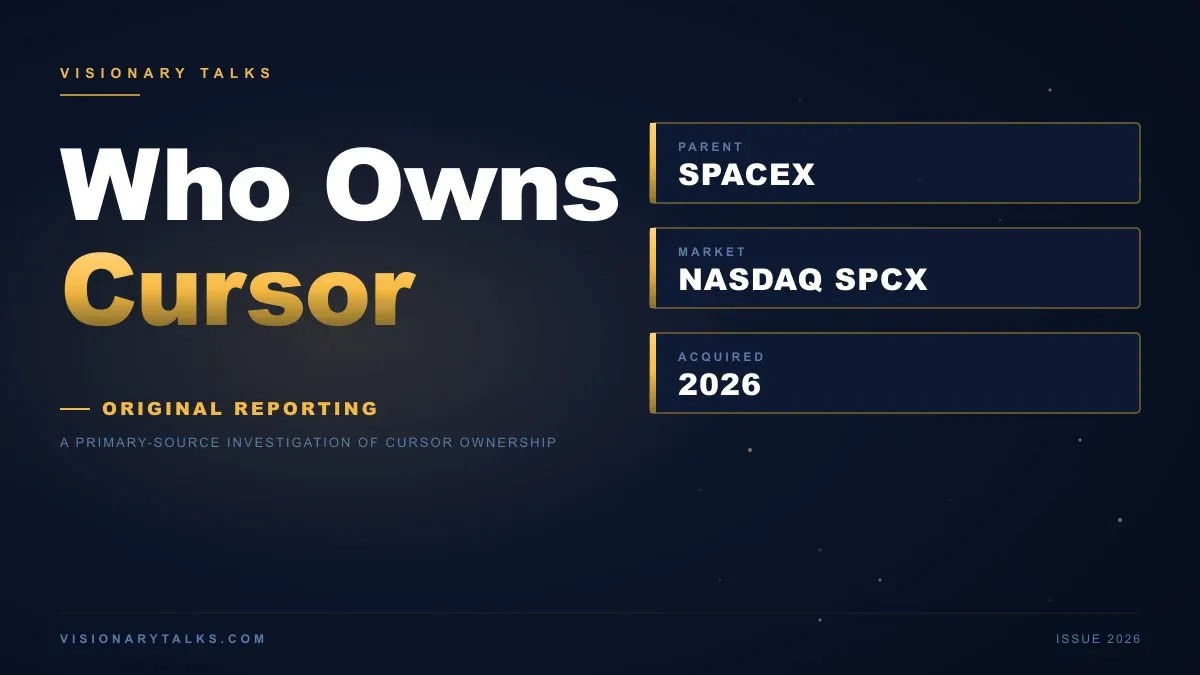
- SpaceX announced the $60 billion all-stock acquisition on June 16, 2026, exercising an option struck in April 2026, and closed it on August 14, 2026.
- Anysphere's outstanding common and preferred shares converted into 389,289,254 SpaceX Class A shares, with options and restricted stock assumed on top.
- Forbes estimates each Cursor cofounder received SpaceX shares worth about $2.4 billion at closing. It puts chief executive Michael Truell's net worth at $2.5 billion as of September 10, 2026.
- Cursor passed $1 billion of annualized revenue in November 2025, having been at $100 million in January 2025.
This article is based on primary sources: Forbes' profile of Michael Truell as of September 10, 2026, reporting of SpaceX's Form 8-K confirming the August 14, 2026 close, SpaceX's June 2026 IPO pricing disclosures, and the disclosed funding history of Anysphere, Inc. Where reported revenue figures conflict, both are given with their dates. Full source list at the bottom.
The Short Answer: SpaceX, Since August 14, 2026
If you asked this question in May 2026, the answer was a private company called Anysphere, Inc., controlled by its four founders and a syndicate of venture funds. The answer changed twice in three months.
On June 16, 2026, SpaceX announced it would buy Anysphere for $60 billion in an all-stock deal, exercising an option agreed in April 2026 that let it either pay roughly $10 billion for a partnership or buy the company outright for $60 billion. It chose to buy. The transaction closed on August 14, 2026, and Cursor now operates as a wholly owned unit inside SpaceXAI.
It is the largest acquisition of a venture-backed startup on record.
The ownership chain as of September 2026 runs: Cursor the product, Anysphere, Inc. the company, SpaceXAI the division, SpaceX the parent, and SpaceX's public shareholders at the top, since SpaceX itself listed on the Nasdaq under SPCX on June 12, 2026. Four years after four students forked a code editor, the answer to who owns Cursor is anyone with a brokerage account.
The Four MIT Students Who Started It
Anysphere was founded in 2022 by Michael Truell, Sualeh Asif, Aman Sanger and Arvid Lunnemark. Forbes describes Truell as having cofounded the company with three friends from MIT, where he took a Bachelor of Science. Truell is chief executive. Asif is chief product officer.
One correction to the story as it is usually told: the four did not all stay. Arvid Lunnemark left the company in October 2025, roughly ten months before the sale. He was still a shareholder at closing, which is why Forbes' estimate of what each cofounder received applies to him too.
The founders never sold control on the way up. They raised repeatedly and kept the company private and founder-led, and then disposed of the entire thing in one transaction. That is unusual: most companies at this scale leak control gradually through successive rounds and governance concessions. Cursor's founders went from full control to none of it in a single step.
For the wider category context, the Stockholm company Lovable took the opposite path and stayed independent at a $13.3 billion valuation; the structure there is in our breakdown of who owns Lovable. Two more owner-story breakdowns sit alongside it: who owns Base44, the AI app builder Wix acquired, and the AirOps founder story.
From $100 Million to Billions in ARR in Three Years
The revenue ramp is the reason the price was what it was, and it is the fastest recorded for application software.
| Annualized revenue | As of |
|---|---|
| $100M | January 2025 |
| $500M | June 2025 |
| Over $1B | November 2025 |
| Around $3B | May 2026 |
| $2.6B annualized | June 2026, at the deal announcement |
Two things about that table. First, the last two rows disagree, and honestly so: the figure circulating in May 2026 was around $3 billion, while coverage of the June 16 announcement put annualized revenue at $2.6 billion. Neither is audited, Anysphere never published financial statements, and annualized revenue in this category means a recent month multiplied by twelve. Both numbers describe the same order of magnitude and neither should be treated as a filing.
Second, a widely repeated claim that Cursor reached roughly $4 billion of ARR by mid-2026 could not be verified against any dated, named source, so it is not in this article.
Funding, from the disclosed record: an $8 million seed in October 2023 led by the OpenAI Startup Fund, with angels including former GitHub chief executive Nat Friedman and Dropbox cofounder Arash Ferdowsi; a $60 million round in July 2024 at a $400 million valuation; a $900 million round led by Thrive Capital on June 5, 2025 at a $9.9 billion post-money valuation; and a $2.3 billion Series D co-led by Accel and Coatue Management on November 13, 2025 at $29.3 billion. Discussions in April 2026 reportedly valued the company near $50 billion, before the option agreement overtook them.
From a $400 million valuation in July 2024 to a $60 billion sale price in August 2026 is a 150-fold repricing in twenty-five months.
Why SpaceX Paid $60 Billion
The strategic logic is dependency, not developer tools.
SpaceX had already bought its way into AI once, acquiring xAI on February 2, 2026 in an all-stock transaction that valued SpaceX at $1 trillion and xAI at $250 billion. xAI was rebranded SpaceXAI in July 2026 and now runs the Grok model family, the X social network, and SpaceX's data centres, alongside the Space and Connectivity segments.
What that structure lacked was a coding product with real distribution. Cursor supplies it, and it supplies something more specific: a large base of professional developers whose work generates exactly the data and workflow surface a coding model needs. SpaceX has said publicly that it intends to run Cursor's model-based coding directly on internal engineering servers for aerospace software.
The dependency being cut is the interesting part. Cursor was built on top of frontier models it did not own, which for most of its life meant paying Anthropic and OpenAI for the intelligence inside its own product. Owning Cursor lets SpaceXAI point that demand at Grok instead. If you want the ownership structures on the other side of that relationship, see who owns Anthropic and who owns OpenAI, both of which are considerably more tangled than SpaceX's.
The timing was not incidental. SpaceX priced its initial public offering at $135 a share on June 11, 2026, raising $75 billion at a $1.77 trillion valuation, the largest listing ever, and began trading on June 12. It announced the Cursor acquisition four days later, in stock. A company that has just minted the most valuable equity currency in the market is in an unusually good position to buy things with it.
Michael Truell Net Worth: What the Deal Implies
Forbes puts Michael Truell's net worth at $2.5 billion as of September 10, 2026, ranking him 1,643rd in the world. He is 26.
The mechanism matters more than the number. Forbes estimates that each Cursor cofounder received SpaceX shares worth about $2.4 billion at the deal's closing on August 14, 2026. That is not a cash payout. It is Class A stock in a newly listed company, and the founders' wealth now moves with the SPCX share price rather than sitting in a bank.
That distinction is the whole point of an all-stock deal, and it cuts both ways. The founders are no longer exposed to whether Cursor wins its market; they are exposed to whether SpaceX does. A rocket, satellite, social network and AI conglomerate has a very different risk profile from a code editor, and neither founder chose the former on the merits of its business.
For how we read paper valuations of private and newly liquid stakes generally, see net worth from filings.
Who Owned Cursor Before the Deal
Before August 14, 2026, Anysphere was a private Delaware company with a conventional venture cap table: four founders holding the largest individual positions, and preferred stock spread across the OpenAI Startup Fund from the 2023 seed, Thrive Capital from the 2025 round, and Accel and Coatue Management from the November 2025 Series D, alongside earlier investors and angels.
No single investor controlled it. Anysphere never filed with the SEC, published no proxy statement, and disclosed no beneficial ownership table, so exact percentages were never public and still are not. What is public is the outcome: every share of that structure, common and preferred, converted into 389,289,254 shares of SpaceX Class A common stock, with additional restricted stock units and options assumed by SpaceX, taking the total issuance to roughly 391 million shares.
That conversion is the cleanest ownership document this story has. It is also the end of it: there is no longer a Cursor cap table to read.
The Bear Case Nobody Prices In
Here is the honest limitation, and it is not small.
Cursor's moat was being the best product. That is the most perishable advantage in software, because it depends on model capabilities that Cursor did not own and that are converging fast. GitHub Copilot had years of head start, Microsoft's distribution, and direct access to the largest code corpus on earth, and it still lost share to a four-person startup. The same dynamic that let Cursor win is the one that can unseat it, and a $60 billion price assumes it will not.
There is a second problem specific to the new ownership. Cursor's developer base is not aligned with SpaceX. Enterprises that standardised on Cursor now route a core engineering workflow through a subsidiary of a company that competes with Anthropic and OpenAI, owns a social network, and is controlled by one of the most politically exposed executives in the world. Procurement departments notice that. Some will switch on principle, some on risk policy, and the switching cost from one AI code editor to another is a weekend.
Finally, the price is denominated in the acquirer's own stock at a moment of maximum enthusiasm for it. SpaceX paid $60 billion in a currency it had been able to price publicly for four days. If SPCX re-rates downward, the deal will look expensive in hindsight and the founders' $2.4 billion each will have been a smaller number than the headline.
Cursor ownership FAQ
Is Cursor owned by Elon Musk?
Not personally. Cursor is owned by SpaceX, which Musk leads and in which he holds a large stake, and SpaceX has been publicly traded on the Nasdaq as SPCX since June 12, 2026. So Cursor's ultimate owners are SpaceX's shareholders, with Musk the most significant among them rather than the owner outright.
Did SpaceX buy Cursor or xAI?
Both, in separate transactions. SpaceX acquired xAI on February 2, 2026 in an all-stock deal that valued xAI at $250 billion, and rebranded it SpaceXAI in July 2026. It then acquired Anysphere, the maker of Cursor, for $60 billion, closing on August 14, 2026. Cursor now sits inside SpaceXAI.
How much revenue does Cursor make?
Cursor passed $1 billion of annualized revenue in November 2025, from $100 million in January 2025. Figures for 2026 are reported rather than filed: around $3 billion of ARR in May 2026, and $2.6 billion of annualized revenue in coverage of the June 2026 deal. SpaceX has not broken out Cursor revenue separately as of September 2026.
Who founded Cursor and how old are they?
Michael Truell, Sualeh Asif, Aman Sanger and Arvid Lunnemark, four MIT classmates, founded Anysphere in 2022. Truell, the chief executive, is 26 as of September 2026. Lunnemark left the company in October 2025.
Is Cursor the same company as Anysphere?
Yes. Anysphere, Inc. is the legal entity and Cursor is its product, so the two names refer to the same business. Since August 14, 2026 that entity has been a wholly owned subsidiary of SpaceX.
What I am watching next
1. Whether SpaceX ever discloses Cursor revenue. Anysphere never had to file. SpaceX does now, and a segment breakdown would settle the ARR question permanently.
2. Enterprise churn. The switching cost between AI code editors is trivial and the ownership change is a procurement event at every large customer.
3. Model substitution. If Cursor is quietly moved from third-party frontier models onto Grok, quality comparisons will tell you whether the strategic thesis was sound.
Sources
1. Forbes profile, Michael Truell forbes.com/profile/michael-truell. Establishes his net worth of $2.5 billion and world rank of 1,643 as of September 10, 2026, his age of 26, his MIT degree, the founding of the company with three MIT friends in 2022, the August 2026 acquisition, and the estimate that each cofounder received about $2.4 billion of SpaceX stock at closing.
2. SpaceX completes its $60 billion acquisition of Cursor, August 14, 2026 Yahoo Finance. Establishes the closing, the conversion of Anysphere shares into 389,289,254 SpaceX Class A shares with options and restricted stock assumed on top, and Cursor's status as a wholly owned unit of the SpaceXAI division, citing SpaceX's Form 8-K.
3. SpaceX announces the $60 billion Cursor deal, June 16, 2026 Yahoo Finance. Establishes the announcement date, the all-stock structure, the expected third-quarter close, the April 2026 option to pay about $10 billion for a partnership or acquire for $60 billion, the $2.6 billion annualized revenue figure, and the roughly $50 billion valuation under discussion in April 2026.
4. SpaceX finalizes regulatory procedures to close the acquisition, August 13, 2026 SatNews. Establishes the regulatory timeline, the intent to run Cursor's coding models on internal engineering servers, and SpaceX's three-segment structure.
Secondary sources:
5. Wikipedia, Cursor (code editor) and SpaceX, used for the disclosed funding history of Anysphere, Inc., the founders' roles, Arvid Lunnemark's October 2025 departure, the revenue milestones of January 2025, June 2025, November 2025 and May 2026, the February 2, 2026 xAI acquisition and its $250 billion valuation, the July 2026 SpaceXAI rebrand, and SpaceX's IPO pricing of $135 per share on June 11, 2026 raising $75 billion at a $1.77 trillion valuation. Each figure was checked against contemporaneous reporting before use.
Compare private AI ownership structures
A company partnership, investor and shareholder are different relationships. Our investigations of Groq’s Nvidia agreement, Mistral AI’s strategic investors and Cohere’s pending combination trace those differences through the dated records.
Workplace and professional software offer another comparison: Canva’s parent-company exchange, Glean’s venture shareholders, Notion’s employee tender and Harvey’s legal AI financing show why private liquidity and new company capital should be reported separately.
For capital-intensive AI businesses, follow Anduril’s stock-transfer rules, Crusoe’s infrastructure funding and Lambda’s equity and debt history. Their financing records help explain what ownership means before a possible public offering.