
Key takeaways
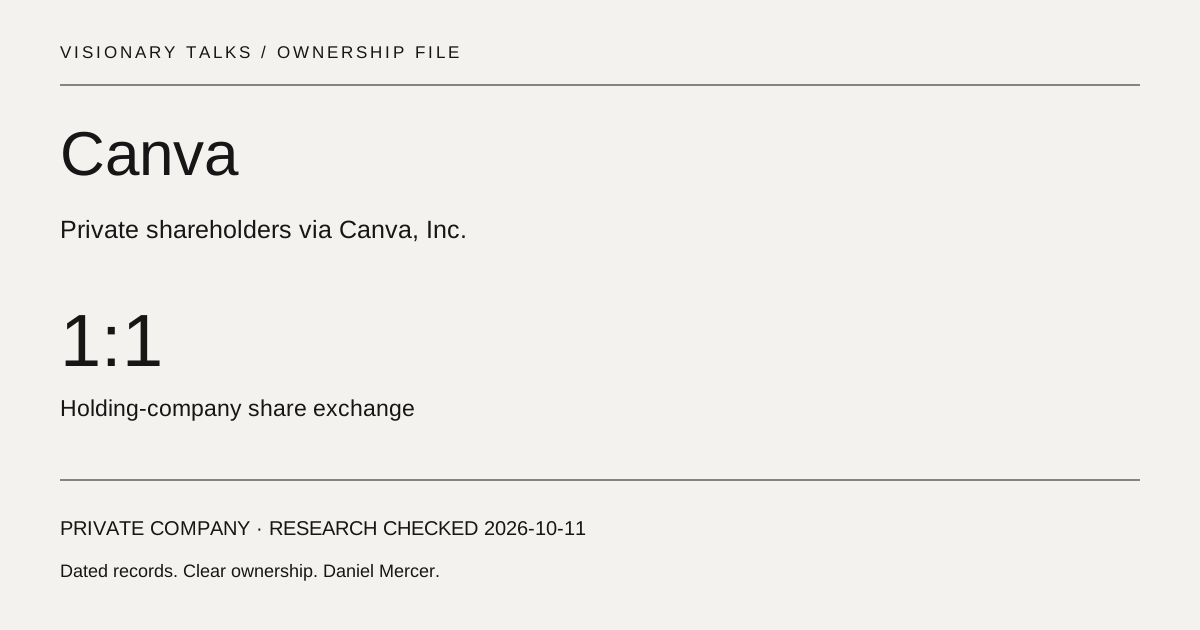
- February 12, 2025 US time: the holding-company merger became effective.
- The ruling says shareholders kept equivalent percentages and rights; this was not a cash buyout.
- September 2021: $200M of financing valued Canva at $40B.
- A new holding company does not establish a public listing date.
What changed in 2026
The supplied brief placed the US restructuring in September 2025. Class Ruling CR 2025/36 gives an earlier effective date and a step-by-step chain. I use that primary record to explain what moved and what shareholders received.
The current question is whether IPO preparation has become an offering. The documents here establish a private corporate structure and historical financing. They do not establish a completed 2026 IPO. Unverified listing predictions do not belong in the short answer.
Who owns Canva?
Funding releases identify participants, not necessarily the largest current holders. The table therefore dates named backers without inventing a rank or a contemporary percentage.
Canva can mean the product, an operating company or the ultimate parent. That distinction matters when reading an employee award, fund holding or eventual offering document. The new Canva, Inc. sits above the surviving old entity, while the ruling does not provide every ultimate shareholder’s current interest.
| Holder | Type | Stake / basis | Voting rights | Source / date |
|---|---|---|---|---|
| Founding team | Founders; current holdings unverified | Not disclosed | Not disclosed | www.canva.com Historical company timeline |
| T. Rowe Price | 2021 round lead | Not disclosed | Not disclosed | www.canva.com 2021-09-15 |
| Blackbird; Felicis; AirTree | Named financing investors | Not disclosed | Not disclosed | www.canva.com 2021-09-15 |
| Franklin Templeton; Sequoia Capital Global Equities | Named financing investors | Not disclosed | Not disclosed | www.canva.com 2021-09-15 |
Which Canva company sits above the operating business?
The ruling describes a new Delaware parent, merger subsidiary and reverse triangular merger. Old shares were exchanged for an identical number of holding-company shares with matching rights. The old entity survived below that parent.
Subsequent conversion and Australian registration help explain why an older legal name may differ from a later record. I would check the issuer on a certificate or award before equating it with an interest in the present ultimate parent.
My read: this altered the legal chain, without evidence of an outside acquirer cashing out the founders. A public listing would require its own records. Reorganizing a group can prepare future options without guaranteeing which option management will choose.
The share exchange did not sell Canva to an American buyer
The Australian Taxation Office ruling lets me test the restructuring without relying on a fundraising headline. It describes an exchange into a new Delaware parent, with corresponding shares preserving relative interests. The old Australian company then became an indirect subsidiary. This is why the answer can be both US parentage and continuity of the existing shareholder group.
I would look for cash consideration, a buyer receiving control or a changed percentage schedule before describing this as an acquisition. The ruling’s exchange mechanics do not establish those events. They also do not tell me each investor’s percentage after later transactions, so the holder table does not turn continuity at the restructuring date into an October 2026 cap table.
The funding history supplies a different set of observations: $6B in 2020, $15B in April 2021 and $40B in September 2021. My calculation makes the first-to-last increase roughly 6.7 times. Those are financing benchmarks, not the tax value of the restructuring and not a current executable price for a founder or employee’s common shares.
The company’s ten-year timeline also records its founders’ commitment to direct a substantial part of the value they create toward philanthropy. A pledge is meaningful intent, but a dated shareholder list and completed transfers would be needed to map legal ownership and votes. I keep the philanthropic story separate from the current holder table.
For a possible IPO, the parent-company change may remove a structural step from a future listing process. That is my interpretation of the corporate arrangement, not evidence that a registration statement has been filed or an offer priced. An employee liquidity transaction would likewise require its own date and terms rather than extending the old primary-round chart.
How the founders built Canva
Melanie Perkins, Cliff Obrecht and Cameron Adams are the founders in Canva’s product story. Incorporation and launch are different milestones: the ruling dates the old entity to 2012, while the company timeline describes the design product’s development. I do not turn an incorporation date into the first-customer date.
A foundation pledge also differs from a current shareholder register. A philanthropic commitment does not, by itself, demonstrate that a specific number of shares and their votes have already transferred. Exact current founder holdings should be sourced before building personal net-worth estimates.
Funding and valuation history
The 2020 announcement and 2021 release provide priced milestones. The restructuring has no equivalent financing price and belongs only in the event table.
A fund markdown values that fund’s holding under an accounting policy. A tender prices a particular secondary sale. Neither should appear in the primary-round chart as though it supplied new capital on identical terms. The last historical bar is explicitly not labeled today’s market value.
The investment question also depends on rights. A preferred holder may receive protections different from common shareholders or employee options. The sum invested divided by the headline company value is insufficient to establish a current percentage after later transactions.
| Date / event | Amount | Valuation | Lead / counterparty | Evidence |
|---|---|---|---|---|
| 2020-06-23 Financing | $60M | $6B | Bond; Blackbird; General Catalyst | www.canva.com disclosed |
| 2021-04 Financing | $71M | $15B | T. Rowe Price; Dragoneer | www.canva.com disclosed |
| 2021-09-15 Financing | $200M | $40B | T. Rowe Price | www.canva.com disclosed |
| 2025-02-12 Holding-company restructure | No cash share-exchange consideration | Not a financing valuation | Existing shareholders | www.ato.gov.au disclosed |
Canva: dated funding valuations
USD billions · priced rounds only
Scroll horizontally to see every column. Keyboard: focus the chart and use the arrow keys.
Zero baseline. Missing values are not interpolated.
Separate round observations. Tenders, debt, proposed deals and valuation lower bounds are excluded. No values between rounds are estimated.
I count three priced financing milestones in this window, increasing about 6.7 times from first to last. The bars stop at the last priced round in this ledger and do not interpolate through tenders, fund marks or the restructure.
Canva ownership timeline
| Date | Event | Ownership after event | Money / basis | Source |
|---|---|---|---|---|
| 2012 | Original entity incorporated | Private founding shareholders | No valuation assigned | www.ato.gov.au |
| 2020-06-23 | Financing | Private investors | $60M at $6B | www.canva.com |
| 2021-04 | Financing | Private investors | $71M at $15B | www.canva.com |
| 2021-09-15 | Financing | Expanded private syndicate | $200M at $40B | www.canva.com |
| 2025-02-12 | Merger, US effective date | Existing holders exchange into new Canva, Inc. | Equivalent percentages and rights | www.ato.gov.au |
| 2025-03-12 | Old entity registers in Australia | New parent above Canva Australia Holdings Pty. Ltd. | Corporate form change | www.ato.gov.au |
| 2026-10-12 | Research check | Private group; current cap table unavailable | Completed IPO not established in this review | www.ato.gov.au |
An identical-number exchange is not an ownership cash-out
I read paragraphs 28–32 for what holders received: matching rights and relative values, without monetary consideration for the exchange. That answers whether the restructure itself sold Canva to an outside owner.
A tax provision can call an arrangement a takeover because an entity becomes wholly owned below another. That classification does not mean unrelated investors bought out the original holders. This ruling also explains continuity of their percentages.
For a future IPO investigation, I would follow the parent into the prospectus and reconcile its pre- and post-offering classes, votes and beneficial holders. The present ruling maps the restructure; it cannot replace those later disclosures.
Who runs Canva?
Can you buy Canva stock? What about an IPO?
No verified public Canva ticker appears in the reviewed source set. An indirect private offering needs to specify its issuer and holdings; a fund unit is not automatically a direct share in Canva, Inc.
IPO readiness may describe reporting systems, governance or management ambition. It does not settle timing, pricing or offered classes. Notion’s ownership investigation follows a tender without a listing; Glean’s company file separates operating growth from financing prices.
For comparison, who owns Cursor follows the legal ownership of an AI software product, while who owns ChatGPT distinguishes product branding from the company structure. These are different corporate arrangements, so I compare the records rather than assume every AI platform has the same parent.
Frequently asked questions
Who owns Canva now?
Canva is privately held through the new US holding company described in the tax ruling. Founder and investor participation is documented at historical events; a full current register is not disclosed here. Exact contemporary stakes require a cap table or an offering document.
Is Canva publicly traded?
This investigation does not establish a completed Canva IPO or public ticker as of the research check. A Delaware parent can have private shares. Corporate reorganization and comments about IPO readiness are different milestones from an admitted exchange listing. The source date matters.
Did Canva move ownership to the US?
The ruling describes an exchange into a new Delaware ultimate parent effective in February 2025. Existing shareholders retained equivalent percentages and rights. The legal chain above the business changed, without establishing an outside purchase of all founder interests. The source date matters.
What is Canva’s valuation?
The chart ends at the $40 billion company financing in September 2021. This historical benchmark is not a current tradable stock price. Later tenders and accounting marks need dates and separate labels before comparison with those financing observations. The source date matters.
Who built Canva?
Melanie Perkins, Cliff Obrecht and Cameron Adams founded Canva. The company’s history describes its development as a visual design platform, while the Australian tax ruling separately dates the original entity’s incorporation to 2012. Product launch, legal incorporation and today’s parent-company ownership are distinct milestones in this investigation.
What I am watching next
Next offering: identify the issuer, classes and beneficial ownership table before attaching a listing date.
Next liquidity transaction: distinguish secondary proceeds from capital raised by the company.
Next governance refresh: confirm current leadership and votes from a recent direct record.
Our independent research methodology
I read the full ATO ruling in the browser, company funding announcements and historical timeline. The ruling establishes structure, not an audited current cap table. Our research method separates records, reported developments and interpretation. No confidential listing submission or private register was obtained.
Research checked 2026-10-12. Updated 2026-10-12. Meet the author and read our research approach.
Sources & methodology
Observations retain their source, period and definition. Uncertainty is preserved; missing values are not zero.
- ATO Class Ruling CR 2025/36 ↗
www.ato.gov.au · 2025-05-28
Read full ruling in browser. Paragraphs 22, 28–38 identify new holding company, exchange rights and effective dates. Accessed 2026-10-11.
- Canva $60M round at $6B ↗
www.canva.com · 2020-06-23
Company-priced round, not a fund mark. Accessed 2026-10-11.
- Canva $200M financing at $40B ↗
www.canva.com · 2021-09-15
T. Rowe Price-led round and participating investors. Accessed 2026-10-11.
- Canva ten-year company timeline ↗
www.canva.com · 2023
Company history includes founders, April 2021 $71M financing at $15B, acquisitions and foundation pledge. Accessed 2026-10-11.
- Melanie Perkins: company author biography ↗
Canva · Undated; accessed 2026-10-11
Current newsroom author page names cofounder and CEO. Accessed 2026-10-11.
- Cliff Obrecht: company author biography ↗
Canva · Undated; accessed 2026-10-11
Current newsroom author page names cofounder and COO. Accessed 2026-10-11.