
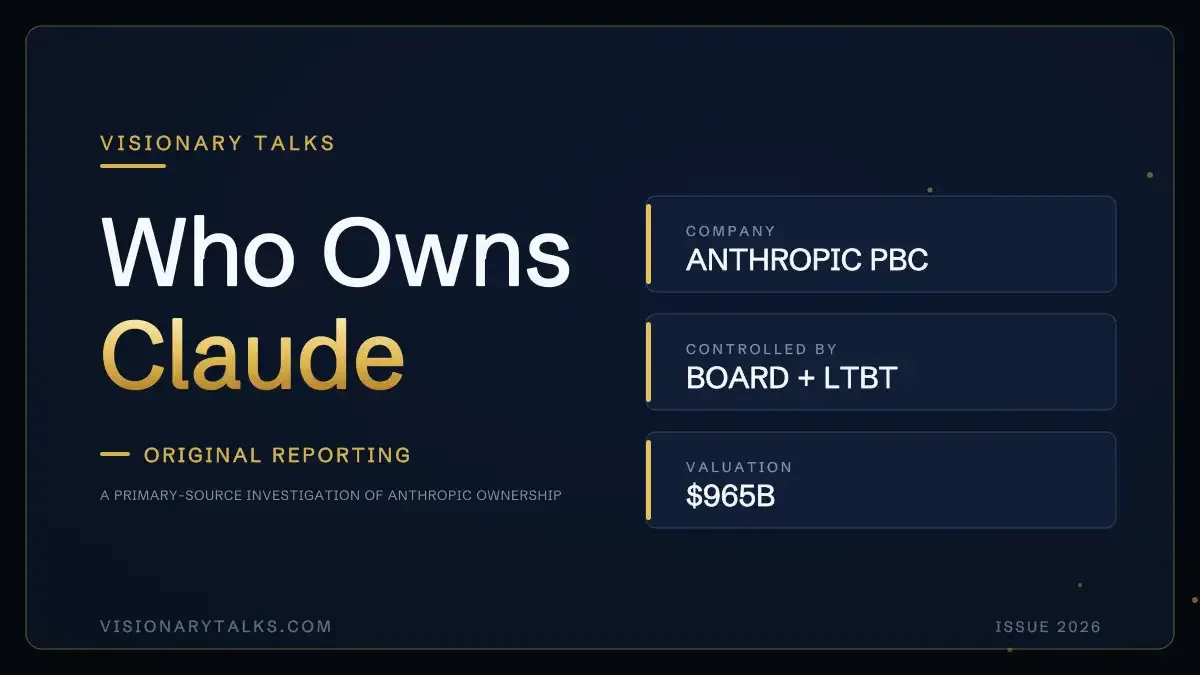
Every other "who owns Anthropic" article leads with the investor headline. This one separates the three layers and dates every number, because Anthropic's valuation climbed from about $61.5 billion to roughly $965 billion in a little over a year — and is still moving.
Key takeaways
- Claude is a product family, not a company. The company is Anthropic PBC, a Delaware public benefit corporation founded in 2021.
- The largest economic backers are Amazon and Google — and both hold their stakes in nonvoting instruments with no board control.
- Control runs through the founders, the board, and the Long-Term Benefit Trust, an independent trust that, per Anthropic, will elect a majority of the board within four years.
- Amazon has deployed roughly $18 billion (with up to $20 billion more committed) and carried the position at about $190 billion at the end of June 2026 — as convertible notes plus nonvoting preferred stock.
- Google/Alphabet holds a minority stake reported near 14%, contractually capped at 15% with no votes or board seats, and has committed up to $40 billion more.
- Anthropic's Series H (May 28, 2026) valued it at roughly $965 billion; secondary markets marked it near $1.2 trillion by early July 2026.
- There is no public ticker. A confidential S-1 was submitted to the SEC on June 1, 2026; reporting points to a possible listing as early as the fall of 2026.
- Anthropic was founded by former OpenAI staff — which is why people ask if Claude is "owned by OpenAI." It is not.
Editorial disclosure: this site's research workflow uses Claude, the AI assistant made by Anthropic — the company this article is about. We cover Anthropic the same way we cover every company: from public filings and on-the-record reporting. Disclosing the connection is what keeps that credible. This article is built on primary and near-primary sources: Anthropic's own company and governance pages; Amazon's and Alphabet's SEC filings (10-Q/10-K); court records from the Google antitrust proceedings; and reporting from Reuters, Bloomberg, CNBC, Fortune, Forbes and The Information. Full source list at the bottom.
Claude vs Anthropic: what actually has an owner
"Claude" is a family of AI models and apps — Claude Opus, Sonnet and Haiku, plus products like Claude Code. A product is owned by the company that builds it, and that company is Anthropic. So the real question is never "who owns Claude" but "who owns and controls Anthropic PBC."
Anthropic was founded in 2021 by a group of former OpenAI employees, led by the siblings Dario Amodei (CEO) and Daniela Amodei (President). (Accounts differ on the exact co-founder roster — commonly cited names include Tom Brown, Jack Clark, Jared Kaplan, Sam McCandlish, Benjamin Mann and Chris Olah — but Anthropic itself names only the Amodeis.) It is incorporated in Delaware as a public benefit corporation — a for-profit legally required to balance shareholder returns against a stated public mission, here the safe development of AI. That legal form matters, because it is the hook the company's unusual governance hangs on.
Who owns Anthropic right now?
Anthropic has never published a full cap table, and its two largest backers hold their positions in convertible and nonvoting instruments whose as-converted size shifts with each round. So treat the figures below as economic estimates, dated, not a clean ownership ledger.
| Stakeholder | Approx. economic stake (2026) | Instrument & control |
|---|---|---|
| Amazon | Mid-teens to ~21% (as-converted) | Convertible notes + nonvoting preferred; no board seat, no control |
| Google / Alphabet | ~14%, capped at 15% | Minority; no votes, no board seats or observer rights |
| Founders, employees & other investors | The remainder | Where the voting power and governance actually sit |
| Long-Term Benefit Trust | Special Class T shares (no economic value) | Elects a majority of the board within 4 years |
The most important thing that table shows is what it can't show: the two names with the biggest dollar figures, Amazon and Google, do not appear in the control column. Economic ownership and governance are deliberately split. That is by design, and it is the next section.
The inversion: biggest money, no votes
Anthropic's structure is built to stop its investors from steering it. Two mechanisms do the work.
Nonvoting instruments. Amazon and Google were brought in through securities that carry economics but not governance — convertible notes and nonvoting preferred stock. They get the upside of Anthropic's rise (and, as we'll see, enormous paper gains on their own balance sheets) without the votes that would let them direct it. Google's deal goes further still: its stake is capped and comes with no voting rights, no board seats, and not even a board-observer seat.
The Long-Term Benefit Trust (LTBT). This is the piece competitors gloss over. The LTBT is an independent trust of five trustees, chosen for their alignment with Anthropic's safety mission rather than any financial stake. It holds a special class of Anthropic stock, Class T, that carries no economic value but grants the Trust the power to elect and remove directors. That power phases in on time- and funding-based milestones, and in Anthropic's own words the Trust "will elect a majority of the board within 4 years." The point is to give an independent, mission-focused body a durable, growing voice in who governs the company — insulating long-term decisions from investors chasing a return.
If that sounds familiar, it should. It is the same species of structure as OpenAI's — a mission-guarding body sitting above a for-profit — but a different mechanism. OpenAI puts a nonprofit foundation on top that appoints the entire board; Anthropic keeps a conventional board but hands an independent trust the power to elect a rising share of its seats. Two labs, two answers to the same problem: how do you take tens of billions from Big Tech without letting Big Tech run you? We break OpenAI's version down in who owns ChatGPT and OpenAI.
Is Anthropic owned by Amazon?
No — and Amazon's own filings are the best proof. Amazon is Anthropic's largest financial backer. Its SEC filings show about $8 billion put in as convertible notes between 2023 and 2025, plus roughly $5 billion in the Series G and another $5 billion in nonvoting preferred after the first quarter of 2026 — on the order of $18 billion deployed — with a further facility of up to $20 billion tied to compute-delivery milestones. Depending on the source and the conversion assumptions, outside estimates put Amazon's economic stake anywhere from the mid-teens to about 21%.
Here is the structural fact that every summary skips. Amazon does not hold Anthropic common stock. Per its June 30, 2026 quarterly filing, the position is held as convertible notes plus nonvoting preferred stock — roughly $97.9 billion in notes and $92.5 billion in preferred, about $190.4 billion of carrying value, after Amazon marked the position up to Anthropic's latest funding. Those markups flow through Amazon's income statement: it booked roughly $16.8 billion in pre-tax gains from the Anthropic stake in the first quarter of 2026 alone, with even larger markups in the second quarter.
What Amazon gets for its money is commercial, not control: Anthropic has committed to expand its spending on Amazon Web Services chips and cloud by more than $100 billion over ten years, and AWS is a primary training and serving partner. That is a deep, mutually dependent relationship. It is not ownership of Claude, and it is not a seat at the table where Anthropic is governed. For the wider context on why hyperscalers are pouring this kind of money into AI compute, see our explainer on how leverage and margin calls work.
Is Anthropic owned by Google?
No. Google/Alphabet is the other giant backer. It had put in several billion dollars by 2025, and on April 24, 2026 announced a commitment of up to $40 billion more — a $10 billion tranche at the time plus up to $30 billion contingent, alongside a large expansion of Anthropic's use of Google's TPU chips. Alphabet's holding has been reported near 14% — and it is contractually capped at 15%. That cap surfaced publicly in court documents from the Google antitrust proceedings, which also confirmed Google has no voting rights, no board seats, and no board-observer rights in Anthropic.
The markups are staggering on Alphabet's books too: in the first quarter of 2026 Alphabet reported roughly $36.9 billion in net gains on non-marketable equity securities, which analysts attributed largely to the Anthropic step-up (Alphabet did not name Anthropic in the filing). A capped, nonvoting minority that throws off tens of billions in paper gains is a remarkable thing to own — but it is not the same as owning, or running, the company.
The funding ladder: from $61.5B to $965B in a year
Anthropic's cap table has been reshaped by one of the fastest valuation climbs in corporate history. The recent rounds, dated:
- Series E — March 2025: $3.5 billion raised at a $61.5 billion post-money valuation, led by Lightspeed.
- Series F — September 2025: $13 billion at a $183 billion post-money valuation, led by ICONIQ, co-led by Fidelity and Lightspeed, with QIA, Blackstone and Coatue.
- Series G — February 12, 2026: $30 billion raised at a $380 billion post-money valuation, led by GIC and Coatue (with Dragoneer and others) — then the second-largest venture round in history.
- Series H — May 28, 2026: about $65 billion raised at a valuation near $965 billion, with a broad syndicate led by Altimeter, Dragoneer, Greenoaks and Sequoia, and including roughly $15 billion from strategic and hyperscaler partners.
Across all its rounds, Anthropic has raised well over $120 billion. Alongside the venture money, in November 2025 Microsoft and NVIDIA announced planned investments of up to $5 billion and $10 billion respectively, paired with Anthropic's commitment to buy $30 billion of Microsoft Azure compute; only a portion of those investments has actually closed, folded into the Series G. It is a sign that Anthropic, like OpenAI, is increasingly funded by the same infrastructure giants whose chips and clouds it depends on.
The business under all that capital is growing just as fast. Anthropic's total revenue run-rate reached roughly $65 billion by mid-2026, up from about $9 billion at the end of 2025, and Claude Code alone was reported at a $2.5 billion annualized run-rate as of February 2026.
The FTX thread nobody else pulls
Here is a piece of Anthropic's ownership history that almost no ownership explainer mentions: its early cap table ran straight through the FTX bankruptcy. In its early days, Sam Bankman-Fried's Alameda Research put about $500 million into Anthropic (anchoring a 2021–2022 round), a stake later estimated near 8%. When FTX collapsed, that Anthropic position became one of the estate's most valuable assets.
The FTX estate sold the stake in 2024. In March 2024 it sold about two-thirds of the block to a group of roughly two dozen investors for $884 million — the largest buyer being ATIC Third International Investment Company, a vehicle tied to Abu Dhabi's Mubadala — and it sold the remainder later that year for several hundred million more. The proceeds went toward repaying FTX's creditors. So a slice of the money flowing back to the people burned by one of the largest frauds in history came from the rising value of Claude's maker. It is the kind of detail that shows how tangled the early funding of frontier AI really was.
Is Anthropic going public? Can I buy Anthropic stock?
Not yet, and not through a brokerage. Anthropic submitted a confidential draft S-1 to the SEC on June 1, 2026, a formal step toward an IPO that sets no date and whose contents are not public. By early July 2026, secondary markets were valuing the company near $1.2 trillion — above its last primary round — with reports of higher marks since, and some reporting has pointed to a possible listing as early as the fall of 2026, with Morgan Stanley, Goldman Sachs and JPMorgan named as underwriters. Date-stamp anything you read here: this is the fastest-moving part of the story.
One telling episode: an employee tender offer that ran from late February into early April 2026, priced around a $350 billion valuation, reportedly came up short because many employees declined to sell — a bet by insiders that the number was still going up. Given that secondary marks soon ran far higher, they were right. Until there is a ticker, the only way to hold Anthropic exposure is through accredited secondary markets, and there is no legitimate way for an ordinary retail investor to "buy Anthropic stock."
Is Claude owned by OpenAI?
No — and the confusion is understandable, because the connection is human, not corporate. Anthropic was founded by people who left OpenAI in 2021, including Dario and Daniela Amodei, over differences about direction and safety. OpenAI has no ownership of Anthropic and no stake in Claude. The two are independent, competing companies — and, curiously, two of the clearest examples of the same governance experiment: a mission-guarding body placed above a for-profit AI lab.
Ownership history: from a 2021 spinout to a $965B company
| Date | Event | Ownership impact |
|---|---|---|
| 2021 | Anthropic founded by former OpenAI staff as a Delaware PBC; Alameda invests ~$500M | Founder-controlled; FTX-linked early stake |
| 2023 | Long-Term Benefit Trust established; Amazon and Google begin investing | Independent trust gains power to elect board seats |
| Mar 2024 | FTX estate sells ~$884M Anthropic block; top buyer is Mubadala's ATIC vehicle | FTX exits; stake helps repay FTX creditors |
| Mar 2025 | Series E: $3.5B at $61.5B (Lightspeed) | Valuation base for the climb ahead |
| Sep 2025 | Series F: $13B at $183B (ICONIQ, Fidelity, Lightspeed) | Sovereign and crossover money enters |
| Nov 2025 | Microsoft and NVIDIA announce planned investments + $30B Azure compute | Infrastructure giants join the backer list |
| Feb 12, 2026 | Series G: $30B at ~$380B (GIC, Coatue lead) | Valuation more than doubles in five months |
| Q1 2026 | Amazon books ~$16.8B and Alphabet ~$36.9B in equity gains | Markups hit the backers' income statements |
| Apr 24, 2026 | Google commits up to $40B more; employee tender at ~$350B falls short | Employees hold; Google stake stays capped |
| May 28, 2026 | Series H: ~$65B at ~$965B | Approaches a trillion-dollar private valuation |
| Jun–Jul 2026 | Confidential S-1 filed (Jun 1); secondary markets mark Anthropic near ~$1.2T | Above the last primary round; IPO groundwork |
So who really owns Anthropic and Claude?
Put the layers back together. Claude is a product, owned by the company that builds it. Anthropic PBC is that company — a public benefit corporation whose largest economic stakes belong to Amazon and Google, held in nonvoting instruments worth, on Amazon's books alone, around $190 billion. And control belongs to none of them: it runs through the founders, the board, and the Long-Term Benefit Trust that is set to elect a majority of that board.
The single sentence competitors won't write is this: at Anthropic, the biggest owners are structurally forbidden from being the biggest deciders. Whether that firewall holds as the numbers climb toward a public listing is the question worth watching — and it is exactly the kind of case where the largest owner and the ultimate controller are two different parties.
FAQ
Is Anthropic owned by Amazon?
No. Amazon is Anthropic's largest financial backer — roughly $18 billion deployed, carried near $190 billion at mid-2026 — but it holds the position in convertible notes and nonvoting preferred stock, with no board seat and no control.
Is Anthropic owned by Google?
No. Alphabet holds a minority stake (reported around 14%) that is contractually capped at 15%, with no votes, board seats or observer rights, as confirmed in Google antitrust court records. It is a large economic holding, not control.
Is Claude owned by OpenAI?
No. Anthropic was founded in 2021 by researchers who left OpenAI, which is the source of the confusion. OpenAI has no ownership of Anthropic or Claude; they are competitors.
Can I buy Anthropic stock?
Not on a public exchange. There is no ticker, and the S-1 filed in June 2026 is confidential. Exposure is only available to accredited investors through secondary markets, where the company was marked near $1.2 trillion in mid-2026.
Who controls Anthropic?
The founders and the board, with a majority of board seats set to be elected by the independent Long-Term Benefit Trust within four years of its creation. The big investors do not control it.
What I'm watching next
- The IPO. A confidential S-1 is on file and secondary marks are above the last round. If Anthropic prices, the private-market guesswork ends and a real cap table becomes public — the single biggest clarifier of everything above.
- Whether the LTBT firewall holds. As a public listing approaches, watch whether the Trust's power to elect a majority of the board is preserved, diluted, or restructured. That is where mission-versus-money gets tested.
- Amazon's and Google's conversion terms. The as-converted size of their stakes — and whether Google's 15% cap survives — will move with each mark. Their next 10-Q filings are the place to look.
- The compute commitments. Anthropic's $100 billion-plus AWS pledge and the Microsoft/NVIDIA arrangements tie its future tightly to a few suppliers. Any change there matters more than a shift in the share register.
For more on how investors are financing the AI-infrastructure boom that Anthropic and its rivals are riding, see our profile of Leopold Aschenbrenner's net worth and the "Situational Awareness" thesis behind his AI fund.
Who owns the AI companies
This is part of our ownership cluster on the companies building frontier AI:
Sources
- Anthropic company and Long-Term Benefit Trust pages. Establish the 2021 founding by former OpenAI staff, the Delaware public benefit corporation structure, the five-trustee Trust, the Class T shares, and the commitment that the Trust will elect a majority of the board within four years.
- Amazon 10-Q / 10-K SEC filings (2026). Establish that Amazon's Anthropic position is held as convertible notes plus nonvoting preferred stock (~$97.9B notes + ~$92.5B preferred = ~$190.4B carrying value at June 30, 2026), the ~$16.8B Q1 2026 pre-tax gain, the ~$8B in notes plus later preferred tranches, the up-to-$20B facility, and the $100B-plus AWS commitment.
- Alphabet SEC filings and Google antitrust court records (2026). Establish the ~$36.9B Q1 2026 net gain on non-marketable equity securities (analyst-attributed to Anthropic), Alphabet's ~14% holding, the 15% cap, and the absence of voting rights, board seats or observer rights.
- Fortune (June 4, 2026) and Motley Fool (August 2026). Corroborate Amazon's cumulative investment, carrying value, and stake estimates (mid-teens to ~21%).
- Anthropic funding announcements and Reuters / Bloomberg / CNBC coverage (2025–2026). Establish Series E ($3.5B at $61.5B, Mar 2025), Series F ($13B at $183B, Sep 2025), Series G ($30B at $380B, Feb 12, 2026, GIC/Coatue) and Series H (~$65B at ~$965B, May 28, 2026).
- Anthropic / Microsoft blogs and CNBC (November 18, 2025). Establish the announced Microsoft and NVIDIA investments and the $30B Azure compute commitment, only a portion of which closed (in the Series G).
- Anthropic's confidential S-1 announcement (June 1, 2026) and secondary-market reporting (Caplight, July 2026). Establish the IPO groundwork, the ~$1.2T secondary mark, and the ~$350B employee tender that fell short.
- CoinDesk / Bloomberg / CNBC coverage of the FTX estate's Anthropic sale (March 2024). Establish Alameda's ~$500M investment (~8%), the ~$884M block sale led by Mubadala's ATIC vehicle, the later remainder sale, and that proceeds repaid FTX creditors.
- Forbes (February 2026) and CNBC / TechCrunch (August 2026). Establish the ~$2.5B annualized run-rate for Claude Code and Anthropic's ~$65B total revenue run-rate by mid-2026.
Compare private AI ownership structures
A company partnership, investor and shareholder are different relationships. Our investigations of Groq’s Nvidia agreement, Mistral AI’s strategic investors and Cohere’s pending combination trace those differences through the dated records.
Workplace and professional software offer another comparison: Canva’s parent-company exchange, Glean’s venture shareholders, Notion’s employee tender and Harvey’s legal AI financing show why private liquidity and new company capital should be reported separately.
For capital-intensive AI businesses, follow Anduril’s stock-transfer rules, Crusoe’s infrastructure funding and Lambda’s equity and debt history. Their financing records help explain what ownership means before a possible public offering.