
Key takeaways
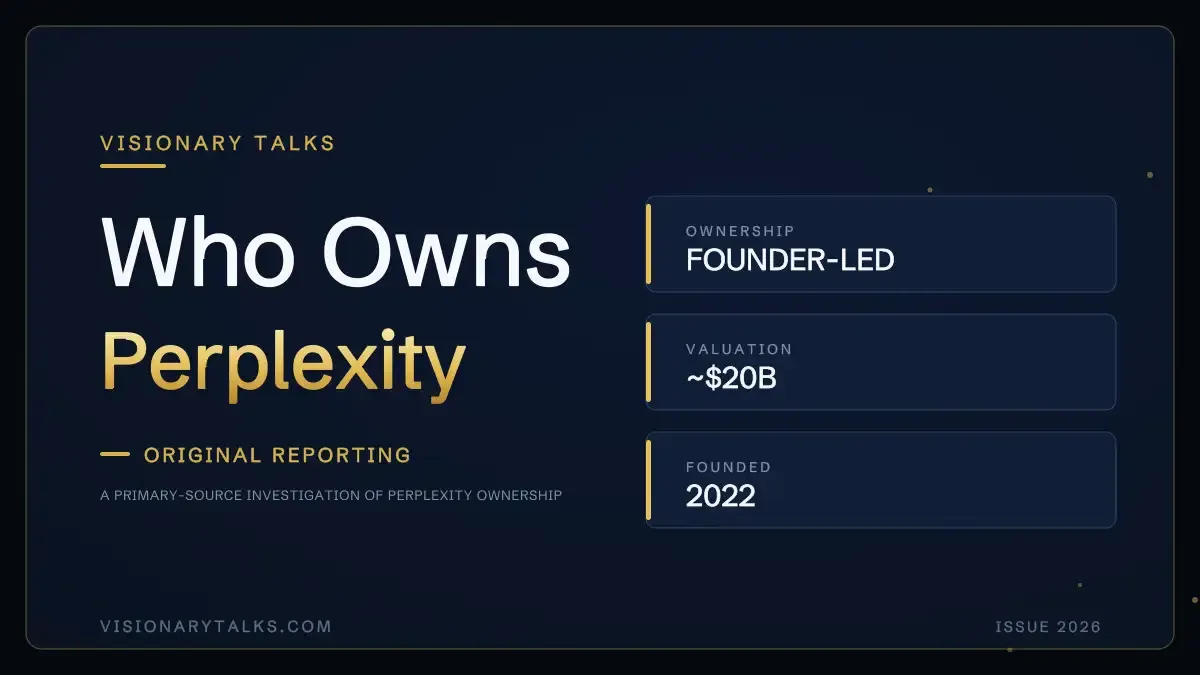
- Perplexity AI was founded in 2022 in San Francisco and is controlled by its four co-founders, who remain in leadership.
- It is not owned by Google, Microsoft, Amazon, or Jeff Bezos personally. Bezos is one of many angel investors.
- The most recent marks put Perplexity around $20 billion+, up from about $520 million in January 2024 — but the later figures are reported, not always formally confirmed.
- Backers include institutional funds (IVP, NEA, Accel, Bessemer, SoftBank Vision Fund 2, NVIDIA, Databricks Ventures) and a long list of tech-founder angels.
- Perplexity has raised roughly $1.7 billion across about eleven rounds and, per CEO Aravind Srinivas, is targeting a 2028 IPO.
This article is based on Perplexity's own funding announcements, on-record interviews with its founders, and reporting from Reuters, Bloomberg, CNBC, TechCrunch and The Information. Where a valuation is reported rather than formally confirmed by the company, I say so. Full source list at the bottom.
Who owns Perplexity?
Perplexity is a private company, so there is no public cap table. What is clear from its funding history and its leadership is that ownership sits with two groups: the founders, who still run the company and reportedly hold founder-protective voting arrangements, and a wide bench of venture funds and angels who own economic stakes without control.
| Stakeholder | Role | Control |
|---|---|---|
| The four co-founders | Srinivas, Yarats, Ho, Konwinski — all in leadership | Operating control; reported founder-protective voting |
| Institutional VCs | IVP, NEA, Accel, Bessemer, SoftBank Vision Fund 2, NVIDIA, Databricks Ventures | Economic stakes; board representation (NEA, others) |
| Angel investors | Jeff Bezos, Elad Gil, Nat Friedman, Daniel Gross, Paul Buchheit, Tobias Lütke, Dylan Field | Small individual stakes; no control |
No single investor holds a controlling position. The board is reported to include the founders alongside outside directors such as the AI researcher Pieter Abbeel and NEA's Peter Sonsini.
The founders
Perplexity's four co-founders are all still in senior roles, which is a big part of why it remains founder-controlled:
- Aravind Srinivas — CEO and the public face of the company, previously a researcher at OpenAI and Google DeepMind.
- Denis Yarats — CTO, leading the technical side.
- Johnny Ho — Chief Strategy Officer.
- Andy Konwinski — President, and also a co-founder of the data giant Databricks; since 2025 he has also run the Laude Institute, an AI-research fund he launched.
Is Perplexity owned by Jeff Bezos or Amazon?
No. This is the single most common misconception, and it comes from an early headline: Bezos participated as an angel investor in Perplexity's seed-stage funding. An angel check buys a small, early equity stake — not ownership, not control, and not a board seat. Bezos is one name on a list that also includes Nat Friedman, Elad Gil, Shopify's Tobias Lütke and Figma's Dylan Field. Amazon, the company, is a separate matter entirely and is not a controlling owner of Perplexity.
Is Perplexity owned by Google or Microsoft?
No. Perplexity competes directly with Google Search and with Microsoft's Copilot, and it is independent of both. NVIDIA is an investor, but as a strategic minority backer, not an owner. The confusion is understandable because Perplexity's product — an AI-powered answer engine — is squarely aimed at the search market those companies dominate. That makes it a rival, not a subsidiary.
Why the ownership matters
Independence is not a footnote here — it is the strategy. Because Perplexity is founder-controlled and not owned by any of the search incumbents, it can do things a subsidiary never could. In August 2025 it made an unsolicited, all-cash bid reported at around $34.5 billion for Google's Chrome browser, larger than its own valuation at the time; a company partly owned by Google could not launch a raid on Google. It made its Comet browser free worldwide to attack the most valuable piece of Google's distribution. And it can pursue an IPO on its own timeline rather than a corporate parent's.
The flip side is that no deep-pocketed parent is guaranteeing Perplexity's compute bills. It has to keep raising — which is exactly why the valuation ladder is so long, and why the ownership base keeps widening with each round even as the founders hold on to control.
The valuation ladder
Perplexity's valuation has climbed steeply, and honestly, the later marks are messy — different sources report different figures, and not every round is formally confirmed. Here is the sequence as best supported:
- January 2024: ~$520 million valuation on a $73.6 million round led by IVP.
- April 2024: roughly $1 billion — Perplexity joins the "unicorn" club.
- December 2024: ~$9 billion on a $500 million round led by IVP.
- Mid-2025: reported marks of ~$14 billion and then ~$18 billion.
- September 2025: ~$20 billion on a reported $200 million raise.
- 2026: further reported marks (a ~$22.6 billion figure circulated in January, and a mid-2026 raise around the Comet browser was reported near $20 billion).
The honest current frame is ~$20 billion+. Anyone quoting a single precise number for a fast-moving private company like this is over-claiming; the marks conflict, and the post-$9 billion figures are reported rather than company-confirmed. In total, Perplexity has raised on the order of $1.7 billion across roughly eleven rounds, per funding trackers.
How does Perplexity make money?
The ownership question is easier to understand once you know what investors are buying into. Perplexity's core product is an answer engine: instead of returning a page of blue links, it reads across the web and writes a cited answer. The business built on top of that has a few layers. There is a free tier; a Perplexity Pro subscription (around $20 a month) that unlocks more powerful models and features; and an enterprise tier sold to companies. On top of subscriptions, Perplexity has pushed into usage-based pricing for its newer agent and "assistant" products, which is a big part of why annualized revenue jumped toward $500 million in early 2026.
It has also experimented with the harder, more controversial revenue stream in search: advertising, alongside a publisher revenue-share program meant to answer criticism that an answer engine siphons traffic from the sites it summarizes. Whether that model can scale into Google-sized profits is the open question underneath every one of these valuation marks — and the reason investors keep re-pricing the company upward on each new usage milestone.
What Perplexity is doing now
A few developments explain why the valuation keeps rising — and why the company is suddenly everywhere:
- The Chrome bid. In August 2025, Perplexity made an unsolicited offer reported at around $34.5 billion for Google's Chrome browser — a striking move for a company then valued below that number, and a clear statement of ambition.
- Comet goes free. In October 2025, Perplexity made its Comet browser free worldwide, pushing directly into the browser market.
- Revenue growth. Revenue was estimated around $232 million in 2025, and annualized revenue reached roughly $500 million by April 2026 (per The Information), with a headcount of about 1,400 per employee trackers.
- IPO timing. CEO Aravind Srinivas told CNBC (June 9, 2026) that Perplexity is targeting a 2028 IPO — so there is no public stock to buy today.
Where Perplexity sits in the AI race
Ownership context is incomplete without the competitive one. Perplexity is trying to win a market — search — that Google has dominated for two decades and that OpenAI is now attacking too, with search features built into ChatGPT. Unlike those two, Perplexity does not train its own frontier models from scratch; it orchestrates a mix of models (its own and others') into a fast, cited answer product. That makes it lighter than an OpenAI or an Anthropic, but also more exposed: it depends on the model layer above it and on winning users away from an incumbent with effectively unlimited resources.
For a private, founder-controlled company, that is a high-wire act — which is why every funding round, and the ownership it reshuffles, gets so much attention. The bet investors are making is not just on a product; it is on an independent company's ability to keep raising enough to fight Google without being absorbed by anyone bigger.
FAQ
Is Perplexity owned by Jeff Bezos?
No. Bezos was an early angel investor, one of many. He does not own or control the company; the founders do.
Is Perplexity owned by Google or Microsoft?
No. It is an independent company that competes with both in search. NVIDIA is a minority investor, not an owner.
Who is the CEO of Perplexity?
Aravind Srinivas, a co-founder and previously a researcher at OpenAI and Google DeepMind.
Can I buy Perplexity stock?
Not on a public exchange. Perplexity is private, with a 2028 IPO targeted per its CEO. Exposure is limited to venture and accredited secondary markets.
How much has Perplexity raised, and at what valuation?
Roughly $1.7 billion in total across about eleven rounds, per funding trackers. Its valuation has climbed from about $520 million in January 2024 to a current frame of about $20 billion or more — though the most recent marks are reported rather than formally confirmed by the company.
What I'm watching next
- The next confirmed round. With so many reported-but-not-confirmed marks, the next official announcement will finally pin down where the valuation really sits.
- The browser bet. Comet going free is expensive; whether it converts into durable usage against Chrome is the product question that justifies the valuation.
- The 2028 IPO. If Perplexity lists, a real cap table becomes public and the "who owns it" guesswork ends.
One of Perplexity's angels, Daniel Gross, is a useful lens on how the AI-investor class is built — see our profile of Daniel Gross's net worth.
Who owns the AI companies
This is part of our ownership cluster on the companies building frontier AI:
Sources
- Perplexity funding announcements and company pages. Establish the 2022 founding, the four co-founders and their roles, and the confirmed rounds (Jan 2024 $73.6M at ~$520M; Dec 2024 $500M at ~$9B).
- Reuters, Bloomberg, CNBC and TechCrunch coverage (2024–2026). Establish the reported valuation marks ($1B, $14B, $18B, $20B, $22.6B), the investor and angel lists, the ~$34.5B Chrome bid, the free Comet browser, revenue figures, headcount, and the 2028 IPO target (Srinivas to CNBC, June 9, 2026).
- The Information and Forbes. Corroborate the total raised (~$1.7B across ~11 rounds) and the founder-protective governance reporting.