
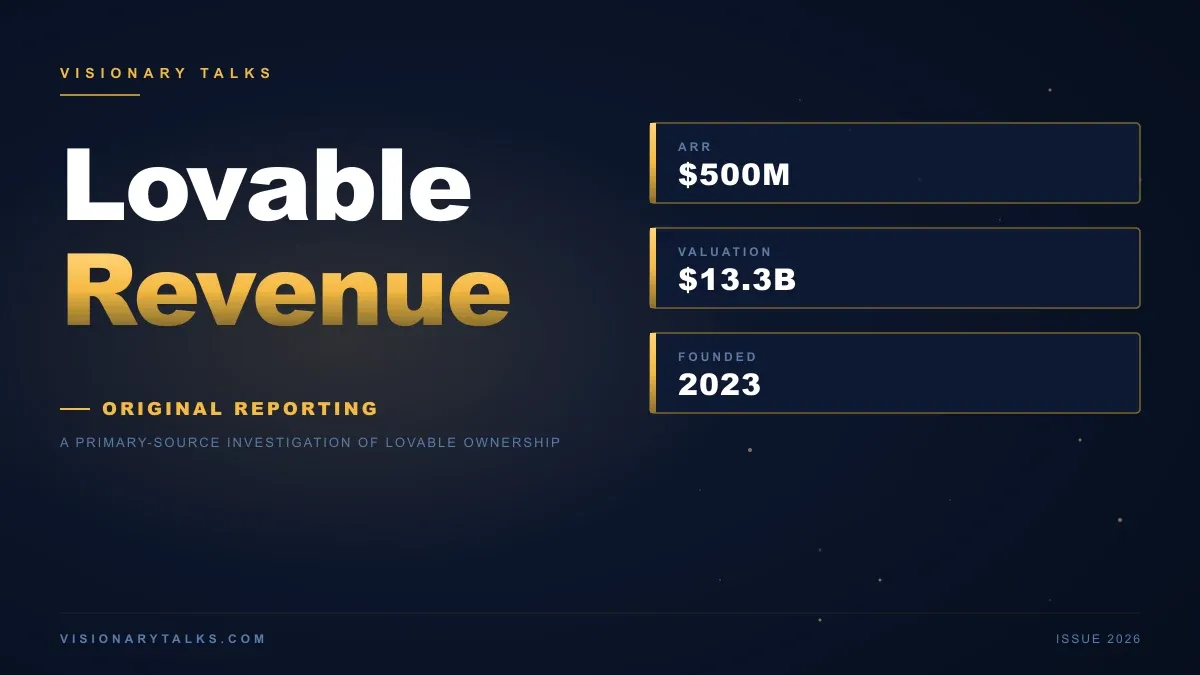
Lovable was running at $500 million in annualized revenue as of June 2026, per TechCrunch, up from $200 million in November 2025 and $100 million in July 2025. At its $400 million Series C on August 12, 2026, the Stockholm company said it was on track for a run rate near $600 million by the end of that month, roughly triple the figure it disclosed in December 2025.
Key takeaways
- $500 million annualized run rate as of June 2026, per TechCrunch, reported alongside the August 12, 2026 Series C.
- Lovable reached its first $100 million of ARR about eight months after launching in November 2024, then doubled to $200 million in four months, announced by Anton Osika at Slush in November 2025.
- The August 12, 2026 round was $400 million at a $13.3 billion valuation, led by Menlo Ventures and the EQT-managed Scaleup Europe Fund. That is double the $6.6 billion valuation set in December 2025.
- Total raised is roughly $950 million across four rounds.
- Lovable has never published a profit figure. As of September 2026 there is no verifiable margin number for the business.
This article is based on primary sources: Lovable's own Series A, Series B and Series C announcements on lovable.dev, TechCrunch's reporting of 17 July 2025, 18 December 2025 and 12 August 2026, Fortune's 21 November 2025 interview with Anton Osika at Slush, and Forbes' 19 December 2025 estimate of the founders' stakes. Full source list at the bottom.
How Much Money Does Lovable Actually Make?
The most recent figure attached to a named source and a date is $500 million in annualized run rate revenue as of June 2026, reported by TechCrunch on August 12, 2026 alongside the Series C. At the same announcement the company said it expected to be near a $600 million run rate by the end of August 2026.
Note the wording. These are run-rate figures, not audited revenue for a completed year. Lovable is private, publishes no financial statements, and every number here is either a company statement or a reporter's figure sourced to the company.
On ownership, the short version: Lovable is still independent and founder-controlled, with Anton Osika and Fabian Hedin holding the largest individual stakes and a long list of funds holding the rest. The full structure, round by round, is in our separate breakdown of who owns Lovable.
The ARR Timeline, Dated
| Figure | As of | Source |
|---|---|---|
| $10M ARR | January 2025, two months after launch | Lovable blog |
| $100M ARR | July 2025, about eight months after launch | TechCrunch, Fortune |
| $200M ARR | November 2025, announced at Slush | Fortune, 21 November 2025 |
| $500M annualized run rate | June 2026 | TechCrunch, 12 August 2026 |
| Near $600M run rate, expected | End of August 2026 | Company, at the Series C |
The eight-month sprint from launch to $100 million is the claim that made Lovable famous, and it is the fastest such ramp on record for a software company. The more revealing number is the second: doubling to $200 million took four months, and the next two and a half times took about seven.
For scale in the same category, Cursor's parent Anysphere ran from $100 million to billions in ARR before being bought outright in the SpaceX-Cursor deal. Lovable is growing very fast in a category where very fast is the entry requirement.
What ARR Means Here (and What It Hides)
This is the part almost no coverage explains, and it changes how you should read every figure above.
ARR stands for annual recurring revenue. For a company like Lovable it is not a measurement of a year. It is last month's subscription revenue multiplied by twelve. A company that billed $50 million in May reports $600 million of ARR in June, having collected $50 million.
Three consequences follow, and they all cut the same way.
It flatters growth. One strong month raises the headline by twelve times the increment. A company that adds $100 million of ARR in a month collected about $8 million more than the month before.
It hides churn timing. Self-serve products sold to individuals and small teams churn faster than enterprise software, and a multiplied snapshot of the best month captures the sign-ups, not the cancellations that follow.
It says nothing about cost. Every Lovable app generation consumes model inference the company pays for, and that cost scales with usage. Revenue of this shape can arrive with thin or negative gross margin, which is what happened at Wix's Base44, a comparable product whose non-GAAP gross margin entered 2026 near zero.
None of this makes the numbers fake. Lovable's ARR is real subscription revenue and the trajectory is genuinely extraordinary. It does mean that "Lovable makes $500 million a year" is not what the $500 million figure says.
How Lovable Makes Money
Lovable sells subscriptions. Users describe the software they want in plain language, Lovable builds and hosts it, and paid tiers buy more capacity, collaboration and control. Revenue tracks usage of a metered, model-backed product rather than seats in an enterprise contract.
The mix is shifting upward. Osika told Fortune in November 2025 the company was pushing into enterprise, and at the August 2026 Series C, Lovable said it had a presence at nearly two thirds of Fortune 500 companies, naming Adidas, NVIDIA, Deutsche Telekom, Zendesk, Handshake and Checkr.
The demand-side numbers published in August 2026 are the best proxy for why revenue keeps climbing: more than 60 million projects created since the November 2024 launch, more than 900 million monthly visits to apps built on Lovable, and nearly eight in ten builders working on something they intend to monetise, more than a third of them already earning from it.
Here is the honest limitation. In March 2025 a Replit employee found that sites built on Lovable and connected to Supabase frequently failed to configure access controls correctly, leaving their contents publicly readable. Lovable added automated access-control checking in response, a scan that flags missing controls but cannot verify that the controls are correct. Growth of this kind puts a great deal of production software in the hands of people who are not security engineers, and that is a real cost the revenue line does not show.
Anton Osika and Fabian Hedin: The Billionaire Math
Lovable grew out of GPT Engineer, the open-source project Anton Osika started, which was commercialised and rebranded as Lovable. Osika is chief executive and Fabian Hedin is chief technology officer.
Forbes reported on December 19, 2025 that each of them held an estimated 24% of the company, which at the $6.6 billion December 2025 valuation put each of their stakes at about $1.6 billion. Osika was 35 and Hedin 26, making Hedin one of the youngest self-made billionaires in Europe, a few months behind Arvid Lunnemark of Cursor, who reached the same mark in November at 26.
If that 24% estimate still holds after the Series C, the $13.3 billion valuation of August 12, 2026 implies roughly $3.2 billion each. Treat that as arithmetic on an estimate rather than a disclosure: dilution from three subsequent rounds is exactly the sort of thing an outside percentage estimate gets wrong, and neither founder has published a cap table. For how we handle paper valuations of private stakes generally, see our note on how we read paper wealth.
Both founders have pledged to give away half of what they eventually realise. Osika told Forbes in July that he and Hedin had committed a very large part of the value they build at Lovable to ensuring humanity's transition to superintelligent AI goes well.
Why Staying in Stockholm Worked
Lovable was built in Sweden and stayed there, which was not the advice on offer. Osika has credited remaining in Europe for the company's success, and the structural argument is simple: European engineering talent at European salaries, against a product sold in dollars to a global market.
The clearest evidence it worked is who showed up. The December 2025 round was led by CapitalG, Alphabet's growth fund, with Menlo Ventures' Anthology fund, plus NVentures, Salesforce Ventures and Databricks Ventures. The August 2026 round was co-led by the EU-backed Scaleup Europe Fund, managed by EQT, alongside Menlo, with Tencent, Balderton, Carmignac and Kaszek participating. American and Chinese capital came to Stockholm rather than the other way round.
Lovable plans to reach roughly 450 people by the end of 2026, up about 50%, across European and US offices.
Lovable revenue FAQ
What is Lovable's ARR right now?
The most recent sourced figure is $500 million in annualized run rate revenue as of June 2026, per TechCrunch. At its August 12, 2026 Series C the company said it expected to be near $600 million by the end of that month. Lovable has not published a figure dated later than that as of September 2026.
Is Lovable profitable?
Unknown, and nobody outside the company can say. Lovable is private, publishes no financial statements, and has never disclosed a profit or gross margin figure. Anyone quoting a Lovable profit number is estimating.
How much is Lovable worth?
$13.3 billion, set by the $400 million Series C announced on August 12, 2026 and led by Menlo Ventures with the EQT-managed Scaleup Europe Fund. That is double the $6.6 billion valuation from December 2025 and more than seven times the $1.8 billion of July 2025.
How much of Lovable do the founders own?
Forbes estimated in December 2025 that Anton Osika and Fabian Hedin each held about 24%. That is an outside estimate, not a disclosure, and it predates the August 2026 round.
What I am watching next
1. Whether a gross margin figure ever appears. The margin, not the ARR, decides whether this is a good business.
2. Whether enterprise revenue gets broken out. A presence at two thirds of the Fortune 500 is a logo count, not a contract value.
3. Whether the founders' stakes are confirmed. The 24% figure is doing a lot of work in a lot of articles, including this one, and it comes from one Forbes estimate in December 2025.
Sources
1. Lovable Series C announcement, August 12, 2026 lovable.dev/blog/series-c. Establishes the $400 million raise, the $13.3 billion valuation, the full investor list, 60 million projects since the November 2024 launch, 900 million monthly visits, the Fortune 500 penetration claim, the named customers and the roughly 450-person headcount plan.
2. TechCrunch, August 12, 2026 Lovable confirms new $13.3B valuation, raises another $400M. Establishes the $500 million annualized run rate as of June 2026 and the $6.6 billion December 2025 prior valuation.
3. Lovable Series B announcement, December 18, 2025 lovable.dev/blog/series-b. Establishes the $330 million raise at $6.6 billion and the investor syndicate.
4. Fortune, November 21, 2025 Lovable's CEO says the company is targeting enterprise customers as its ARR doubles to $200 million in just four months. Establishes the $200 million ARR figure, its Slush announcement, and the enterprise push.
5. Forbes, December 19, 2025 AI Startup Lovable Just Minted One Of Europe's Youngest Ever Self-Made Billionaires. Establishes the estimated 24% stakes, the $1.6 billion valuations, the founders' ages, the charity pledge and the Lunnemark comparison.
Secondary sources:
6. Bloomberg, August 12, 2026 AI Coding Startup Lovable Raises $400 Million at $13.3 Billion Valuation. Establishes the expected run rate near $600 million by the end of August 2026 and the November 2024 launch date.
7. Wikipedia, Lovable (company), for the March 2025 Supabase access-control disclosure and the GPT Engineer origin, both traced back to their underlying reporting before use.